Wednesday, 22 December 2010

The Christmas story for the digital age


Letter boxes have still overflowed this year notwithstanding text and email's dominance of our normal communications flow. There's something satisfying about sending and receiving a card, however little may be written on it, and despite - perhaps because of - the expense and labour-intensiveness. I never cease to wonder at the variety of representations of the Christmas message that the postman brings: duplicates occur, but they are rare. My father used to hang cards up on sticky tape, and we played a game trying to spot which card image contained a certain unique feature.

This year, we have had a smattering of e-cards as in recent years past; but so far the best e-message has been forwarded by Thomas from Lisbon: as one might expect from him, both up-to-date and tongue-in-cheek.

Tuesday, 21 December 2010

Hallelujah


This is one of the gates of St Gregory's Church, here in Cheltenham town centre: I took it on Sunday night. We were due to go again last night for the carol concert, but it was called off. As compensation, I discovered this joyous video: it has been viewed nearly 25 million times already, but some of you (like me) may have missed it.

Monday, 20 December 2010

"The Nativity"


We watched the first episode of BBC1's "The Nativity" this evening. Very good it was too. A perceptive review has already appeared here.

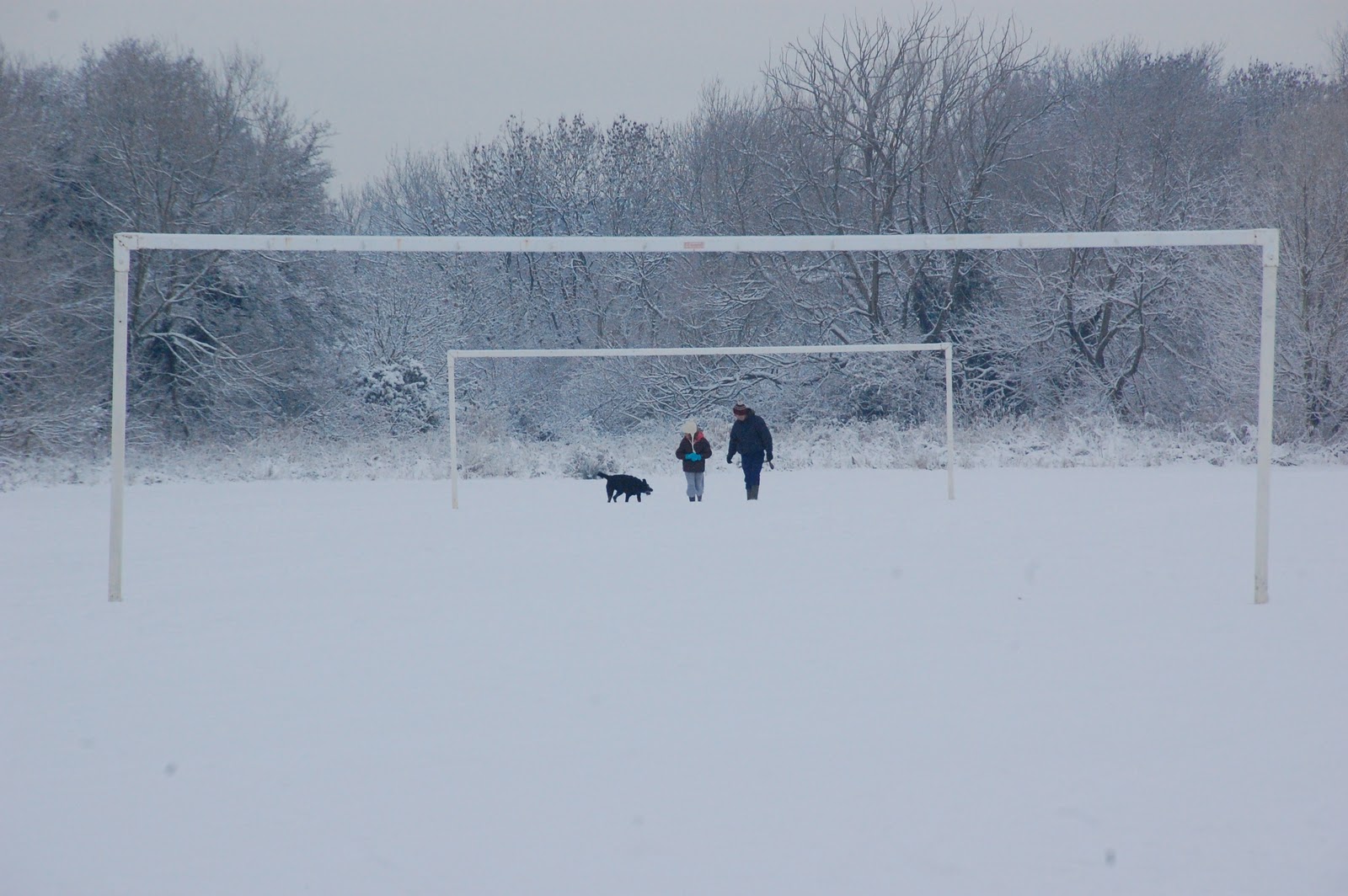
What I particularly liked about it was the depiction of the holy family as made up of very ordinary people, rather like those out walking their dog on our local playing field yesterday. (Not sure the holy family would have kept a dog, mind you.) We shall try and catch the remaining three episodes - which is not so hard now that we are house-bound because of the weather: we've just been coping with a burst pipe.

Sunday, 19 December 2010

paper white


Caroline was out early this morning, sweeping our drive after our first really serious fall of snow this Winter: we have got off lightly up till now. I was quite surprised that the newspapers had got through, as the roads are treacherous. Gritters don't seem to work on a Sunday, I concluded as I slithered by foot to mass this evening. I sneaked in a prayer for a better performance by our batsmen after the Perth debacle.

Friday, 17 December 2010

Phoenix of Avon


My photograph, taken this afternoon from the old bridge across the Avon at Stratford, shows the remade Royal Shakespeare Theatre, which opens in earnest next February. By the waterside, the line of the Scott building has been restored, with the café resited in the stalls bar, and a wide outdoor terrace opened up in place of the café. The dressing-room block has been refaced: in 1955, stagestruck, I saw Vivien Leigh on one of those little balconies during an interval of Twelfth Night: she was playing opposite her husband Laurence Olivier. The restaurant - excellent food and of course views - is now in the glass-faced box overlooking both the river and former theatre car park: it paid to be on good terms with Victor there - as with Leslie Mitchell in the box office. The tower is of course totally new, and I think rather regrettable. I would say the same for the octagonal crown over the refashioned auditorium.

Inside, there is plenty to admire. The layout is on the same lines as that of the Swan next door, but altogether less claustrophobic. The seats look really comfortable, and of course none is any distance from the stage - as in the Courtyard. I can't wait to hear what the sound is like.

One major disappointment: try as I might, I can find nothing in the literature to indicate what steps have been taken to make the refurbished RST energy-efficient. Heating the cavernous new shop/foyer area seems likely to cost a bomb.

Thursday, 16 December 2010

Grandparenting


Verdict on last night's predictions:

* the cricket - better than I expected (Day 1): a long way to go though!

* the weather - as bad: not much fun bicycling back from Cheltenham Station in the snow this evening.

I had taken the bike on the train to Bristol, for a visit to watch grandson Laurie in a starring role as a gingerbread man - in his playgroup's Christmas show. In fact, all 31 of the little darlings had starring roles, but naturally Laurie was the only one who really mattered. (Photography generally encouraged, but results not to be posted on the internet, I was advised.) I wondered if any of them would make it onto whatever turns out to be the 2025 equivalent of The X Factor.

It is always nostalgic, coming to Temple Meads Station, and reliving the misery of the beginning of each new school term in the early 50s.

Wednesday, 15 December 2010

Cricket and carols


Good friends invited us to their carol party this evening, which put us well into the mood for Christmas. Not many are privileged to sing together in an upstairs drawing-room accompanied by a chamber organ. We began with my favourite Advent hymn, O come, O come, Emmanuel, with five carols following on - just the right number, and played at a good lick. There's nothing worse than a dirgy pace where carols are concerned.

The snow is coming back, we are told, but at least we shall hear about warmer doings overnight, tuning in from Perth. (I have a hunch that all is not going to go according to - English - plan.) Meanwhile, the British Council have added an amazing historic film about cricket in post-War London to their website.

Tuesday, 14 December 2010

An Oscar at the RCE


Yesterday, I related unnecessary packaging to incipient climate chaos. Today, the RCE Severn Christmas Lecture by Michael Wadleigh related consumerism as a whole to unsustainable development by means of the simple equation:

H+P = -R

where H = the human population, P = manufactured products and R = resources. It's hardly an original thought, but he put it across well by means of excellent slides. They imagined our world was encapsulated in a space station with ten occupants - one of whom enjoyed half the available resources, the other nine sharing the rest. Result: of course, revolution.

What makes human beings happy? he asked. Products? No: nature, other human society and activities leading to fulfilment. Truth and finit-ism were his watchwords.

I commend Michael's presentation, called the Homo Sapiens report: he offers it free of charge to secondary schools and universities. And he'll bring along his Woodstock Oscar for a talking point!

Monday, 13 December 2010

Cancún


At this checkout at lunchtime, I was told I was the first person today to refuse a plastic bag for my purchases. Is there any wonder we can only just about keep the climate talks on the road?

Sunday, 12 December 2010

Sire


48 hours after Hamlet, I returned to our local Cineworld's Screen 3 for Don Carlo last evening: live relays from the Metropolitan Opera have begun again, praise the Lord. A couple of minor hiccoughs with the transmission served only to underline the miracle of modern science that enables us to sit in Cheltenham and watch what New Yorkers are experiencing in the theatre. To be able to bike 10 minutes down to the cinema and pick up a ticket at the door (and for only £10) seems to me incredible good fortune.

Both production and performances were outstanding. I forgot I had seen most of the principals in the same staging when televised from Covent Garden a year or so ago, but no matter when such excellence is on hand. Of the cast, Marina Poplavskaya again stood out for me, with her extraordinary legato and perfect looks for the part of Elisabeth de Valois.

Something else we now take for granted is subtitling. Not every word of the libretto is given us, but last night, with the King of Spain around, "Sire!" naturally recurred a good deal. And earlier in the day we had seen another famous sire. Makfi, winner of this year's 2,000 Guineas, resides in a stableyard beside the house where we were lucky enough to be invited to lunch yesterday: stud fee, £25,000.

Friday, 10 December 2010

Hamlet by the dozen


I collect Hamlets as others collect rare books. The bibliophile leaves many of his volumes unopened on the shelf: likewise, this Hamlet collector doesn't record the minutes his eyes have remained closed during a performance. (Kenneth Branagh took a long time doing his Dane, I recall, on a particularly stuffy evening at the RST in 1992...)

Alan Badel was my first Hamlet - 1956, Stratford. I remember him, but not much about Anthony Quayle and Glen Byam Shaw's production, the first of half a dozed (this is as I typed it - too good to correct) I saw in what we must now call the old Shakespeare Memorial Theatre: that meant something different to theatregoers in the 1950s, whose memories went back before the 1926 fire.

Ian Bannen, David Warner in long sudent scarf, Nicol Williamson with some machine gun delivery at The Round House, Alan Howard, Ian McKellen in 1971, Alex Jennings (1996), Simon Russell Beale (2001), and the great Russian film Hamlet with Innokenti Smoktunovsky: now the collection has an addition to it, following a visit to Cheltenham's Cineworld last night for the relay from the National Theatre. And Rory Kinnear's Hamlet goes to the top of my list.

Wednesday, 8 December 2010

Student unrest - in Cheltenham


"Hundreds of students are gathering in Cheltenham to stage a protest against a planned rise in tuition fees" - so promised the press release issued first thing this morning. The police turned out in force. Bus routes were diverted, and not just because of the snow.

The water froze before reaching the taps in my Oxford rooms in 1962. Surely students today are not put off from marching by a little cold? In a place where the annual GCHQ rallies used to witness thousands coming together, just a few tens ambled in after midday today - shepherded by as many (if not more) of the boys and girls in yellow jackets, their kettling skills unneeded. William IV looked down scornfully from his plinth.

Tuesday, 7 December 2010

Patsy Hendren


Half a century ago, I used to travel into Birmingham on the top deck of the Midland Red bus, to watch Warwickshire play cricket. I sat at the front alongside Mr. Austin, the Warwickshire scorer: he, his wife and daughter Joan lived near us in Alcester. I regarded him and indeed all the cricket establishment with awe.

After lunch, Chico, as people less in awe called him, would let me come and sit at the front of the score box - but only upon the arduous condition that I resisted the urge to clap. Chico knew of my propensity for collecting autographs, and one day when Middlesex were our visitors, suggested I might like to ask his fellow-scorer to sign my book. Who was this white-haired veteran, I wondered? The name in the book was clear: "E.H. Hendren". But it meant little to me, hardly surprising since he had made his Middlesex first team debut in 1907.

Today, we sleep-deprived cricket addicts are rejoicing in a famous victory at Adelaide, brought about through England scoring 620 for 5, their second-highest total in a test match in Australia. Even when rain threatens, the temperature there is up in the 30s: here, by contrast, we walk out into a white wonderland, where even the traffic lights are decorated with hoar-frost. Retreating to the fireside, I read of the occasion in 1928 when Jardine's men reached 636, with 251 from Hammond. The second highest scorer? E.H. Hendren.

Wednesday, 1 December 2010

David Fleming RIP


This afternoon, I was looking at this amongst other photographs I had taken during 2010, to select some for our usual kitchen calendar. As I did so, I thought to myself how short life is for some people - and that perhaps indeed it would be so for David. I can't imagine what gave me this idea, as that Michaelmas Day in Cornwall when I took this, just two months ago, he was in prime form - as cadaverous as ever, but enjoying a healthy if quirky diet, and no more stressed than usual about what might become his very own Casaubon delusion.

An hour later came the shocking news that David had indeed died at the weekend. What a friend we have all lost! Others have written more knowledgeably than could I about his originality of thought. You could see him as a curmudgeon if you opposed the invasion of Iraq; or the mad professor if you looked for a practical, straightforward answer to a question. He regularly won the family's competition for most unusual Christmas card. Sir Andrew Aguecheek sprang occasionally to mind, though David was nobody's fool - and never had money enough to match his generosity of spirit. Such a mixture of the extremes of conservatism and radicalism puzzled many, but beguiled our children, who will be heart-broken. And what other economic dictionary offers a definition of "quick" in the biblical sense?

The Iraq conflict re-erupted over supper in our kitchen on 8th October 2005 - between David and his good friend Jonathon Porritt. This photograph was taken a few glasses of wine later.

Monday, 1 November 2010

Don Hunter RIP


When walking the Gloucestershire Way last year, I called at Don Hunter's workshop in Shipton Oliffe. We haven't had any need for furniture repair for a year or two, but over more than three decades Don had always been our man when something antique needed fixing properly: surely nobody took more care or can have been more respected.

Besides our professional contact over the years, I counted Don amongst my oldest friends, having met him in 1973 at North Farm House soon after I arrived in the neighbouring parish of Sevenhampton. Through his trademark smiles and just a few words, I have been able to follow the blooming of his marriage to Pauline, and of the welling pride he had in Andrew, their only child.

That day in March 2009 Don was with a customer: I told his colleague Carl that I was on a mission and wouldn't dally. So I moved over the road to pay a quick visit to St Oswald's before walking on through the village.

Don wasn't tied up for long, however, and came running across to the church after me. "You look different," I said. "Yes, my hair has gone curly: I've been in hospital," he explained, "for Treatment." Of course I knew what this must mean, but Don was in no mood to yield to self-pity. Indeed, he was his usual optimistic self, full of trust in the God he had long known so well and personally.

In Saturday's Gloucestershire Echo, his death was announced - "peacefully, at home.. Wonderful husband... much loved father... dearly loved by many." That last certainly includes me.

Friday, 22 October 2010

The Kumar at the UoG


Satish Kumar came to the University of Gloucestershire this afternoon for what he called a fireside chat: no open log fire there, unlike at Dartington Hall - though plenty of fire in the belly.

"My pet theme is about soil, soul and society - a new Trinity for the age of ecology." It avoids, he said, the dualism of the Christian Trinity; the anthropocentricity of the American life, liberty and the pursuit of happiness, and the all too personal "mind, body and spirit".

We are not separate from nature: we are nature, that is "to be born". What we do to nature, we do to ourselves: there can be no healthy society on a sick planet. From one, bitter-tasting pip, the apple tree grows, yielding year after year an abundant harvest, not discriminating between those who enjoy its fruit, whether they be saints, sinners - or grubs.

A body without a soul is only good to be buried. We need to put the soul back into society, for its well-being. You can be rich and not be well - and many of us are exactly that. Without beauty, the soul will starve.

"I'm going to Pakistan," Satish told a fellow-Indian. "Take some food with you," came back the advice. "No, I am foremost, not an Indian, but a member of the earth community. Your parcels of food are parcels of mistrust."

Tuesday, 19 October 2010

Climate Stewards

Brendan Bowles, Director of A Rocha's Climate Stewards, paid a visit to Cheltenham last evening, to speak at a meeting of Christian Ecology Link. "Christian responses to climate change" was his theme - what is the particular vision Christians have to offer? What example are we able to set?

Brendan began with the two greatest commandments: love God and love your neighbour as yourself. Loving God means working in his direction: he said of his creation, that it was good. And creation is sustained by Jesus. Can it be a good idea, therefore, to trash it?

Our neighbours all round the world are in need of good soil and good rain to feed themselves. Just as being the League Champions doesn't cause you to win a football match, so climate change doesn't cause floods or drought; but if climate change is due to our human behaviour, then that behaviour needs to be looked at - in just the same way as Christians have championed fair trade, and (in the past) the abolition of slavery.

Brendan used to think that the way was for us to reduce our own emissions, before we started to get other people on board. But whilst moral purity is impressive, it makes it difficult for some ever to start on the journey: you hear the reaction, "Anything I can do is never going to be enough. In order to be really green, I need to be dead."

A Rocha has been planting trees in the arid North of Ghana, to act as a barrier against the encroaching desert; to encourage biodiversity, and to enhance the rainfall pattern in that part of the country. £40,000 a year or thereabouts has been pledged by people in other countries towards this scheme, as a way of compensating for their carbon use being so much greater that that of Ghanaians and others under similar climate stress. Planting a tree has its parallel in Jesus's parables of the sower and his seed; of the mustard seed that grew into a large tree; of the yeast that raised the whole loaf, and the candle that shines in the dark. "You are the salt of the world." (To learn more about Climate Stewards and offsetting, see here.)

What goes on in our churches affects the whole of society: we need a huge response to the challenge that climate change brings. It is never going to be sufficient to have just a few really committed people. The power is in the multiplication. Like Jesus, we each have to talk to the bad guys, to get them to make a symbolic change. Like baptism.

Our vision is of a better way of living on low carbon. What we need is, not to accuse people, but to make the good, normal.

Sunday, 25 July 2010

"With an eye on the Via de la Plata"


Happy St James' Day! It also happens to be the day when I've put the finishing touches to my new book about our month on The Way of St James in April - from Seville to Salamanca.

As reported here at the time, Caroline and I went by train from Cheltenham to Seville, arriving on Maundy Thursday, and walked the first half of the Camino de Santiago which starts there, the Via de la Plata - I with my camera. The resulting photobook with the above title can now be seen here: click and you'll see that its 90 pages (with my 325 photographs and 11,000 words of commentary) are all available to view free online - if your eyes are good enough!

The book is also available for sale - print on demand; but as it's in the style of a coffee table book, it is, I fear, rather expensive: for further details see here.

All feedback extremely welcome!

Tuesday, 13 July 2010

Worcester to Tenbury by bicycle


There are three ways to tackle this problem, all with drawbacks for the cyclist (like me) who is aware of Old Father Time's approach. Today, I made the journey to Worcester by train, both cheap and bike-friendly. Rather than wait for 90 minutes for the next bus to Tenbury, I set out under a grey sky to find the Martley road, via good views of the Cathedral, the River Severn and the Worcester County Cricket Ground. The decision has to be taken whether to follow the River Teme, after its crossing at Ham Bridge, or to plough on the B4204, involving a 200m ascent. Well, that's where it ought to be taken, but I missed the turning after the bridge and by the time I was half way up to Clifton (misleadingly called "on Teme"), it was rather late to go back.

The advantage of sweating up the hill is that you have a nice long downhill into Tenbury, passing Hill Top and Kyrewood, two places mentioned in my ancestor's diaries: I'm in the process of editing these, hence the expedition.

On the way back, I had thought of taking the relatively flat (until Abberley) A443, but having biked along to Burford Church from Tenbury, quite a wide stretch of that road, I realised that I might be lucky to survive the unequal battle with the lorry traffic. So instead I took the minor road along the South bank of the Teme, via Lower Rochford, Eastham, Orleton and Stanford - coming out again to join the B4204 at Ham Bridge. Drawbacks? Well it's marked with 19th Century milestones, scenic and there isn't a lot of traffic; but it's very steep and narrow - and it was pouring with rain.

Thursday, 10 June 2010

"Bad habits die hard"


Yesterday marked the start of this year's Cheltenham Science Festival, which seems to attract bigger audiences year by year: certainly, if the crowd at the event with this title last evening is anything to go by. Jonathon Porritt was talking to psychologist Stuart Derbyshire, of Birmingham University's School of Psychology, and the ESRC's Dale Southerton about why we find it difficult to change our behaviour.

Dale preferred to consider habits, not as addictions we needed to kick, but as essential matters of routine. They are shaped by our daily context. So, the development of deep freezes – which has happened at a rate "faster than that of the internet" – gets us into a dependency on out of town supermarkets: we have become locked into the freezer habit. And power showers lock us into more water use, as few of us use them solely as an alternative to the bath. Our need is to design habits that are more sustainable: what about Tesco's turning into a food delivery service only, and converting their stores into laundrettes? Tesco vans could then return full of our dirty washing when they have delivered the groceries, and millions of home washing machines would never need replacing.

Stuart, however, generally took quite a contrary tack – possibly for the sake of argument, but I rather doubt it. "I refuse to wash my yoghurt pots," he boasted. Che sarà, sarà. But that drip in the background didn't turn into a cataclysm, at least while this hour lasted.

Wednesday, 9 June 2010

A moral climate


Michael Northcott came to Cheltenham last evening, to address a Cheltenham Inter Faith meeting. His talk was based upon his 2007 book, "A moral climate: the ethics of global warming."

Professor Northcott comes across less as an academic (he is Professor of Ethics at Edinburgh University) than as a campaigner. Not that I have anything against a passionate speaker, but I emerged from the normally tranquil setting of the Friends' Meeting House feeling rather shell-shocked.

Or should that be "Shell shocked"? The first part of the Northcote fusillade was aimed at the oil companies. "Shell paid my school fees... but oil and blood have often intermingled," he told us. Tar sand extraction was "an unbelievably filthy process." And he had brought along the images to prove it.

Professor Northcott's thesis is that inequity is the central feature of the climate crisis; that those who suffer are least responsible, whilst those who are the cause are least affected. The climate, he says, is a global commons, and commons are not traditionally managed by either markets or states; yet the atmosphere is now being "enclosed" by the carbon emissions trading procedure. Climate change cannot be resolved by emissions trading: we have to "keep it in the ground".

The faiths can contribute two things towards meeting this challenge. First, the dimension of healing and restoration (in Christian terms "resurrection"); and secondly their sense of posterity: again, as a Christian, he pointed to the Communion of Saints: we worship God in churches which are traditionally built with graves - containing the bodies of the Saints - all around them. "I am a hopeful person," he concluded (albeit with a rare note of hesitation in his voice).

Wednesday, 2 June 2010

Birds of passage


Nicki Gwynn-Jones ARPS has a new exhibition of her photographs in Cheltenham: it opened this evening, "A bird's eye view". Her stunning ornithological treatments are shot in Florida, whither she commutes along with her husband. ("How long, O Lord?" It's all very well dedicating your show to those rescuing sea birds on the Gulf of Mexico's shores, but don't airoplanes run on... oil?)

Nicki is sharing the Gardens Gallery this week with Helen Dewbery LRPS, whose photography is less spectacular, but in a way more coherent. Both shows are worth a visit, I'd say. Especially on an evening like tonight, when the Montpellier Gardens are to be seen at their most vibrant. What a joy it is to live in Cheltenham!

Monday, 31 May 2010

Freedom in The Suffolks


For once Cheltenham has had a dry late May Bank Holiday Monday this year. And The Suffolks were thronged with happy-looking people, strolling along, people-watching, enjoying the music - and browsing the stalls: one which caught my eye was selling fruit swirls, a sort of sorbet in an edible cup: mine was strawberry and yogourt flavoured - rather delicious.

"A taste of Freedom" was their slogan, and the name of a new social and environmental venture, intercepting fresh yet unwanted fruit before it rots - 20 million tonnes of it are said to be wasted annually in the UK. Tristram Stuart, on the right of my photograph, is behind it: his book, Waste: Uncovering the Global Food Scandal, was published by Penguin last year.

Saturday, 22 May 2010

The music festival season is upon us


We were at Highnam yesterday on a sunny evening for the opening of this year's Carducci Festival, a glorious event! The young and engaging Carducci String Quartet have been putting on an intensive weekend of music-making there each year since 2007, and people respond. No wonder! The setting is perfect - a much-loved Victorian Gothic church amidst parkland; the quartet's programmes are imaginative, and the playing both rich and delicate - absolutely no gothic horrors.

An interesting contrast was the recital we attended on Wednesday night, as part of the Newbury Spring Festival. St Mary's Church, Kingsclere predates Gambier Parry's Highnam by 700 years, and for a performance the Norman setting feels more secretive than exuberant. The virtuosic intensity of the Trio con Brio Copenhagen's playing contributed to this atmosphere, especially in the tragic music of Smetana's G minor Piano Trio.

Saturday, 15 May 2010

Ascension-tide in Cheltenham


It was a fine day for Cheltenham's first carnival for many years. The children loved it, especially the extremely well-behaved sheep, which led the procession. More often associated with racehorses, Edward Gillespie was properly dressed up as freeman of the borough, and made a splendid Mine Host for the afternoon. He was pursued through the streets by swirling kilts (pipes and drums), and a ukelele band, amongst others.