Showing posts with label Shakespeare. Show all posts

Wednesday, 3 September 2014

Four Gentlemen of Leisure


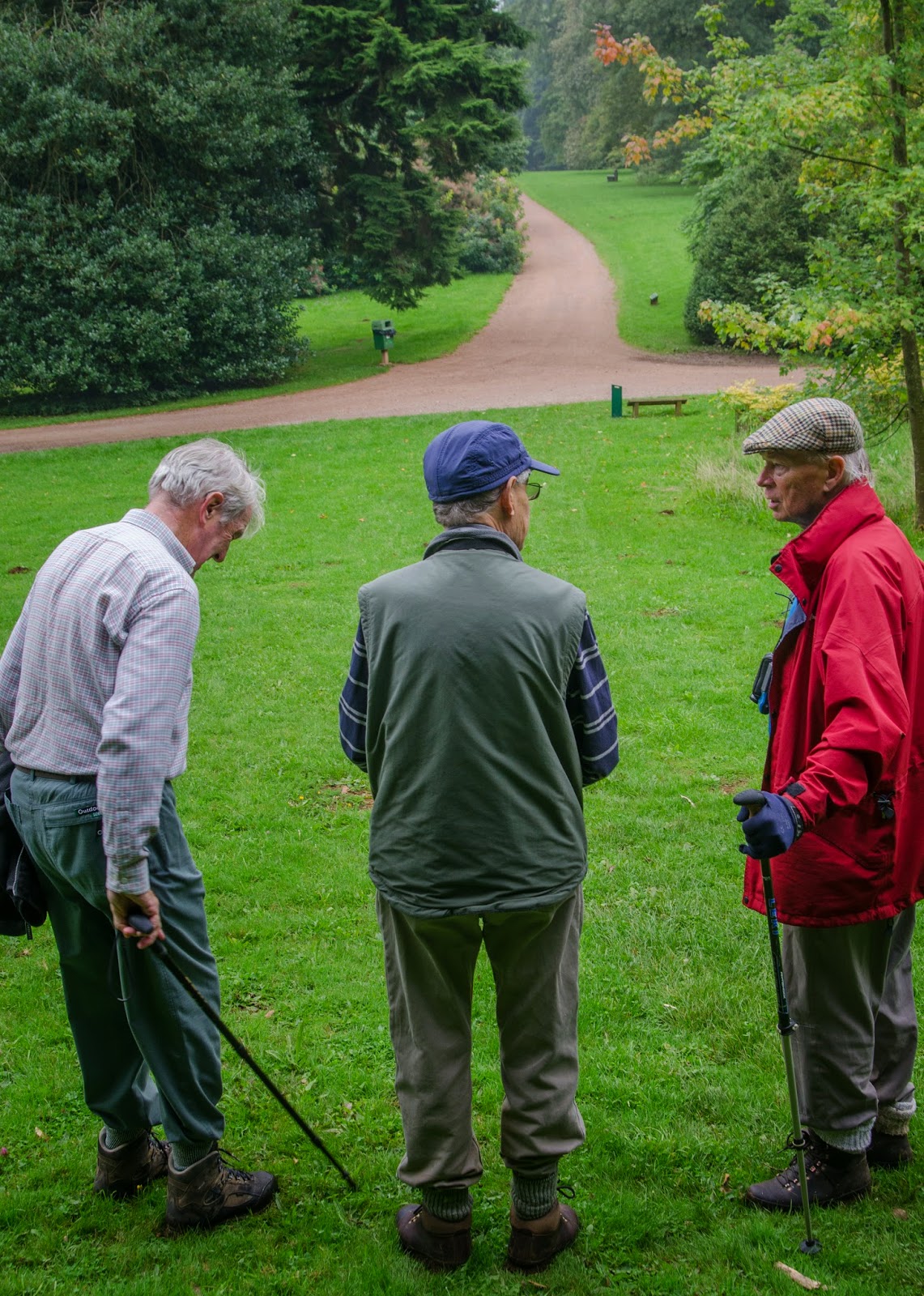
A quartet of Wednesday walkers started out from Leighterton this morning, and made for the Silkwood at Westonbirt, not a walk I knew. Though the sun didn't come out till later, it was very warm, and the scenery varied. Rather too many stiles for my liking.

I've come home this evening from an RSC live relay (to our Cineworld). Another first for me - Two Gentlemen of Verona. Though it's early Shakespeare, with a far from plausible plot, there are still plenty of good lines, and they came across well in Simon Godwin's production. Michael Bruce's music played a big part in creating a playful atmosphere, though no setting of the celebrated song is ever going to be a match for Schubert's An Sylvia.

Monday, 19 May 2014

Malleable


Sculptor Anne Boning is a new name to us: we met her this morning up at Farmcote, where she is exhibiting (alongside Sarah Loveday and Diana Green) as part of the Winchcombe Festival. Caroline bought one of her extremely tactile stone pieces.

I write this having just returned from seeing King Lear. Perhaps three major Shakespeare plays within the space of six days is one too many: anyway, this evening felt like a long one. As Michael Billington wrote in his review, "There are times when I feel that Lear is a play that has to be endured as much as enjoyed." No question, Simon Russell Beale invests the name part with all his very considerable skill, but his performance seemed from first to last relentless. "A very foolish, fond old man"? In this modern dress production's quest for character, the poetry seemed somehow to have gone missing.

Friday, 16 May 2014

The Windrush


Four of us, having parked under the vast Sycamore tree at Cold Aston this morning, walked to Aston Farm and then up the South bank of the Windrush, from where I photographed this peaceful scene. Another idyllic Spring day!

It follows two evenings out with Shakespeare. As You Like It performed by the Tobacco Factory at Cheltenham's Everyman Theatre last night, and Henry IV Part 1 relayed from Stratford to our Cineworld on Wednesday. In his magnum opus, Harold Bloom writes, "Shakespeare's invention of the human, already triumphant through his creation of Falstaff, acquired a new dimension with Rosalind... the most admirable personage in the whole of Shakespeare,... the most remarkable and persuasive representation of a woman in all of Western literature." What a privilege to see two excellent productions of these masterpieces on consecutive days!

Tuesday, 4 March 2014

"City of kites and crows"


Shakespeare's Coriolanus is not a bundle of laughs. But it does have one or two memorable speeches and phrases. An earlier NT live performance relay - we were turned away in January when the connection to Cheltenham failed - was encored yesterday afternoon.

My companions left at the interval: I admit to being tempted to follow, but on balance I'm glad to have sat it out, bloody though the hero's (literal) comeuppance was.

Josie Rourke's Almeida production fills that small stage with action rather than props. It's a pocket battleship version, and you miss the scale of unfolding events: I have a dim memory of Peter Hall's epic 1959 rendering at Stratford, with Olivier in the name part and Edith Evans, Mary Ure and Vanessa Redgrave as the three main women (Diana Rigg, Ian Holm and Albert Finney in minor parts). Tom Hiddlestone at 33 looks and may inevitably seem lightweight when compared to Olivier at 52, but his coiled energy, if not his mainly soft-spoken poetry, makes for a compelling performance.

Meanwhile, our garden boasts neither kites or crows, but a robin settled happily on my spinach basket this morning.

Tuesday, 14 January 2014

King...?


This morning, I went to Cineworld to pick up the tickets I'd ordered online for a National Theatre live relay a while ahead. My dialogue with the young woman (early 20s) on the till went as follows:

YWET (looking at screen after my credit card had been inserted): There you go. "King ..." [pause]
Me: "... Lear?"
YWET: That'll be it.
Me: It's by Shakespeare.
YWET: Shakespeare?
Me: Didn't you do him at school?
YWET: That was ages ago. I can't remember.
Me: Which school did you go to?
YWET: Cleeve Comprehensive. I think it's got better since I was there.

Earlier, we had a visit from our friendly neighbourhood piano tuner, who admired our roses, still flowering on both sides of the front door: he might suit the part of Lear, don't you think? Though in view of his back problems, he wouldn't want to be lifting even a featherweight Cordelia.

Monday, 30 December 2013

Birmingham


I knew David Wood a little at Oxford, where he displayed a precocious talent in the OUDS and ETC. Starting as he meant to go on, he is now hailed by some as the children's theatre laureate. We turned our backs on panto for once in order to sample his adaptation of "Tom's Midnight Garden" this afternoon, the children scoring it 10 out of 10.

For this, the five of us sat at the back of the steeply-raked stalls at Birmingham Old Rep. It's celebrating 100 years as a theatre this year, and the space between the rows is an indication of how well we've all been eating our greens in the interim. I remember being taken to pantos there by my grandmother Gateley - probably in the 1940s, when my legs and trousers were shorter.

Before the play, we paid a visit to the crib at St Philip's (in fact two cribs - plus of course the Burne-Jones Nativity window); and then had lunch in the new Library café, explored its lifts and escalators and admired the view from the top floor. The children rolled merrily around on the carpet of the recreated Shakespeare Memorial Room, where they clearly felt at home. (Ida has been spouting Macbeth.)

Friday, 1 November 2013

Richard II


"In a theatre, the eyes of men, after a well-graced actor leaves the stage, are idly bent on him that enters next," says York in Richard II. Currently, however, eyes (not only of men) are far from idly bent on David Tennant's performance as the King: we have tickets for the live relay in a fortnight, the first such from the Royal Shakespeare Theatre. There are queues for returns at the box office, and that will no doubt also be the case at Cineworld.

On Radio 4's Today programme, Maroussia Frank and David have just been talking to Rebecca Jones about the large ring David is wearing as Richard. Maroussia had inherited it from her husband Ian Richardson, who wore it in the iconic 1974 John Barton production, where he alternated with Richard Pasco in the roles of king and usurper: she felt it appropriate that a second Scottish RSC "Richard" should have it, especially - no doubt - bearing in mind that Ian's ashes are interred beneath that very stage on which David Tennant ("son" of Richardson, as it were) has next entered.

As a car-less tour guide at Charlecote Park in the early Summer of 1962, I made it my business to be especially nice to the last party I was taking round in case I could cadge a lift from one of them, back to Stratford. From there, it was usually easy to hitchhike home. One sunny afternoon, some actors were in this final posse, and I ended up with one of them in his Austin A30.

From a stage photograph I spied in the glove compartment, I realised it was Ian Richardson: though I had seen him several times in plays at Stratford, I would hardly have recognised him. "That was a bit of a matinée performance you gave us, I thought." He spoke in a soft, Scottish accent, quite different from his evil-sounding Don John or high-pitched Oberon. ("I had great difficulty persuading Peter Hall that I was right for this part," he told me: Titania was Judi Dench, Helena, Diana Rigg, etc. etc.)

I had asked for a lift to Stratford, but having explained that I lived at Arrow, Ian offered to take me the extra eight miles home. "Would you like to come in?" my father asked him, when we arrived. "Why not?" he replied. After two gins, my parents apologised, "but we are all now due to go for a drink up at Oversley Castle... perhaps you would like to come too?" "Why, yes," was the eager response, and so it was that we had the pleasure of Ian's company for the evening: as it progressed, so his tongue loosened.

I went back stage a few times after seeing him perform subsequently, the final occasion - shortly before his too early death - being after a reading of Shakespeare's Sonnets in our Town Hall. Never, of course, did I quite manage to recapture the easy atmosphere of that Summer evening.

My photograph was taken in Bristol Cathedral on Monday: there are a number of fragments of mediaeval glass preserved there. "Within the hollow crown, that rounds the mortal temples of a king, keeps Death his court and there the antic sits, scoffing his state and grinning at his pomp." One might almost suppose that Shakespeare wrote these lines having visited Bristol and seen this curious image.


Thursday, 10 October 2013

Umbrella post


"Climate change and the art of memory" was an opaque title for what turned out to be the stimulating event I attended last evening, at the Literature Festival.

There was more about memory than art though. Mike Hulme - founder of the Tyndall Centre for Climate Change Research - spoke of us being inducted into the weather from an early age. "Who doesn't remember what it was like on their wedding day?" Weather provides the bookends round which we can safely navigate the rest of our lives, he said: an envelope of stability. So, how might we find a way to embrace weather weirding and the jumbling of seasons?

Greg Garrard, eco-critic, asked how we can widen the discussion of climate change from just the scientific. Shouldn't we be talking about human racism, he asked: the assumption that our future matters above all else. Climate change "dramatically impacts upon our culture." He offered the ambiguous role of children: we are saving the planet for them, yet we might be better off not having any. And ignoring the importance of biodiversity will lead our grandchildren into an age of loneliness. The challenge is so enormous, yet there seems so little each of us can do: the challenge is so urgent, yet the effects of climate change will only be felt over the long term. The huge number of people on Earth "dilutes our agency", and by flying everywhere we treat the world's oceans as if they were so many puddles.

I am not familiar with the work of Maggie Gee, the only "artist" who spoke. Her novels, she told us, are about threatened nature. More people read them, possibly, than the IPCC Report, which - though vital - doesn't begin to engage with our human experience. Perhaps, I reflected, there is a parallel with Richard III. Historians are only now beginning to retrieve his reputation, over which so much water (or worse) was poured by Shakespeare. And maybe Jonathon Porritt is onto something with his new fictional autobiography, now out.

For supper afterwards, Caroline had cooked the mushrooms I picked on the walk earlier, St George's and Chanterelle. I photographed - but didn't pick - these huge ones: they looked iffy. But when I looked them up, I see they were edible - Parasols.

Saturday, 10 November 2012

Prospero's new clothes


This afternoon, we drove up Churchdown Hill. I must have been there years ago, before the trees were decimated, but I couldn't recall looking at the church itself. The panels of some early 18th Century table tombs are embedded in the exterior South wall (we couldn't get inside) - this rather primitive, alien carving amongst them.

From here it's a remote segue to Tom Adès' "The Tempest", relayed today from The Met. Especially as the Shakespeare-lite libretto seemed to ignore Prospero's great speech, "Our revels now are ended": with its likening of life to "this insubstantial pageant", it would have brought to mind my earlier walk through the beautiful graveyard of St Bartholemew's.

Notwithstanding Lepage's amazing production, and some astonishing singing (especially from Audrey Luna as Ariel), I really couldn't be doing with Adès' music: a waste of time and money! But plenty to discuss over dinner afterwards.

Thursday, 1 November 2012

"Timon of Athens"


In recent months, we've missed a couple of National Theatre Live relays, but tonight's "Timon of Athens" made up for that: Simon Russell Beale's performance was, as we have come to expect, a tour de force. And excellent Shakespearean verse-speaking, in the main throughout.

Not that I have anything to compare the production with, as it's the first time I've seen this play. It's a strange one, possibly because it's not all Shakespeare. A lot happens in the first half - not much in the dour second.

Nicholas Hytner's modern-dress production (with Alcibiades the leader of the Occupy Movement) recognises that the play has a contemporary feel to it: we can perhaps think of people who have been generous to a fault, then repulsed by those who failed to return the favour. "Neither a borrower nor a lender be," urges a more circumspect Shakespearean character.

There's a touch of Job about Timon, not to mention the echo of Jesus driving the traders out of the Temple - the parallel being rammed home by El Greco's celebrated painting adorning The Timon Room, the clever setting for Act 1.

By way of contrast, this week's Something Understood - always one of the highlights of my radio week - saw Mark Tully looking at misers. I particularly liked his anecdote about the Delhi Press Club member mocked as "pencil shy" because he never stood his round: when it's your shout at the bar there, no money changes hands, but instead you just sign the book - or not, if you are mean.

Thursday, 18 October 2012

London


We have been in London today, to visit the exhibition of an artist friend in Islington. We met him, his wife and two friends for lunch first at the Quaker Meeting House in Euston, and afterwards dropped into the Coram Foundation en route for a rather brief look at the huge Shakespeare exhibition at the British Museum. This gentleman was picnicking as, on a beautiful Autumn day, we walked through Brunswick Square.

Tuesday, 24 July 2012

Farewell Hugh


A hundred or so gathered in Stratford this afternoon for Hugh Chatwin's funeral, the average age well below the usual upon such occasions. I knew hardly more than half a dozen of those present, but it was good to see those few very old friends again, and to celebrate Hugh together.

I have to admit to feeling distracted during the rather long service: the words "transport of delight" in the first hymn induced a frisson, reviving the memory of Hugh's car being squashed by a bus. And the lights were blazing throughout: given that the chapel was more than full of natural light on this hottest of days, that would no doubt have appealed to Hugh's sense of the ridiculous - being the good Green that he was.

Following discussions in my early days of blogging, apart from the family I generally try to avoid naming living people who are referred to in these posts - unless it's a public occasion I'm writing about. But, following receipt of the news of his sudden death, in mentioning Hugh's experience as a sailor, I included Rosalind Anderson's name - she being the third person on a not-to-be-forgotten holiday Hugh had organised many years ago; and glad I was that I had done so, as otherwise Ros wouldn't have heard about Hugh's death and been there at today's send off. "Who's the bikini girl?" asked a friend. "Let me introduce her," I was able to say!

Having lived within half a dozen miles of Stratford all my early life, I felt strange discovering for the first time the beautiful Guild Chapel and Shakespeare's adjoining school room - that's it in my photograph: how old are those formes?

Monday, 16 July 2012

"How like an angel"


These celebrated words of Hamlet about man's nature go with either the preceding phrase - "In action..." - or that following - "...in apprehension" - according to whether you prefer the First Folio or the Second Quarto. At one point tonight, in Gloucester Cathedral, they fitted the latter to perfection.

We were at a performance by the Australian acrobatic ensemble Circa alongside I Fagiolini, the specialist vocal ensemble which emerged a quarter of a century or so ago out of Oxford. "How like an angel", a production shared by Norfolk & Norwich Festival between Norwich and three other English cathedrals, attempts (not always very successfully, IMHO) to fit music of the 12th, 16th/17th and 20th/21st Centuries with mind-blowing acrobatics, principally on stages at either end of the nave. However, at the mid-point of the hour-long performance, one of the five acrobats stands "apprehensively" in the spotlit clerestory before allowing himself to tumble freely down to the floor: there thankfully his fall is broken by some sort of bed that's been wheeled onto precisely the right spot. Never have I heard such a sharp collective intake of breath!

Saturday, 21 April 2012

"Twelfth Night"


Happy 448th birthday, William Shakespeare! To celebrate it, there were madrigals - my photograph shows them being sung by Shakespeare's (decorated) bust at the foot of the RST main stairs, but elsewhere too.

Other Stratford merriment included sonnets on the chain ferry: we crossed over on it, having tickets for Twelfth Night in the main theatre this afternoon. As last week, with The Tempest, David Farr directed, and Jonathan Slinger, Emily Taaffe and Kirsty Bushell led a strong cast.

Row G in the Stalls suited me fine, with a gangway in front for me to stretch out my legs: it's worth the premium you pay to have this degree of comfort, the first time I've experienced it. At one point - from the plume of smoke Caroline pointed out to me, emerging from behind the stage - it looked as if the theatre was about to catch fire; so it's also handy being able to dash for the exit when necessary. (It wasn't.)

I enjoyed, but without going overboard, both performances and production. Just one belly laugh I counted, and the very act of keeping count is an indication of some reserve.

Could it be my favourite Shakespeare play? If so, it's because it was the very first I saw, when that I was and a little tiny boy. Well, an impressionable 12-year-old anyway, whose parents took him, in 1955, to Gielgud's production, also at Stratford: a lisping Olivier ("Thome are born great...") played Malvolio, and his then wife, Viola. In the interval, my mother and I walked to the East end of what was then the narrow riverside balcony, and watched Vivien Leigh standing at her dressing-room French window.

Fast forward nine years, and I saw the play again, this time at the Oxford Playhouse - in Michael Rudman's OUDS production, with Michael York as Orsino: the cast included Oliver Ford Davies, David Aukin (Malvolio) and Annabel Leventon (a well-upholstered Viola). Other memorable Malvolio/Viola couplings were Donald Sinden/Judi Dench (1969) and Nicol Williamson/Jane Lapotaire (1974). The list is incomplete, as are my records, alas.

But no previous Aguecheek, not Michael Denison, nor Michael Elwyn, nor David Warner, nor even my hero Ian Richardson, matches - to my mind - the splendid Bruce MacKinnon in the present production.

Friday, 2 March 2012

Black "Comedy"


Happy memories of Clifford Williams’ RSC production of The Comedy of Errors were brought back last evening! They were awakened by the National Theatre relay of its current revival of this early Shakespeare.

First put on in September 1962, I saw it at Stratford the following year, with Alec McCowen and the late-lamented Ian Richardson, Clifford Rose and Barry MacGregor in the male leads - other parts played by Donald Sinden, Diana Rigg, Janet Suzman…

I'm inclined to confess that yesterday the best bit was my Ben & Jerry ice cream in the interval. The production by the Royal Court's Dominic Cooke is dark, dark, dark - more uniformly so even than Act 1 of Propeller's recent Winter's Tale. I really don't think that the earlier play can stand that much directorial business: it left a distinctly unpleasant taste in the mouth - not one offset by some excellent acting and - praise be! - verse speaking: in the latter department, Pamela Nomvete as an unlikely-looking Abbess was outstanding, though her part is only a minor one.

It was the second occasion this week that I've left a so-called comedy dissatisfied: on Tuesday our Film Society showed a French film (from 2008), Louise-Michel: it was the first time I've ever found myself walking out before the end: it made me feel quite sick.

Saturday, 21 January 2012

"The Winter's Tale"


The all-male company, Propeller are in Cheltenham with two Shakespeare plays: we saw The Winter's Tale yesterday evening, last seen by me in 1993 (Adrian Noble's magical production at Stratford). This was only the second night of Edward Hall's production, and perhaps it will improve; but I wonder. The verse speaking left a lot to be desired: so much of the text is gabbled. (We were near the front, and I don't think I'm getting that deaf!)

In the first three Acts, men playing ladies' roles are fine. But then a major problem arose, with the entry of the 16-year-old Perdita. In Shakespeare's day, I imagine it wasn't as difficult a part as many others in the canon for a teenage boy, who could look much like a beautiful princess in shepherd's guise; but Ben Allen? No.

The best bit of the evening by far was the chorus of sheep - The Bleatles. A pity the bear wasn't equally evident. And a great shame there were so many empty seats! For, whatever one's reservations about the production, it's a joy to have live Shakespeare in our beautiful Everyman Theatre. Is this the recession?

Friday, 2 September 2011

The Meckler "Dream"


My first "A Midsummer Night's Dream" was the then 28-year-old Peter Hall's 1959 production at Stratford-upon-Avon - in the Shakespeare Memorial Theatre. It was a pastoral "Dream", as I recall. On the evidence of the matinée yesterday on the same site (but in a rebuilt as well as renamed theatre), I doubt many of the cast of the production by Nancy Meckler will be as well-known to theatre-goers 50 years hence as Charles Laughton (Peter Hall's Bottom), Ian Holm (Puck), Albert Finney (Lysander) or Vanessa Redgrave (Helena) are today.

Yes, there were a couple of understudies yesterday, but this does not account for the loss of so much poetry. I exonerate the stand-in Bottom, Felix Hayes, and Alex Hassell, an excellent Demetrius; but few of the others, bent as they were on displaying more larynx than lyricism, gabbled lines often jarringly shouted.

Meckler has some fine credits to her name, but her Gothic production (designed by Katrina Lindsay to place the emphasis on "night") smacked less of 24th June than Walpurgisnacht: the dismal Puck even carried a broomstick. It was amusing to have alternate readings from Folio and Quarto spelled out at one point, but what was the dramatic value of Bottom and Flute revelling so explicitly in each other's erotic capital? This was a production of effects, but little magic. There were moments when it took off ("Tie up my love's tongue, bring him silently"), but precious few.

I expect all this carping comes from age and from having a slight ear infection. After all, most of the others in the audience seemed to enjoy themselves hugely. (As of course I did, really.)

Friday, 19 August 2011

Henry IV Part II


The 2010 Globe Theatre production of one of my favourite Shakespeare plays came to our local Cineworld last night. It was a long evening, as we had a false start - they put the wrong tape in, so we began with the first scene of Henry IV Part I ("So shaken as we are, so wan with care..." - rather a bonus). The production by Dominic Dromgoole was noisy, vivacious and only momentarily moving ("If I had a thousand sons..."): there was no foretaste of Chekhov as in Peter Hall's so-memorable RSC version in the early '60s, with Hugh Griffith and Roy Dotrice as Falstaff and Shallow. But the Globe gave us the marvellous, rumbustuous Roger Allam as the not-too-fat knight and a totally brilliant William Gaunt as Shallow. These apart, though, and save when it went down Gloucestershire way, the acting was one-dimmensional.

Thursday, 11 August 2011

John Wood RIP


I once read that every building in Chipping Campden High Street was listed, plus of course many others in the town. One of them was the much-loved home, more than 300 years old, of the actor John Wood, who died last week and is now rightly and lavishly mourned in the newspapers. Of his obituarists, Michael Coveney surprised me by writing that "His real passion was architecture, which he rated the most important of all the arts."

Only a day or two ago, when clearing out, I threw away theatre programmes bearing Wood's name as star of the show. Whether in Shakespeare or Stoppard, Gorki or Etherege, comedy or tragedy, he always seemed to me to excel: indeed, he was one of the few I actors whose performances I would invariably seek out. Why did he never get a knighthood? No doubt because he was too self-effacing.

Wednesday, 16 March 2011

Romeo and Juliet


We were treated to an evening out on Monday - Romeo and Juliet at the just-reopened Royal Shakespeare Theatre at Stratford. From my tour last December, I knew already how extensive the rebuilding has been. And very impressive it is also for its main purpose of presenting Shakespeare! My seat was in the back row of the Circle right at the side, no distance from the stage. The balcony scene took place just below me, and it mattered not at all that I couldn't see the back wall. Possibly, though, I wouldn't wish to sit any higher up.

The exhilarating production by Rupert Goold disturbed me, though it clearly entranced the Worcester school party alongside me. Goold deliberately alienates us with a mixture of period and modern dress, and an unconventionally plain-looking (grunge being their motif) pair of lovers. His cast throws away many beautiful lines, or plays them against their normal dramatic sense. The programme book contains just a couple of essays, on martyrdom and suicide, which threw little light for me on the production's values or its intended relationship to previous interpretations.

Altogether, the evening lacked a sense of history, which for the reopening of such an historically important place of theatre was disconcerting.