Showing posts with label Cheltenham. Show all posts

Friday, 19 December 2014

Wherefore art thou?


Though we only learnt about it after our return from five weeks away, at Easter, Cheltenham's Banksy hit the local headlines. Now, near to Christmas, the covered-up art work seems to have become just a blot on the landscape. I biked past this sunny morning when delivering Christmas cards.

Saturday, 1 November 2014

Göttingen


Merlin, a 14-year-old from Göttingen, has been with us this week, part of a group on a half-term twinning deal. We were to have had a second boy, but he cried off at the last moment through illness - which meant that Merlin had to work that much harder on his English.

He wasn't missing anything, he said, being away from home on Halloween. All the action takes place on St Martin's Day, when children process from house to house with colourful paper lanterns made in school, sing a song - the last line of each verse is "Rabimmel, rabammel, rabum" - and get sweets in return. No trickery required. (I have since discovered that the lantern procession symbolises the light that holiness brings to the darkness, just as St Martin brought hope to the poor through his good deeds.)

Merlin's father is Martin (too).

The book Sarah kindly gave me last Christmas tells us that Göttingen "has nurtured 40 Nobel Prize winners". Compared to how many from Cheltenham I was wondering.

Monday, 13 October 2014

Season of mists - 2


The air was still yesterday, and the day seemed a dull one here in Cheltenham. But a watery sun was trying to break through at the top of Leckhampton Hill, and - a first for me - thick cloud more or less filled the Severn Vale, the top of Bredon Hill, like a sand spit, alone visible.

Monday, 23 June 2014

"The gay frivolities of Cheltenham"


Lunching out on a Monday is one of the perks of the retired; and we were given a good one today, in a terraced house near the centre of Cheltenham. Amongst our number was a descendant of Gloucestershire's most celebrated diarist, F.E. Witts. He it was who gave me the title for this post.

In his entry of a week previous (30th June 1827), Witts rails splendidly against the Season: "...The [Talbot] family is in town: so it is that fashionable people desert their country seats, their rich parks and lovely gardens in the finest season and live there only in the gloomiest months of the year; for when the London season is over, fashion dictates a second edition on an inferior scale at some sea-bathing or watering place or some rambling tour in search of ever-eluding pleasure."

Our "lovely garden" was looking particularly colourful this morning, as we breakfasted outside.

Tuesday, 10 June 2014

April weather in June


We have had plenty of warm weather lately, punctuated by sharp showers. This view was taken from our bedroom this morning. As you can see, the house to the right is now looking more normal, following the removal of its artistic confection of scaffolding. For our part, we still have it up: another roof (or rather chimney) leak still has to be fixed.

Monday, 2 June 2014

Nostalgia


In Cheltenham on Saturday morning, I must have seen a dozen old buses of similar vintage to the one in my picture, most of them in service for the day. Needless to say, I was not the only one to whip out a camera.

Monday, 24 March 2014

Ron Summerfield dec'd


I remember vividly the day Ron Summerfield died (not least because of the mountain of work to which his death gave rise). Can it really be 25 years ago today? That's what the local paper tells me.

Its report is OK as far as it goes, but barely scratches at the surface of what Ron's legacy has achieved for Gloucestershire. Around £10m will now have been donated to local charitable causes by the Summerfield Trust, and the giving goes on.

I took the above photograph for a booklet published to commemorate the first 20 years of the Trust's existence. Alas, the gallery in question (at Pittville) is now closed: funding its refurbishment might be thought one of Summerfield's less successful efforts. But there's a long list of more lasting achievements. You keep coming across them in surprising places: this old graveyard (below) was, for instance, restored to community use with the help of a grant the Trust made, an oasis just off Cheltenham High Street.

Sunday, 2 March 2014

"The Testament of Mary"


This was the subject of our discussion at our book group lunch in Cheltenham yesterday. We hadn't met for more than four months, yet still expressed relief that it was a short read. Is our stamina failing as we near our group's tenth anniversary?

I liked the juxtaposition of the mannequin's anorexic legs with the Big Issue salesman feeding a sandwich to his molly-coddled dog in the Promenade.

Thursday, 19 December 2013

"The Wilson"


The publicity boxes given out by our newly-reopened museum and art gallery came in useful today, as we were able to fill one with festive goodies to take along to its namesakes, where we were as usual bidden for eats, drinks and carols.

There we found the accustomed mix of nice old friends and interesting new faces; plus delicious food, thanks to Christine, and enough singing to put us in the groove but leave us with enough voice for sessions to come. Oh, and just brisk enough musical accompaniment by John on his beautiful chamber organ - how many Cheltenham terraces have one to grace their first floor drawing-room, I wonder?

Tuesday, 17 December 2013

Don't get me started on...


...people who include pets as "signatories" on their Christmas cards. The Season of Goodwill is stressed and strained enough as it is without extra provocation.

The ox and ass know their place in a Nativity scene, but a pony in Verdi's Falstaff? Well, at the outset of Act III, one puts in an appearance in Robert Carsen's syndicated production. It was relayed from The Met. to us amongst others - not that many, surprisingly - in our local Cineworld on Saturday evening. A riotously enjoyable evening it was too, discounting a few excesses (in addition to the pony): these so easily take attention away from a score that describes the action more than sufficiently. So, the wonderful orchestral accompaniment to "Mondo ladro" etc. was lost by my efforts to discern where Falstaff had ended up when he should have been "seated on a bench beside the door of the Garter Inn" (according to the stage directions).

As suggested in the interval discussion, Falstaff is a giant standing on the shoulders of others - Figaro and Meistersinger, but also Rosenkavalier. And something of the humanity, the stillness of a very great work needs bringing out, that was just a little lacking on Saturday. Nevertheless, for the first time in a while at these relays, I felt an urge to clap at the end.

This made me reflect again on a weird genre: the audience in New York is enjoying a live performance, but though we are watching it real-time, we might as well not be. It could be the Oscars on telly at home. I guess that's why I prefer the relative anonymity of Screen 4 (possibly Cineworld's largest auditorium) to the chi-chi of the more exclusive Screening Rooms downstairs. There you are in a full house, waited on with wine and nibbles while you wallow in leather seating alongside other regulars.

I discussed this over wine and (somewhat more than) nibbles with Robert Padgett, Chairman of the Cheltenham Opera Society, at lunchtime on Sunday. What was the effect of all these relays, I wondered, upon the audience for the actual performances (in New York, London, Glyndebourne, Stratford etc.); and upon the audience for less prestigious productions in the same towns/cities as had the relays?

Not much photography lately: so here instead is an image taken when out walking on an icy lane this time last year - it was a good few degrees colder then.


Thursday, 24 October 2013

Joint Core Strategy


With heavy hearts, we trekked down to Shurdington Social Centre this evening: the outing was to visit the three local Councils' travelling exhibition to promote their draft plan for where to locate an extra 33,200 new homes over the next 18 years. Of particular concern to the Davis family is that over a thousand of them are scheduled to interfere big time with Caroline's dog-walking.

We listened to a desperately dull presentation from one of many men in a suit, who then declined to answer questions from the floor. Whereupon the microphone was grasped by a spokesperson for the snappily-acronymed Hatherley and Shurdington Triangle Action Group, HaShTAG. Bridget Farrer (she it is in my photograph), the bit firmly between her teeth, resisted all the suits' attempts to cut her short, a doughty display, much appreciated by the citizenry.

It has to be important to safeguard the lea of the Cotswold escarpment from the building that's mooted. I go back to an idea promoted by Kit Braunholtz many years ago: develop along a channel directly between Cheltenham and Gloucester, and combine that development with a major upgrade of the public transport infrastructure - e.g. a new light railway - and a strategy for bringing together the complementary strengths of Cheltenham and Gloucester. So far from either losing its identity, there's no reason why their distinctive attributes could not be enhanced by such a process. Further, the joint attraction of the two towns would make our area a more viable alternative to Bristol for those wishing to relocate to the South-West.

Saturday, 5 October 2013

More Festival-going


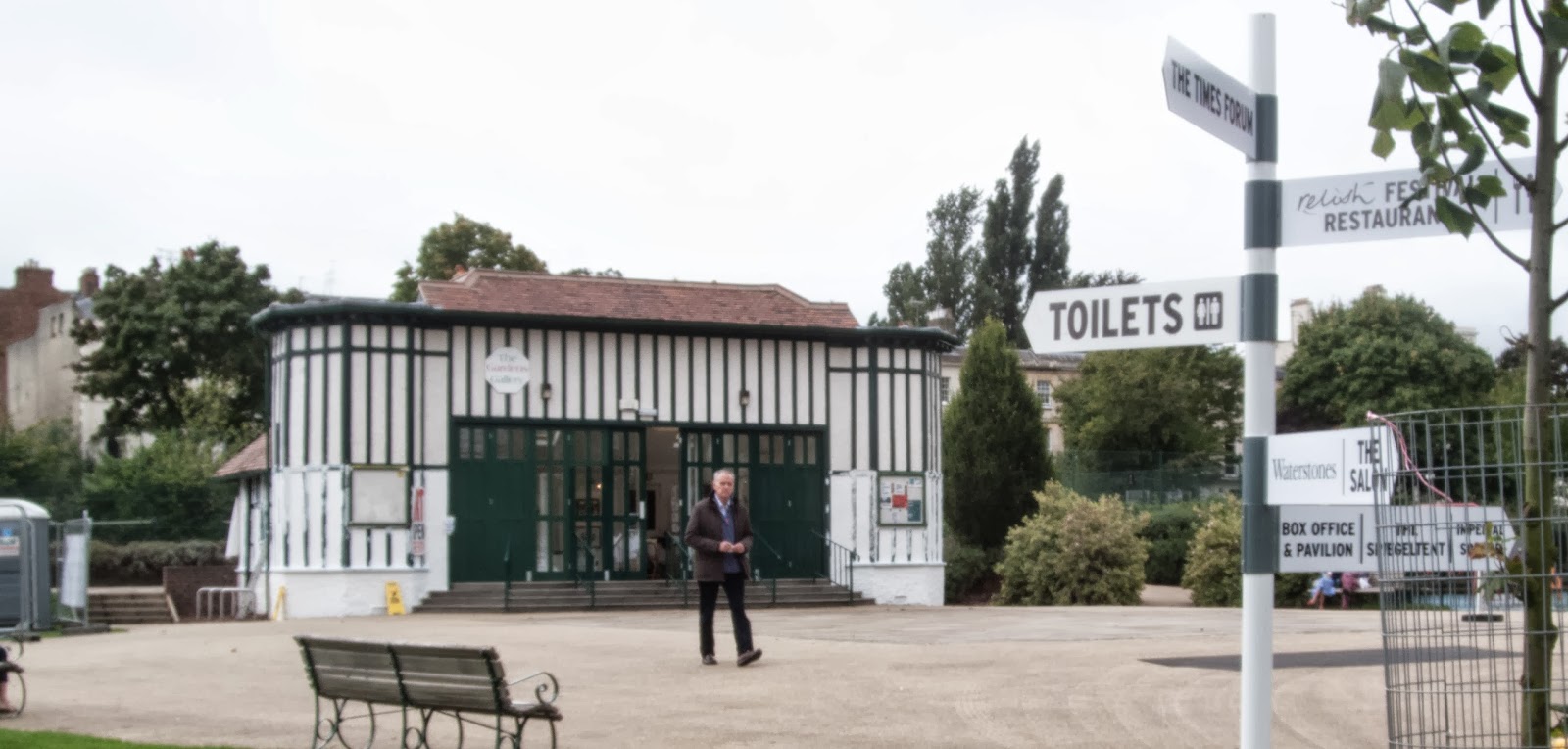
Caroline is rightly indignant with the Cheltenham Festivals continuing to sideline the Gardens' Gallery in Montpellier. Not only do they omit any mention of the Gallery in their brochure, it doesn't even feature on the festival maps, or on the signposts. And the massed bank of festival loos is plonked just next to it, reducing it to worse than Cinderella status. (Postscript: A Festival-goer caught short, spent her penny, and then - noticing the Gallery - went in and spent a further £300.)

Until a month ago, Pascal Lamy headed the World Trade Organization: yesterday afternoon he came to Cheltenham to discuss his forthcoming memoir, "The Geneva Consensus". The Times' Philip Collins kept the discussion nice and general, though without much sympathy for where Lamy was coming from, Collins appearing both less internationalist and more Conservative.

The memoir's title was chosen to juxtapose the author's standpoint with the Washington Consensus, which has come to stand for "Liberalise and God will take care of the rest." Lamy's approach is rather to take care of how trade works - in order for trade to work at all.

He praised Gordon Brown - prescient about the need for global governance - but China's "Don't ask me to do what you haven't done!"sums up the impasse, for instance in reaching a worldwide consensus on carbon reduction. We can't, Lamy maintains, halt globalisation, because technology is its engine - and technology has no reverse gear. It brings people closer to one another, but they still have different cultures. (The Inuits have always killed seals, but Europe expresses its disgust by banning Canadian imports.) Globalisation has formidably shrunk the numbers of the planet's poor, but at the expense of greater inequality.

A stimulating hour! As was my evening session - a genial chat between Mark Lawson and Jonathan Miller. Again, the interviewer gave his subject plenty of rope: with this, he readily reprised the role of enfant terrible, by which he first came to fame. There were a few repetitions, and one or two names escaped him, but otherwise it was hard to think that this was a man in his 80th year.

Until afterwards, that is: beginning my bike ride home, I saw someone in the shadows outside the Writers' Room, puffing at a cigarette. The enfant terrible had morphed into the Picture of Dorian Gray. I turned the bike round, and asked if I could take a photograph. (Nothing ventured...) "I hate being photographed," came the response, but he was willing to chat. "I'm not a Jew, just jewish," I quoted from Beyond the fringe. Was he a believer in the divine? "Certainly not," he said, "and what's more if Jesus came back I would ensure he was brought before the International Criminal Court."

This morning, by contrast, I escaped to Tetbury again, and heard - inter alia - the sublime Sarah Connolly singing Schumann and Duparc. These repeated words of Baudelaire, set by the latter, sum up Tetbury in contrast to grungy, pragmatic, busy, eclectic Cheltenham: "Là, tout n'est qu'ordre et beauté, luxe, calme et volupté."

Used condoms form the detritus after Glastonbury: discarded Times cotton shopping bags after Cheltenham, and statins after Tetbury.


Friday, 4 October 2013

Cheltenham Festival of Literature


Two competing festivals this year, less than 30 miles apart! At least till the end of this weekend. Tetbury, hub of Royal South Gloucestershire, attracts a wide local audience plus many loyal regulars from London and further afield, émigrés for the weekend, no doubt dipping into Westonbirt Arboretum for some Autumn colour during their stay. Cheltenham's twin tented villages draw many more all and sundry, an amorphous horde growing by the year, less dress-conscious than last night's gang.

Once, at a gathering near Tetbury, I fell into conversation with one of the RSG Set. "Where do you live?" he inquired. "Cheltenham," I replied. "Cheltenham?" He spoke the word as if he was rinsing his teeth with a wine he thought was corked. "Cheltenham? Completely beneath my radar."

At our Literature Festival events, you used to be able to meet up with friends: now it's a matter of chance whether or not, even as a long-established punter, you see anyone you know. Harri is one of the regulars: I remember seeing her and her mother at an early event in last year's Festival and being amazed by the thickness of their ticket bundle. Today, therefore, I requested a photograph: the wadge on her lap covers admission to 42 events, I gathered!

We were queuing to get into The Times leader conference: I loved it last year, an hour of rich theatre with a highly-articulate cast of six. The only disappointments this year were the absence of the editor, and the distraction of the large screen flickering away in the background, above the stage.

Tuesday, 20 August 2013

"Why do we have to get richer?"


This was the question posed by Mark Tully in Sunday's Something Understood on Radio 4. (It's on - live - either very early or very late, but you can of course listen online till Sunday next.)

Something Understood is my "go to" programme each week, when I reach for the button of my bedside play again radio. Five eclectically-chosen pieces of music, four prose or verse snippets (Ronald Pickup is one of the readers this week), and a shortish informal interview: that's the pattern. Tully concentrates more upon the questions than the answers, often drawing on his long experience in India.

Gandhian economist, Devaki Jain, this week's interviewee, considered the value of craft work as a contribution to a nation's health and wealth. This question was in my mind also yesterday, as I inspected the modern designer furniture etc. at this year's Celebration of Craftsmanship & Design, held just down the road from us. Caroline and I biked along together, meeting up with friends. They, unlike us, were prospective buyers, so I tried to divide the prices by the number of hours I imagined the piece had taken to make. Ikea, it's not.

The exhibition is held in one of Cheltenham's finest buildings (in recent years, part of Cheltenham College). The catalogue attempts - not entirely accurately - to narrate the history of the building and its owners: I took a particular interest in that aspect, as the first major name on the list, the 3rd Baron Northwick has a walk-on part in my ancestor, Peter Davis' The diary of a Shropshire Farmer. They were near contemporaries, born in the same parish.

Photography wasn't allowed in the exhibition building: this impression is therefore the best I could manage - taken through one of the windows, where a trio of Judith Nicoll's driftwood wading birds were displayed. Godwits (though "Goodwits" for some reason in the catalogue).

We came away, stimulated, but in need of a cup of tea.

Wednesday, 14 August 2013

Dining out


We don't often go out to dinner, but Caroline was anxious to try out the acclaimed fish and chip restaurant (cum shop) on the other side of town. So, we booked a table for this evening and gave it a try. Not bad, was the verdict, if you don't expect haute cuisine. The chips weren't cooked enough for my taste, but they were certainly not too oily. My sea bass could have been anything, though again the batter didn't cloy in the mouth as it can do. There was a genuine no nonsense feel to the place, and a warm welcome

Funnily enough our friends the Greenwolds, whom we saw on Saturday, were telling us about their son Michael's new venture: the first fish and chip shop to be opened in Paris, The Sunken Chip.

Friday, 2 August 2013

Lapping it up


As Ogden Nash wrote, "The entrance requirements for grampahood are comparatively mild. You only have to live until your child has a child." Well worth the wait, I say!

It was 16 years ago that Sophie Ryder's Minotaur and the Hare was purchased for permanent display in a prominent position in Cheltenham's Promenade. There were the predictable howls of protest, but now I guess they would be easily drowned out by a chorus of approval - if it was to be mooted that the sculpture be removed. The chorus would be led by grandparents deprived of a most beautiful climbing frame.

Sunday, 23 June 2013

Cheltenham Green Doors


Last year and the year before we called it Eco Open Homes or ECOHAB: this year, we were Cheltenham Green Doors, to chime in with the Bristol model. And we brought forward the openings to June, rather than September, as they were previewed by an event in the Cheltenham Science Festival earlier in the month.

So I had an enjoyable time this weekend cycling around the fifteen venues - houses, a shop and gardens demonstrating a more sustainable way of life - and took some photographs. In most places, there were visitors at the time I called in, and they were eager to know what was on offer and to engage in conversation: our increased efforts at publicity seem to have reaped some dividend. We shall see what others, more closely involved, have to say at the meeting that's fixed for 2nd July: it's a lot of work, but is it worth going on with it year in, year out?

Friday, 7 June 2013

America in Cheltenham


Out of the blue, an old school friend contacted me last month. He had found me via this blog, and in particular a post I put up following the death of our housemaster last year. Yesterday, he came to lunch, and we then walked some of the town's streets looking at Regency and Victorian buildings - he is an architectural historian, who has worked for three decades or so in the United States. In spite of this, he has not lost the Irish accent I first became used to hearing at Ampleforth in September 1956.

Both of us seem to have worn quite well, thank God: I had been to the doctor earlier in the day, who gave me a more or less clean bill of health. A waxed up ear is hardly cause for complaint, even though it now means I have some form of medicine for every orifice of my body apart from my tummy button.

Last evening, I spent in the company of two more Americans: the almost legendary James Watson was supposedly in debate with Charles Jencks at the Science Festival, "The scientist and the landscape designer." There wasn't much debate, sadly, but the hour was informative for me, who knows nothing about DNA - let alone RNA, its sister molecule.

Most of the talking was done by Charles Jencks, in the role of artist. He acknowledged his debt to Watson and Crick for their pioneering work and subsequently to Watson for the patronage which enabled Jencks to complete his recently-unveiled sculpture for Dublin Botanic Garden. Jencks however criticised the negative metaphors surrounding so many recent discoveries – “the selfish gene,” “the big bang” (“Pentagon language”, he said) and “black holes”, to name but three. As an artist, he was trying to come up with better metaphors, “more challenging, beautiful, seductive.” His landscape designs echo the thought of the late Ian Hamilton Finlay: “A garden isn’t just a retreat, it’s an attack.”

This time last year, Caroline and I joined in a Festival visit to a Cotswold garden crammed full of scientific references: I think I learnt more last night, though, from Charles Jencks' excellent images. What I found hard to accept was the need to distinguish between the mediaeval idea of the Creator, sitting on a cloud, and what Jencks called “cosmogenesis,” the continuing unfolding of creation in which we are all playing a part. For a person of faith, these are just two ways of looking at the same thing, namely the work of God.

The need for elegance in scientific expression was recognised by both speakers. Is there an objective aesthetic? I wondered afterwards. Or does it, as with wind turbines, depend on your point of view: renewable fanatics (me included) more incline to look favourably upon them than do climate sceptics.

Friday, 31 May 2013

Safe return


My four train journeys yesterday and today have all been uneventful, and here I am back at home again. At Cheltenham Station the reception party consisted of Caroline - and Thomas! None of us were expecting him to come from Lisbon for this weekend's celebrations: a lovely surprise, in springing which Sarah has been instrumental.

For the third time in four, I had a sleeping compartment to myself, travelling from Munich to Paris. No disturbances. The early morning run through Eastern France revealed just how much rain has been falling there recently.

In Paris, I wandered round the 10th in search of breakfast, passing some jolly looking shops. In one window, a sign: "Thanx (sic) God I'm a V.I.P." Another went by the name "Yak & Yeti." Johann Strauss's bust enlivened a square I passed through. On the Eurostar, people around me had been in Paris for the tennis, and were returning disappointed at so many matches being lost to the weather. But today at home it's warm and sunny.

Friday, 17 May 2013

Paris 10e


Aristide Cavaillé-Coll - not a name with which I was familiar - was reputed to be the finest organ-builder of the 19th Century. He is commemorated by a garden near the Gare du Nord. I have been strolling around this part of Paris since arriving by Eurostar this afternoon, with time to spare before I catch the night train to Munich.

Sitting outside a café in the sunshine with a beer, I watched children being collected from school, mostly by grandparents. The atmosphere of this area resembles not at all that with which I am familiar, and even in daylight feels quite threatening to an old codger from Cheltenham. I took refuge in the large church of St Vincent de Paul and found Mass in progress - peaceful and dignified, as befitted an elderly congregation, but with a young, rather traditionalist priest.

Emerging, and before walking the short distance to the magnificent Gare de l'Est, I bought apricots, bread and peppermints at a supermarket ahead of the rest of my long journey. Now I'm enjoying dinner in the station restaurant.