Showing posts with label Davis family history. Show all posts

Monday, 17 November 2014

Quink


Quink is the felicitous nickname of a relation of mine, given her because she was the fifth (and last) of her family, and born to a clergyman father - my grandfather's second cousin - on Quinquagesima Sunday. We called upon her in Canterbury today, as we progressed homewards.

Tuesday, 6 August 2013

Forgotten leaves from the family album


Probably on business, my grandfather evidently visited Germany at some time in the 'Thirties: looking through some pages of an old album passed down to me, I have come across this amongst other images of a parade: arms raised by spectators in the Nazi salute: in another swastikas are flying.

Not many photographs from this side of the family have survived the 80 or so years since they were taken: the spectacle must have seemed significant to both my grandfather and my father, for these to have been preserved.

In the same album are a very few holiday photographs - each of my grandparents taken on board ship: the Queen Mary was launched in 1936, so my grandfather would have been in his 50s at the time. A natty dresser, but unable to conceal his middle age spread.


Tuesday, 15 January 2013

"Arrow Vicarage"


Gertrude Louisa Davis' 1865/6 diary has recently been painstakingly transcribed by my Canadian cousin Bruce and his wife. Born in July 1847, she started writing a regular diary when aged nearly 15, and Bruce and Genie have now typed up four volumes/years. There isn't as much of significance in them as in her father's from three decades earlier, but part of the entry for 16th May 1865 interested me: "Papa went to a luncheon at Arrow Vicarage."

Arrow was six miles North of the Davis home in 1865, Bickmarsh Hall. And Arrow Vicarage (photographed, above, at around the time of Peter Davis' visit) was purchased by his great-grandson, my father, 89 years afterwards.

Tuesday, 21 February 2012

Old and new in Brum


En route for Warwick on Saturday, I changed trains in Birmingham. It's my birthplace, which is no doubt why I like to linger there whenever possible: this time, it was to visit St Martin's in the Bullring - for the first time - and to catch the Leonardo Drawings exhibition in the Art Gallery at the other end of New Street.

The Today programme this morning noted the Daily Express's support for investment in a National Water Grid. "Lets do something that will one day make our grandchildren proud of us!" it urges. Coming into Birmingham via Selly Oak, the train runs alongside the Elan Aqueduct, which - more than 100 years ago - was constructed to bring Welsh water to Birmingham, a distance of 73 miles. My father always said his grandfather, as manager of the Birmingham Corporation Improvement Scheme, was instrumental in this, though my researches so far don't throw up his name in connection with this - as opposed to other major projects of his time. "A splendid specimen of the Anglo-Saxon race, as all will admit who know him." So goes one of the many newspaper cuttings in our family album.

Arthur Henry Davis might have recognised the steam train berthed at Moor Street Station: Selfridges in the Bull Ring (behind), however, would have made his eyes pop.

Monday, 19 December 2011

Mary Webster RIP


Today the funeral takes place of my cousin Trevor Webster's wife Mary. In fact, it has already happened, the "venue" being Sydney, New South Wales. Mary and Trevor put Leo and me up for a few days when we went to Sydney in January 1998 - in fact more than that, they provided endless hospitality as well as introductions to places we would never have discovered on our own.

We had first met several years before that, following my father's death: then we lived up in the Cotswolds, and they came to supper while - by one of those extraordinary coincidences - staying with an old friend of Mary's from the next village.

The story of Mary and Trevor's emigration deserves wider publicity: together with their 18-month-old son, they set off from England in June 1958, along with another couple - two cars and much luggage - driving across almost the entirety of Europe and Asia. Arriving in North Australia by boat, they were all set to turn left for Sydney, but were warned against this: "you could never carry enough water to get through on that route!" So, turning the other way, they arrived in Sydney on 17th January 1959 via Perth, Adelaide and Melbourne. On our 1998 visit, we saw the car they had come in. It was in course of restoration, subsequently completed.

Mary's last illness was short, her death (aged 81) sudden. She will be sorely missed by her three children and five grandchildren, as well as by countless friends; but in particular by Trevor.

Wednesday, 30 November 2011

Leicester


A 3rd cousin (once removed) invited me to Leicester today, the first time I'd been there, so far as I can recall. I don't count passing through on the train. It's not a difficult journey by rail, though New Street seems to get busier each time I change there: there was only three minutes to catch the Cheltenham connection this evening, and I had to fight my way from one end of the station to the other. (Perhaps it was all those striking public service employees, taking advantage of a day off work to go somewhere...)

My cousin, having worked in Leicester for many years, knew all about the long-term successes in race relations there, a tribute to much patience and perseverance. We passed the brand new BAPS Shri Swaminarayan Mandir, on Gipsy Lane, opened only last month to great fanfares. Local residents regard it as a great improvement on the old factory that formerly stood on this prominent site. Its building (total cost £3m) took three years and much voluntary effort.

The visit enabled me to catch a glimpse of a set of photograph albums, put together by earlier generations: they fill a number of gaps in my knowledge of the family tree. I rather wish I'd known about them when researching pictures for The Diary of a Shropshire Farmer last year. Even leaving aside any genealogical interest, some of the photography is quite remarkable, and I was delighted to hear that the collection might end up in the Shropshire Archives.

Another pair of third cousins, twins, turns out to have been a teenage song and dance act that transformed itself into a business making bikinis in Florida - shortly after the days they were illegal. It thrives, so I was told in Leicester.

A pity I didn't get a photograph of the two pure white doves that fluttered around my cousin's garden: he and his wife keep a dovecote, perhaps an unusual feature on a housing estate.

Saturday, 15 October 2011

The book is launched!


"The Diary of a Shropshire Farmer: A Young Yeoman’s Life and Travels 1835-37" was officially launched today: I billed the invitation, Cheltenham Festival of Literature, Salon des Refusés, because my suggestion to Director Sarah Smyth that the book be featured in this year's Festival fell upon deaf ears. (Notwithstanding, he adds bitterly, it chimed with two of the Festival's themes, Legacy and Locally Sourced.)

Ah well! It didn't stop us having a great all-day party at home, with some 50 people dropping in, and more than 40 copies of the book signed and sold. It undoubtedly helped that we were able to handle the original texts, brought over for the occasion by cousin Bruce from New Brunswick, and also to see the original oil painting of the Peter Davis-bred Bull ("that bovine BMW" as cousin Susannah terms it).

Though family history retains its attractions even after all the hard work has been completed, its real dividend is the variety of living characters it throws up. Or, as Tolstoy wrote, The leaves of a tree delight us more than the roots.

Friday, 17 June 2011

"The Diary of a Shropshire farmer" - again


It's arrived! There can be nothing much more satisfying than to receive a copy of one's own book in the post. Or seeing one's name as author on Amazon.

As trailed previously, my great-great-grandfather, a farmer, wrote a diary, two volumes of which have only fairly recently come to light. They cover his mini-Grand Tour of the North of England and Scotland as a young man of 23, and his day-to-day life in Shropshire during the two years following. Together, they give a snapshot of what British life was like in the 1830s. I have included an introduction, sketching the changes that he witnessed, and that our landscape faces today. This is the bare outline, anyway: it conceals an awful lot of hard work, and not just by me. Let's hope for some reviews!

Wednesday, 11 May 2011

News from Miri


Jemima Louise Rose Lawrence is the newest name for our family tree, born 7,000 miles away in Sarawak just over a week ago, to Kate and Oliver. With her cousin Sofia Filippi, arriving six months earlier for Hannah and Fabio, she evens things up as between my father's male and female offspring - seven apiece now.

Two granddaughters will surely keep my sister busy for a few years, particularly coming as they do from the more multinational department of our immediate family: she's naturally planning a visit to Miri fairly soon.

Tuesday, 13 July 2010

Worcester to Tenbury by bicycle


There are three ways to tackle this problem, all with drawbacks for the cyclist (like me) who is aware of Old Father Time's approach. Today, I made the journey to Worcester by train, both cheap and bike-friendly. Rather than wait for 90 minutes for the next bus to Tenbury, I set out under a grey sky to find the Martley road, via good views of the Cathedral, the River Severn and the Worcester County Cricket Ground. The decision has to be taken whether to follow the River Teme, after its crossing at Ham Bridge, or to plough on the B4204, involving a 200m ascent. Well, that's where it ought to be taken, but I missed the turning after the bridge and by the time I was half way up to Clifton (misleadingly called "on Teme"), it was rather late to go back.

The advantage of sweating up the hill is that you have a nice long downhill into Tenbury, passing Hill Top and Kyrewood, two places mentioned in my ancestor's diaries: I'm in the process of editing these, hence the expedition.

On the way back, I had thought of taking the relatively flat (until Abberley) A443, but having biked along to Burford Church from Tenbury, quite a wide stretch of that road, I realised that I might be lucky to survive the unequal battle with the lorry traffic. So instead I took the minor road along the South bank of the Teme, via Lower Rochford, Eastham, Orleton and Stanford - coming out again to join the B4204 at Ham Bridge. Drawbacks? Well it's marked with 19th Century milestones, scenic and there isn't a lot of traffic; but it's very steep and narrow - and it was pouring with rain.

Wednesday, 2 December 2009

Davis family history


I spotted this sign when walking down Bond Street last week. This A.B. Davis was no relation of ours (or not to my knowledge anyway). But another A.B. Davis was my grandfather. His ancestry is currently taking up quite a bit of my time, thanks to an incredible piece of good luck.

I've mentioned previously about the family's origins. A.B.D.'s grandfather Peter is the earliest Davis of which we know much: his travel diary of 1835 is a vital record, if not a literary masterpiece.

Now, to cut a long story short, thanks to the curiosity and initiative of my cousin Bruce Coates of New Brunswick, he has acquired a slightly later Peter Davis diary, amongst many other (later) family papers. And, what's more, he and his wife Genie have struggled against many difficulties to transcribe it.

Last night, Bruce sent me this poignant entry made on the day Peter's father died, 30th August 1837: "Warm clear day. This morning about ¼ to 5 o’clock my poor dear Father departed this life without a struggle having bourne a lingering illness of nearly 3 months. In the 69th year of his age. May the Lord have mercy upon the soul of my best friend upon earth."

Isn't this worth a thousand dry facts unearthed via FamilySearch?

Sunday, 31 August 2008

The Bull


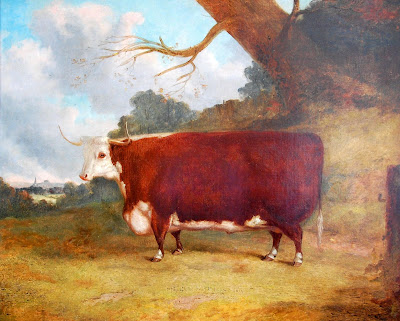
This oil painting by an unknown artist hangs in my sister Sarah Davis’s house, in Kingsclere, Hampshire: Caroline, Agnes, Ida and I had lunch with her in the garden there on a warm and sunny Friday: we took The Bull outside too, to be photographed - not easy, because the oil paint is shiny.

The painting was restored by Pippa Jeffries in 2004, at which time its handsome gilt frame was mended also. On the front of the picture are the words 1st prize 15L [fifteen pounds sterling] & silver medal to the breeder, Birmingham 1865. On the back is written P. Davis, Bickmarsh.

Little is known about the Davis family’s origins. Peter was born in 1812 at Dean Park, just outside Burford in the very South of Shropshire - just North of Tenbury Wells, which is in Worcestershire. He was the son of a farmer, Samuel Davis, and of his wife Elizabeth née Reynolds. The 1851 census records the village of his birth, but the Burford Parish registers do not list his baptism.

Peter had two elder brothers: William (born 1805) carried on farming at Dean Park on his father's death, as did his son (another Peter) after him – until he lost his money, having invested it in South American silver mining shares. Our Buckinghamshire cousin Mike Davis is that Peter's grandson.

The second brother, Samuel, baptized at Burford on 2nd January 1910, went up to Cambridge University. Following ordination, he lived most of his life in Devon, as Vicar of Burrington. He was said to be of simple, sweet disposition and fine presence, much revered in the neighbourhood. He married three times having met all his wives on the same day (the second being the sister of the author of Lorna Doone, R.D. Blackmore).

The brothers had two sisters, Carolina, who died young, and Eliza, who married twice: she had four children, but I have no knowledge of any living descendants.

On 8th June 1835, Peter set out on a journey from his home, “Park” - to Edinburgh. The round trip lasted till 22nd June. I have a copy of his diary of this journey, transcribed by his granddaughter Edith Howard Freer in 1898. [Later: now published!]

At the time of his father's death in 1837, Peter was living at Burford Rectory. By 7th June 1841, the date of that year's Census, he had moved to The Lodge, Broncroft Farm, Diddlebury, where he was head of the household, aged 29, a farmer, and living with his sister Eliza (then Mrs Trumper - but widowed), two female servants and two agricultural labourers.

In 1842, Peter, or possibly someone else in his family, won the Tredegar prize for the best two-year-old Hereford heifer. The prize, in the form of a silver cup, was passed down to my father, and is now in Sarah's ownership along with The Bull portrait.

On 30th January 1845, Peter (then 34) was married by licence to a girl from a well-established local family, 14 years his junior. Jane Jeffries' and Peter's wedding took place at Pembridge Church, Herefordshire, Peter being described as a Gentleman, a bachelor living at Milton in Pembridge parish. It is strange that all the witnesses to the marriage seem to be from the bride’s extended family. Milton was a farm of about 600 acres, Peter Davis being the tenant.

On 21st November 1845, Jane gave birth to the first of her ten children, a son John Jeffries Davis. 21 months later, a daughter, Gertrude Louisa was born. Laura Jane Meredith Davis (Meredith was Jane Davis’s mother’s maiden name) was born on 15th March 1850. After this, the family moved from Milton Farm, as in the 1851 census they are shown as living at Bromfield, in South Shropshire, near the Herefordshire border. In Bagshaw’s 1851 Directory of Shropshire, Peter's address is King’s Head Farm, which is on the West of the village.

In 1852, my great-grandfather Arthur Henry was born in Bromfield: in 1855, Agnes (known as Lil) arrived, and then Georgina Reynolds ("Reynolds" after her paternal grandmother), known as Ina, was born in 1857. Eliza Augusta was born in 1858, and Constance Alathea (Alathea being a name found amongst members of the Cheese family, from which the Jeffries were descended) on 25th March 1860.

At Michaelmas 1860, Peter took over as tenant of the Bickmarsh Hall estate, Warwickshire, some 45 miles South-East of Bromfield. Why he went so far out of his country is a mystery: perhaps he couldn't find a big enough farm to suit his ambitions anywhere nearer to home. In the 1861 census, he is said to be a farmer of 1,270 acres at Bickmarsh, employing 29 men and five boys. Also living with the family were a house servant and a shepherd.

Another daughter, Flora May ("Floo") was born on 5th May 1862, and baptized with her elder sister Constance Alathea at Bickmarsh on 13th January 1863. Floo and her husband took off for Australia after their marriage - as did a descendant of Constance Alathea, but not till the 1950s: between them we know of nearly 200 altogether, about ten times those of my great-grandfather. (The only other descendants of Peter we know of are via John Jeffries Davis - nearing 100, including Bruce Coates from New Brunswick, and his family.)

There was an annual cattle show at Bingley Hall, Birmingham, very near to where Symphony Hall now stands. The catalogue for the 1865 exhibition (2nd – 7th December) confirms that Peter Davis of Bickmarsh was the winning breeder in the Fat Cattle class for Hereford Oxen or Steers exceeding three years and three months old. The Bull was then three years and eleven months, and had been fed on hay, grass, barley and bean meal, oil cakes, swedes and mangolds.

A William Aldworth, of Frilford, Abingdon, had exhibited The Bull, so the catalogue said. From the 1861/71 Censuses, it appears Mr Aldworth was born about 1809, and owned and farmed 550 acres at Frilford – with a staff of 47! The church in the background of the picture is the parish church of Abingdon. Round Hill (121 metres), one of the Wittenham Clumps, is in the background.

Alice Marian Davis, the youngest child born to Jane, arrived on 8th March 1866, and was baptized at Bickmarsh on 8th April that year.

Peter Davis died at Bickmarsh on 3rd October 1873, aged 62, and was buried in nearby Dorsington churchyard. The local paper described him as One of the leading agriculturalists in this district. His imposing gravestone (highly polished red granite) is engraved: This tomb was erected by many friends as a memorial of their esteem and affection. Peter left no will: the grant of letters of administration says that his effects were worth "under £8,000". When his wife Jane eventually died on 18th June 1891, she was buried in the same grave, and a further inscription was added.

So there we are.