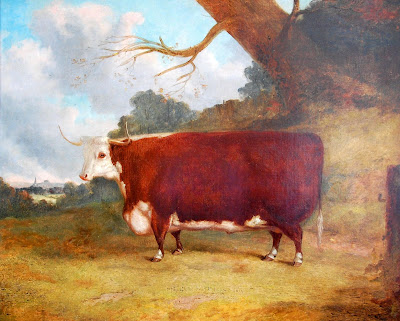
This oil painting by an unknown artist hangs in my sister Sarah Davis’s house, in Kingsclere, Hampshire: Caroline, Agnes, Ida and I had lunch with her in the garden there on a warm and sunny Friday: we took The Bull outside too, to be photographed - not easy, because the oil paint is shiny.
The painting was restored by Pippa Jeffries in 2004, at which time its handsome gilt frame was mended also. On the front of the picture are the words
1st prize 15L [fifteen pounds sterling] & silver medal to the breeder, Birmingham 1865. On the back is written
P. Davis, Bickmarsh.
Little is known about the Davis family’s origins. Peter was born in 1812 at Dean Park, just outside Burford in the very South of Shropshire - just North of Tenbury Wells, which is in Worcestershire. He was the son of a farmer, Samuel Davis, and of his wife Elizabeth née Reynolds. The 1851 census records the village of his birth, but the Burford Parish registers do not list his baptism.
Peter had two elder brothers: William (born 1805) carried on farming at Dean Park on his father's death, as did his son (another Peter) after him – until he lost his money, having invested it in South American silver mining shares. Our Buckinghamshire cousin Mike Davis is that Peter's grandson.
The second brother, Samuel, baptized at Burford on 2nd January 1910, went up to Cambridge University. Following ordination, he lived most of his life in Devon, as Vicar of Burrington. He was said to be
of simple, sweet disposition and fine presence, much revered in the neighbourhood. He married three times having met all his wives on the same day (the second being the sister of the author of
Lorna Doone, R.D. Blackmore).
The brothers had two sisters, Carolina, who died young, and Eliza, who married twice: she had four children, but I have no knowledge of any living descendants.
On 8th June 1835, Peter set out on a journey from his home, “Park” - to Edinburgh. The round trip lasted till 22nd June. I have a copy of his diary of this journey, transcribed by his granddaughter Edith Howard Freer in 1898. [
Later: now published!]
At the time of his father's death in 1837, Peter was living at Burford Rectory. By 7th June 1841, the date of that year's Census, he had moved to
The Lodge, Broncroft Farm, Diddlebury, where he was head of the household, aged 29, a farmer, and living with his sister Eliza (then Mrs Trumper - but widowed), two female servants and two agricultural labourers.
In 1842, Peter, or possibly someone else in his family, won the Tredegar prize for the best two-year-old Hereford heifer. The prize, in the form of a silver cup, was passed down to my father, and is now in Sarah's ownership along with The Bull portrait.
On 30th January 1845, Peter (then 34) was married by licence to a girl from a well-established local family, 14 years his junior. Jane Jeffries' and Peter's wedding took place at
Pembridge Church, Herefordshire, Peter being described as a Gentleman, a bachelor living at Milton in Pembridge parish. It is strange that all the witnesses to the marriage seem to be from the bride’s extended family. Milton was a farm of about 600 acres, Peter Davis being the tenant.
On 21st November 1845, Jane gave birth to the first of her ten children, a son John Jeffries Davis. 21 months later, a daughter, Gertrude Louisa was born. Laura Jane Meredith Davis (Meredith was Jane Davis’s mother’s maiden name) was born on 15th March 1850. After this, the family moved from Milton Farm, as in the 1851 census they are shown as living at Bromfield, in South Shropshire, near the Herefordshire border. In Bagshaw’s 1851 Directory of Shropshire, Peter's address is King’s Head Farm, which is on the West of the village.
In 1852, my great-grandfather Arthur Henry was born in Bromfield: in 1855, Agnes (known as Lil) arrived, and then Georgina Reynolds ("Reynolds" after her paternal grandmother), known as Ina, was born in 1857. Eliza Augusta was born in 1858, and Constance Alathea (Alathea being a name found amongst members of the Cheese family, from which the Jeffries were descended) on 25th March 1860.
At Michaelmas 1860, Peter took over as tenant of the Bickmarsh Hall estate, Warwickshire, some 45 miles South-East of Bromfield. Why he went so far out of his country is a mystery: perhaps he couldn't find a big enough farm to suit his ambitions anywhere nearer to home. In the 1861 census, he is said to be a farmer of 1,270 acres at Bickmarsh, employing 29 men and five boys. Also living with the family were a house servant and a shepherd.
Another daughter, Flora May ("Floo") was born on 5th May 1862, and baptized with her elder sister Constance Alathea at Bickmarsh on 13th January 1863. Floo and her husband took off for Australia after their marriage - as did a descendant of Constance Alathea, but not till the 1950s: between them we know of nearly 200 altogether, about ten times those of my great-grandfather. (The only other descendants of Peter we know of are via John Jeffries Davis - nearing 100, including Bruce Coates from New Brunswick, and his family.)
There was an annual cattle show at Bingley Hall, Birmingham, very near to where Symphony Hall now stands. The catalogue for the 1865 exhibition (2nd – 7th December) confirms that Peter Davis of Bickmarsh was the winning breeder in the Fat Cattle class for Hereford Oxen or Steers exceeding three years and three months old. The Bull was then three years and eleven months, and had been fed on hay, grass, barley and bean meal, oil cakes, swedes and mangolds.
A William Aldworth, of Frilford, Abingdon, had exhibited The Bull, so the catalogue said. From the 1861/71 Censuses, it appears Mr Aldworth was born about 1809, and owned and farmed 550 acres at Frilford – with a staff of 47! The church in the background of the picture is the parish church of Abingdon. Round Hill (121 metres), one of the Wittenham Clumps, is in the background.
Alice Marian Davis, the youngest child born to Jane, arrived on 8th March 1866, and was baptized at Bickmarsh on 8th April that year.
Peter Davis died at Bickmarsh on 3rd October 1873, aged 62, and was buried in nearby Dorsington churchyard. The local paper described him as
One of the leading agriculturalists in this district. His imposing gravestone (highly polished red granite) is engraved:
This tomb was erected by many friends as a memorial of their esteem and affection. Peter left no will: the grant of letters of administration says that his effects were worth "under £8,000". When his wife Jane eventually died on 18th June 1891, she was buried in the same grave, and a further inscription was added.
So there we are.


 Posts
Posts

