Showing posts with label Birmingham. Show all posts

Monday, 22 December 2014

The Christmas Outing


One of Birmingham's favourite sons, John Baskerville (1706 – 1775) is commemorated in the city's Centenary Square by David Patten's Portland stone sculpture of the Baskerville typeface, Industry and Genius (1990). It makes a great climbing frame.

Eight of us were on our way from New Street Station to see The BFG at the Rep, via The National Sea Life Centre, taking in lunch at Ed's Easy Diner en route.

Monday, 30 December 2013

Birmingham


I knew David Wood a little at Oxford, where he displayed a precocious talent in the OUDS and ETC. Starting as he meant to go on, he is now hailed by some as the children's theatre laureate. We turned our backs on panto for once in order to sample his adaptation of "Tom's Midnight Garden" this afternoon, the children scoring it 10 out of 10.

For this, the five of us sat at the back of the steeply-raked stalls at Birmingham Old Rep. It's celebrating 100 years as a theatre this year, and the space between the rows is an indication of how well we've all been eating our greens in the interim. I remember being taken to pantos there by my grandmother Gateley - probably in the 1940s, when my legs and trousers were shorter.

Before the play, we paid a visit to the crib at St Philip's (in fact two cribs - plus of course the Burne-Jones Nativity window); and then had lunch in the new Library café, explored its lifts and escalators and admired the view from the top floor. The children rolled merrily around on the carpet of the recreated Shakespeare Memorial Room, where they clearly felt at home. (Ida has been spouting Macbeth.)

Monday, 11 November 2013

Birmingham


This last weekend, I was supposed to be going to the Lakes: the trip was called off after I had bought my train ticket, so - in order salvage something from it - I spent Friday in Birmingham, mainly looking all round the magnificent new Library.

In the foyer, there's a wooden pavilion housing "The Library of Lost Books". Intrigued by the title, I went in to find the transformation of a collection of old, damaged books and music scores, many over a century old, which had been discarded by different local libraries. Two years ago, local artist Susan Kruse had sent one item to each of more than 40 artists and printmakers from around the UK, to breathe new life into them through their interventions. The reworked books have now returned to Birmingham for this temporary exhibition.

On the way home, before I stepped out into the November gloom (and rain), the conductor made some of us smile: "We are," he said, "now approaching the charismatic station that is Cheltenham. Please ensure that you take all your belongings, relatives etc. with you when you leave the train."

This morning, changing trains on my way to York, I was back in Birmingham. One poor man - "I haven't been on a train for years," he told me - travelled there by mistake. He was seeing his wife off from Cheltenham, and got on so as to lift her case onto the rack above her seat. The doors closed as they were kissing goodbye. So much for gallantry.

A noticeable - if not a complete - hush came about New Street Station for the two minutes after 11 o'clock.

Friday, 8 March 2013

Worcester


Its been nearly five months since our book group convened last: then we met in Birmingham, for a look round buildings in the centre, amongst them the new library in course of construction. Today, it was Worcester's huge new library's turn for a visit: The Hive there only opened last Summer - it felt good and indeed (as it boasts) sustainable. We were impressed.

The exterior, which contrasts markedly with Birmingham, is finished in a dull bronze, reminding me of the Guggenheim in Bilbao - though I rather wonder whether it will last as well. Inside is full of of purpose, comfort and peace, and (besides its 800 study stations) quite a few books. Oh, and at least a couple of quite significant new art works: Robert Orchardson's aluminium mobile, "Kaleidoscope", which hangs in the foyer, making the best use of a light space and people's ability to see it from many angles; and Clare Woods' two-dimensional abstract "Rack Alley", dominating the atrium.

Earlier, our enjoyment of the Cathedral - rather a forbidding building from the outside, especially on a rainy day like today - was greatly enhanced by having Richard Lockett as our guide. His unobtrusive knowledgeability (and wry asides) made the nearly two hours we spent there fly past.

Sunday, 14 October 2012

Birmingham


Yesterday, my book group met in the salubrious surroundings of the Birmingham Art Gallery & Museum restaurant. Not the hautest cuisine, but adequate: we missed our usual pints of bitter. Breaking with tradition, we discussed The Book over lunch, rather than tea. It was the sequel to Hilary Mantel's Wolf Hall: Bring up the bodies didn't grab all of us as firmly as it did me, but we seemed to agree that it was worth looking at. Shall I buy volume 3 when it appears? Probably.

Why Birmingham? Because Peter, our newest member, is full of enthusiasm for its examples of Arts & Crafts architecture. So, after we'd looked round some of the galleries and finished our book discussion, he led us down Edmund Street, Margaret Street, Newhall Street and Colmore Row, ending up at St Philip's.

Having admired the late Burne-Joneses there, we went across to St Martin's to look at the very different earlier window by him, saved by a whisker from destruction in World War II.

My companions were taken aback by Selfridge's, hovering over the Bull Ring, but even more by the new Library, to be opened next September, but now already dominating the East end of Broad Street. For my part, the excitement was this (photographed) new kinetic installation in the oculus of the Museum's new History Gallery - by Keiko Mukaide and Ronnie Watt: it was unveiled earlier this year. And whose is the amazing stained glass window on the stairs behind it, without any label?

Friday, 12 October 2012

"Sharing Eden"


Three Festival of Literature events today: near my limit! Two of them were sponsored by the splendid Coexist Foundation. On the platform for the first of these, a discussion took place between followers of the three great Abrahamic faiths, pooling insights which could secure a better future for our planet. As Rabbi Nathan Levy (2nd from left in my photograph) said, "Even if we don't all share the same vision of heaven, we share the same Earth."

A common Earth manifesto subscribed to by the world's great religions? It could give people of faith that credibility they often lack within our sceptical yet green-inclined society; but how can we hope to achieve such a thing when within each of our faiths there are those who question any commitment to the importance of global stewardship?

This said, I bought the book after the event, the first time I'd succumbed this Festival: I usually buy more, but I'm in a mean streak.

Rabbi Nathan, a co-author of Sharing Eden, reminds us that people of faith are uniquely placed to speak truth to power about a concern for environmental justice. Politicians work to a five-year plan, business people may adopt a ten-year plan, but we are used to thinking longer-term: only after seven times seven years do we celebrate jubilee: "And ye shall hallow the fiftieth year, and proclaim liberty throughout all the land unto all the inhabitants thereof."

A lot – or sometimes very little – can change in 50 years. As I recorded last month, it’s that period since I started at university: had I instead, as destined, gone into articles in a solicitors’ firm in Birmingham, my life would have been very different. Yesterday was 50 years since the 2nd Vatican Council opened: some would say, "plus ça change, plus c'est la même chose." More mundanely tomorrow will be 50 years since the last train went from Cheltenham to Kingham on the old Honeybourne Line, running 50 yards from our front gate: what would we now give to have back the comprehensive rail network, which Beeching axed?

Sunday, 23 September 2012

Gateley solicitors


This photograph shows my grandfather Arthur John Gateley, on the left, arm in arm with his brother (four years older), Stephen Joseph. They were the "Sons" of "Stephen Gateley & Sons", the solicitors firm established by their father Stephen Michael, with offices in Temple Row, Birmingham. The firm continues today with the family name intact, as I've mentioned before. Today would have been my grandfather's 130th birthday.

Friday, 22 June 2012

Birmingham's new library


We're so used to stories in the media - especially our local paper - about libraries being closed, that it was a nice surprise to see a brand new one approaching completion just next to the Birmingham Repertory Theatre.

It's vast! And appears at present not unlike a wedding cake, but is definitely set to look a good deal more exciting that the existing "office block" calling itself a library a few hundred yards further towards New Street.

The puzzling thing is, I can't for the life of me remember what was on this significant site before.

"Weltethos"


Last September, our Town Hall hosted the première of Richard Blackford's "Not in our time": yesterday evening, we went to Birmingham for the UK première of Jonathan Harvey's "Weltethos" on a somewhat similar theme - seeking common ground between the world's main religions on the basis of their shared ethical principles and values. Blackford's focus, a decade on from 9/11, was on peace. Harvey - brought in by the Berlin Phil. to flesh out musically the thoughts of theologian Hans Küng - is operating on a broader canvas: his six "movements" are humanity, the Golden Rule, non-violence, justice, truth and partnership.

You may think this a worthy event for the opening of the London 2012 Festival and Cultural Olympiad. We had both been looking forward to the evening for many months: it's certainly a thrill to visit Birmingham's Symphony Hall, particularly on a big occasion. And after all, isn’t peaceful coexistence what the Olympics are about - individuals competing against each other in sport unburdened by politics?

I was glad we arrived in time for Simon Halsey's pre-performance talk: otherwise the scheme of this ambitious work would have been impenetrable. As it was, I found the 90 minutes dragged, notwithstanding the diversion of watching two conductors, a huge orchestra (there were six percussionists), with the three separate choirs bobbing up and down. I liked the idea of a children's choir to plead for us to plan for the future; but does the awfully dull music of their refrain really bear six repetitions? (Judge for yourself: the piece was broadcast live, so you can ListenAgain.)

There just wasn't sufficient variety between the sections, nor did the work arrive at a significant conclusion. Its appeal is to the head, not the heart; and what's more it is to the Westerner's head, notwithstanding the aspiration of Küng (who was in the audience) to address people of faith throughout the world.

I've been an admirer of Küng since I heard him around thirty years ago, in St George's Chapel, Windsor, eloquently expounding his belief that all the Abrahamic religions should and could work together against the real enemy of our time, materialism. Jonathan Harvey has been a good friend to Cheltenham, visiting often for early performances of his work: much of it I have appreciated in a way that I rarely do with modern classical music. Nor could you wish to meet a milder man. My criticism should not take away from the achievement of bringing together this new piece and the huge forces needed to perform it. But Simon Halsey, methinks, doth protest too much when he mentions it in the same breath alongside "Elijah" and Britten's "War Requiem".

One of the versions of the Prayer of St Francis contains the words "Lord, make me a channel of thy peace;... that where there is discord, I may bring harmony." Ultimately, "Weltethos" wont last because it lacks tunes.

3-minute culture


We were held up by traffic on our way into the centre of Birmingham yesterday, so our intended visit to Ikon was a short one. We dashed up the staircase (shown clad in glass in my photograph) and just had time for a whistle stop tour of the two exhibitions. On the second floor, Bedwyr Williams called his show "My Bad" - an American slang expression from the world of basketball, apparently. It was an eclectic mix, as one has come to expect from Ikon - sculpture, photography, audio and installations; but what I enjoyed most were the 50 or so very varied drawings in the little Tower Room. Thurber came to mind. Yto Barrada's "Riffs" was likewise something of a variety show, but her large photographs of life in Tangier were what left the strongest impression in my mind. Both exhibitions would have repaid a longer look. We came away with the Guide and read it later: a model of it's kind, I'd say, full of illumination and wit.

Tuesday, 21 February 2012

Old and new in Brum


En route for Warwick on Saturday, I changed trains in Birmingham. It's my birthplace, which is no doubt why I like to linger there whenever possible: this time, it was to visit St Martin's in the Bullring - for the first time - and to catch the Leonardo Drawings exhibition in the Art Gallery at the other end of New Street.

The Today programme this morning noted the Daily Express's support for investment in a National Water Grid. "Lets do something that will one day make our grandchildren proud of us!" it urges. Coming into Birmingham via Selly Oak, the train runs alongside the Elan Aqueduct, which - more than 100 years ago - was constructed to bring Welsh water to Birmingham, a distance of 73 miles. My father always said his grandfather, as manager of the Birmingham Corporation Improvement Scheme, was instrumental in this, though my researches so far don't throw up his name in connection with this - as opposed to other major projects of his time. "A splendid specimen of the Anglo-Saxon race, as all will admit who know him." So goes one of the many newspaper cuttings in our family album.

Arthur Henry Davis might have recognised the steam train berthed at Moor Street Station: Selfridges in the Bull Ring (behind), however, would have made his eyes pop.

Wednesday, 30 November 2011

Leicester


A 3rd cousin (once removed) invited me to Leicester today, the first time I'd been there, so far as I can recall. I don't count passing through on the train. It's not a difficult journey by rail, though New Street seems to get busier each time I change there: there was only three minutes to catch the Cheltenham connection this evening, and I had to fight my way from one end of the station to the other. (Perhaps it was all those striking public service employees, taking advantage of a day off work to go somewhere...)

My cousin, having worked in Leicester for many years, knew all about the long-term successes in race relations there, a tribute to much patience and perseverance. We passed the brand new BAPS Shri Swaminarayan Mandir, on Gipsy Lane, opened only last month to great fanfares. Local residents regard it as a great improvement on the old factory that formerly stood on this prominent site. Its building (total cost £3m) took three years and much voluntary effort.

The visit enabled me to catch a glimpse of a set of photograph albums, put together by earlier generations: they fill a number of gaps in my knowledge of the family tree. I rather wish I'd known about them when researching pictures for The Diary of a Shropshire Farmer last year. Even leaving aside any genealogical interest, some of the photography is quite remarkable, and I was delighted to hear that the collection might end up in the Shropshire Archives.

Another pair of third cousins, twins, turns out to have been a teenage song and dance act that transformed itself into a business making bikinis in Florida - shortly after the days they were illegal. It thrives, so I was told in Leicester.

A pity I didn't get a photograph of the two pure white doves that fluttered around my cousin's garden: he and his wife keep a dovecote, perhaps an unusual feature on a housing estate.

Thursday, 24 November 2011

Gateley


My cousin, "young" Martin has alerted me to the change of name of our family firm of solicitors: founded by my great-grandfather, Stephen Gateley, it became Stephen Gateley & Sons when his two sons qualified and joined the practice. My cousin "young" Stephen steered the firm into its first major merger, it being renamed Gateley Wareing. Subsequent amalgamations made it HBJ Gateley Wareing, but a new look was announced in May apparently: from that time, it's just been "Gateley".

Now with some 800 employees, its look and feel differs rather from the days 60-odd years ago when I used to visit my grandfather in his Temple Row office, with clerks sitting on high stools dipping their pens. 13/4d was a fairly standard charge, I seem to recall, less than it now costs to post a large letter.

Sunday, 20 September 2009

Not amused


Caroline bought a bike for Agnes' birthday on eBay, so collecting it was my excuse for an outing to near Nuneaton on Friday. My reward for riding a 19" frame lady's bike from its former owner's to Nuneaton Station was a stop-off in Birmingham on the way there: I wanted to pop into the Art Gallery to see Burne-Jones' Perseus Series, on loan from the Staatsgalerie Stuttgart, the first time it had been on view in the UK. (The show was closing today.)

The pictures tell the story - as gruesome as any Tarantino film - of Perseus visiting the Graiae, Medusa's sisters, who shared one eye between the three of them, and making off with it; cutting off Medusa's head, and using it to win the affection of Andromeda (before turning various people to stone). It amazes me how the Victorian establishment obviously lapped all this up: Burne-Jones' commission came from Arthur Balfour, the future Prime Minister.

I fell asleep in the train going back, waking up with a jolt as it pulled in to Cheltenham. I had put my book on a low shelf beside my seat. Only as I was pushing the bike down the platform, the train moving off to Cardiff, did I remember.

Tuesday, 30 September 2008

Newman


On Friday last, Paul Newman died. For some 50 years he was an icon to my generation of film buffs; but reading his obituaries you see a bigger picture: in his long life, he suffered much personal tragedy, and whilst his success made him rich, he was also hugely generous.

Today's illustration is of another Newman, John Henry, 1801 - 1890. Here he is, shown as an old man in his robes as a Cardinal. The illustration appears on the front of the current Friends of Cardinal Newman Newsletter, kindly dropped on my doorstep yesterday by Christopher Page.

The picture, by the Birmingham artist, Claude Pratt, was owned by my cousin Tom Townsend, who would have inherited it from either his father Sir Reg Townsend or his mother Millie, the daughter of Birmingham-born Ned and Agnes Cartwright. (Agnes was my grandfather's aunt.)

Tom and his wife Betty had no children, and I was fortunate enough to inherit "Cardinal Newman" on Tom's death. But with our impending move, we have been trying to slim down on pictures, so I am very happy that it has now found its way back to Birmingham, and indeed to Newman's Oratory in the Hagley Road.

Sunday, 31 August 2008

The Bull


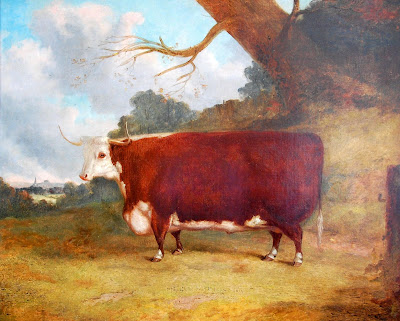
This oil painting by an unknown artist hangs in my sister Sarah Davis’s house, in Kingsclere, Hampshire: Caroline, Agnes, Ida and I had lunch with her in the garden there on a warm and sunny Friday: we took The Bull outside too, to be photographed - not easy, because the oil paint is shiny.

The painting was restored by Pippa Jeffries in 2004, at which time its handsome gilt frame was mended also. On the front of the picture are the words 1st prize 15L [fifteen pounds sterling] & silver medal to the breeder, Birmingham 1865. On the back is written P. Davis, Bickmarsh.

Little is known about the Davis family’s origins. Peter was born in 1812 at Dean Park, just outside Burford in the very South of Shropshire - just North of Tenbury Wells, which is in Worcestershire. He was the son of a farmer, Samuel Davis, and of his wife Elizabeth née Reynolds. The 1851 census records the village of his birth, but the Burford Parish registers do not list his baptism.

Peter had two elder brothers: William (born 1805) carried on farming at Dean Park on his father's death, as did his son (another Peter) after him – until he lost his money, having invested it in South American silver mining shares. Our Buckinghamshire cousin Mike Davis is that Peter's grandson.

The second brother, Samuel, baptized at Burford on 2nd January 1910, went up to Cambridge University. Following ordination, he lived most of his life in Devon, as Vicar of Burrington. He was said to be of simple, sweet disposition and fine presence, much revered in the neighbourhood. He married three times having met all his wives on the same day (the second being the sister of the author of Lorna Doone, R.D. Blackmore).

The brothers had two sisters, Carolina, who died young, and Eliza, who married twice: she had four children, but I have no knowledge of any living descendants.

On 8th June 1835, Peter set out on a journey from his home, “Park” - to Edinburgh. The round trip lasted till 22nd June. I have a copy of his diary of this journey, transcribed by his granddaughter Edith Howard Freer in 1898. [Later: now published!]

At the time of his father's death in 1837, Peter was living at Burford Rectory. By 7th June 1841, the date of that year's Census, he had moved to The Lodge, Broncroft Farm, Diddlebury, where he was head of the household, aged 29, a farmer, and living with his sister Eliza (then Mrs Trumper - but widowed), two female servants and two agricultural labourers.

In 1842, Peter, or possibly someone else in his family, won the Tredegar prize for the best two-year-old Hereford heifer. The prize, in the form of a silver cup, was passed down to my father, and is now in Sarah's ownership along with The Bull portrait.

On 30th January 1845, Peter (then 34) was married by licence to a girl from a well-established local family, 14 years his junior. Jane Jeffries' and Peter's wedding took place at Pembridge Church, Herefordshire, Peter being described as a Gentleman, a bachelor living at Milton in Pembridge parish. It is strange that all the witnesses to the marriage seem to be from the bride’s extended family. Milton was a farm of about 600 acres, Peter Davis being the tenant.

On 21st November 1845, Jane gave birth to the first of her ten children, a son John Jeffries Davis. 21 months later, a daughter, Gertrude Louisa was born. Laura Jane Meredith Davis (Meredith was Jane Davis’s mother’s maiden name) was born on 15th March 1850. After this, the family moved from Milton Farm, as in the 1851 census they are shown as living at Bromfield, in South Shropshire, near the Herefordshire border. In Bagshaw’s 1851 Directory of Shropshire, Peter's address is King’s Head Farm, which is on the West of the village.

In 1852, my great-grandfather Arthur Henry was born in Bromfield: in 1855, Agnes (known as Lil) arrived, and then Georgina Reynolds ("Reynolds" after her paternal grandmother), known as Ina, was born in 1857. Eliza Augusta was born in 1858, and Constance Alathea (Alathea being a name found amongst members of the Cheese family, from which the Jeffries were descended) on 25th March 1860.

At Michaelmas 1860, Peter took over as tenant of the Bickmarsh Hall estate, Warwickshire, some 45 miles South-East of Bromfield. Why he went so far out of his country is a mystery: perhaps he couldn't find a big enough farm to suit his ambitions anywhere nearer to home. In the 1861 census, he is said to be a farmer of 1,270 acres at Bickmarsh, employing 29 men and five boys. Also living with the family were a house servant and a shepherd.

Another daughter, Flora May ("Floo") was born on 5th May 1862, and baptized with her elder sister Constance Alathea at Bickmarsh on 13th January 1863. Floo and her husband took off for Australia after their marriage - as did a descendant of Constance Alathea, but not till the 1950s: between them we know of nearly 200 altogether, about ten times those of my great-grandfather. (The only other descendants of Peter we know of are via John Jeffries Davis - nearing 100, including Bruce Coates from New Brunswick, and his family.)

There was an annual cattle show at Bingley Hall, Birmingham, very near to where Symphony Hall now stands. The catalogue for the 1865 exhibition (2nd – 7th December) confirms that Peter Davis of Bickmarsh was the winning breeder in the Fat Cattle class for Hereford Oxen or Steers exceeding three years and three months old. The Bull was then three years and eleven months, and had been fed on hay, grass, barley and bean meal, oil cakes, swedes and mangolds.

A William Aldworth, of Frilford, Abingdon, had exhibited The Bull, so the catalogue said. From the 1861/71 Censuses, it appears Mr Aldworth was born about 1809, and owned and farmed 550 acres at Frilford – with a staff of 47! The church in the background of the picture is the parish church of Abingdon. Round Hill (121 metres), one of the Wittenham Clumps, is in the background.

Alice Marian Davis, the youngest child born to Jane, arrived on 8th March 1866, and was baptized at Bickmarsh on 8th April that year.

Peter Davis died at Bickmarsh on 3rd October 1873, aged 62, and was buried in nearby Dorsington churchyard. The local paper described him as One of the leading agriculturalists in this district. His imposing gravestone (highly polished red granite) is engraved: This tomb was erected by many friends as a memorial of their esteem and affection. Peter left no will: the grant of letters of administration says that his effects were worth "under £8,000". When his wife Jane eventually died on 18th June 1891, she was buried in the same grave, and a further inscription was added.

So there we are.