Friday, 12 September 2008

Heritage Open Days


I have been stewarding at St Gregory's today: it is open under the Civic Trust's Heritage Open Days scheme, as it was also last year. We didn't get many visitors, but those who did come along seemed to be seriously interested. Hugh Greenhalf had put up a most informative display illustrating the history of the church and of the Cheltenham Catholic community: I loved the contemporary newspaper's description of the incredibly grand opening ceremony, with Cardinal Wiseman in all his pomp. This of course is what the Latin Mass Society's adherents want us to return to! (God forbid!)

One of our "visitors" - as I at first took him to be - was none other than our new parish priest, Fr. Bosco MacDonald: I took this photograph of him, for the rogues' gallery in the church porch, but I haven't the patience to remove the evidence of rain from his coat, in Photoshop; so I shall have to take another one in due course.

Thursday, 11 September 2008

Art and recession


This is "stodgy" Cheltenham House (Pevsner's description), in Clarence Street, Cheltenham. "Offices to let" signs are up; and despite it being mid-afternoon of a weekday (today), no traffic is to be seen along this, the Cheltenham inner ring road. Yes, we are in a recession.

Built in 1972 for the HQ of what was then the Cheltenham & Gloucester Building Society, Cheltenham House cruelly conceals the town's only mediaeval building, the neglected and not-at-all-stodgy St Mary's Church. Barbara Hepworth's sculpture Theme and Variations, attached to Cheltenham House, provides some compensation for this: it is Cheltenham's most prestigious (though hardly most conspicuous) piece of public art.

The C&G left Cheltenham for Barnwood, near Gloucester, abour two decades ago, since when parts of Cheltenham House seem to have been more or less continuously vacant. What hope is there now, therefore, that someone will ring DTZ to say "Yes please, I would like to become your new office tenant," as the advertising boards invite us to do?

Actually, I feel that Pevsner is a bit hard on Cheltenham House: I rather like the building's gentle curve, its ashlar facing and copper-coloured window trim: it's just in the wrong place. And those five hideous posters completely overpower Theme and Variations.

And so does recession compromise art. It puts artists and craftsmen out of work: commissions are stalled, even cancelled. There is less ready money to ensure great works of art - particularly historic buildings - can be adequately maintained. Craftsmen builders, picture restorers, musicians all find their skills untreasured.

The paradox is that recession brings unemployment, meaning more time for those who, having lost mindless but well-paid jobs, seek to develop hidden talents by creating new works of art, notwithstanding there may be no present market for it. And doesn't hardship so often bring out the best?

Wednesday, 10 September 2008

name dropping


A friend of mine at university once described another as one who not so much drops names as hurls them. Caroline is the exact opposite: she hates it when I so much as suggest I know anyone at all celebrated, but as she doesn't read my blog, I am going to risk doing it all the same.

Last Saturday, Agnes had a friend to lunch who turned out to be the great-niece of Christopher Lee, a.k.a. Dracula; and the niece of the actor Harriet Walter, whom we have always much admired.

Last night, we were invited to dinner by Lady Ottoline Morrell's grandson; and here is a photograph of the celebrated artist and art historian John Golding. He was a fellow-guest at the delicious and delightful lunch to which Caroline and I were invited today.

Enough names?

Tuesday, 9 September 2008

One down, two to go


We have all three of our grandchildren at home with us at present. It's exhausting, especially for Caroline. But relief comes at lunchtime today!

Last night, the youngest, Laurie Arthur Davis, gave in first, but William Nathaniel and Ida Frances (here, with Agnes) were not to be fobbed off without several stories. William is in the habit of posting books under his door if he thinks he has been put to bed too soon.

Sunday, 7 September 2008

@ Paice


Richard hosted yesterday's book group meeting. As at our last session, six weeks ago, we were fairly evenly divided about the merits of our choice, The Road Home, by Rose Tremain. Two of us were reminded that we had read her earlier Restoration, and hadn't much enjoyed that either. I for one was baffled that The Road Home should have won the 2008 Orange Fiction Prize: it must have been a bad year. A book with a large hole in the middle, I felt: the main character was a cipher.

We have gone for non-fiction next time: Jonathan Raban's Passage to Juneau: a sea and its meanings. This ties in with the new-found celebrity of Alaska's lipsticked pitbull Governor, and echoes one of our earliest choices The Black Sea when Steve first convened our group, four years ago this month.

The cover of Passage to Juneau includes a puff with a reminder of our last book: "Adrift in foreign lands, eternally questioning the concept of home, Raban crafts a more immaculate, shipshape habitation out of the language than almost all his contemporaries." It's an excerpt from a FT review. The reviewer? Rose Tremain.

I'm not sure when we shall be able to meet next: Richard is usually away in October, and he and Simon were encouraging me to firm up a vague plan to go InterRailing - which means we would be away till late November. We shall see.

Before our book discussion, we were looking forward to a visit to the Moreton Show. With all this rain, though, it would have been a sea of mud so, not surprisingly, it was cancelled. We went instead to the recently-opened Court Barn Museum in Chipping Campden.

A couple of years ago, Richard had taken us round the Court Barn when it was still at the development stage. We were all immensely impressed with the finished product: the displays pull together comprehensively the major contribution the Arts & Crafts movement has made to the life of the Cotswolds. And happily, when there we bumped into one of those most responsible for helping people to appreciate it, Mary Greensted.

But we worried for the Museum's future success. It suffers from real lack of visibility: how can its landlords, the Landmark Trust be persuaded to be more flexible on this front? Would some form of laser projection on the adjoining wall be possible?

Almost the highlight of our day: Richard took us (and his Airedale) round Monique's and his wonderful garden - and the rain stopped.

Saturday, 6 September 2008

Farewell to Fr. John


Last night, there was a great gathering in St Gregory's School here in Cheltenham, to say goodbye to our Catholic parish priest Fr. John Blacker. He is moving on Wednesday next week to Marlborough, and we have a new parish priest arriving (from Bristol), Fr. Bosco MacDonald.

Fr. John will be specially missed for the kindness he always showed to the children of the parish - in this photograph, he was reassuring those just about to process in to their First Holy Communion mass, in June this year.

Fr. Bosco has a heavy workload facing him: St Gregory's priests are taking over responsibility for the adjoining St Thomas More's parish, as their priest, Fr. Mark Moran is also leaving Cheltenham for a new parish, Amesbury: such is the shortage of priests that the Bishop can't replace him.

Thursday, 4 September 2008

Oxford revisited


From the back entrance to my former College, Univ., it was only a short distance to the Canterbury Gate of Christ Church ("the House"), so I passed that way often when I was up at Oxford (in the early 'Sixties). I took this photograph on Tuesday morning, standing just inside the Gate. On the left is the East end of the Library which faces onto Peckwater Quad, scene of much partygoing.

In 1765 General John Guise, an Old Member of the House, died leaving it a collection of some 2,000 drawings and 200 paintings. They were hung - or a few of them were - in the Library until the late 'Sixties, when the Christ Church Picture Gallery was built - to "House" them properly. It's celebrating its 40th anniversary with a special exhibition and has on display some of the best drawings, prompting our visit - my first for a long while.

What an amazing collection it is! And what a place on its own is Christ Church! We were there with Caroline and Andrew Meynell, having been staying with them. This gave us easy access to the Cathedral - Andrew being an Hon. Canon - via Cardinal Wolsey's Tom Quad.

Doubling as a college chapel, it's a tiny cathedral, you tend to forget - compared to Gloucester for instance. But the stained glass is particularly fine, dating from many different periods.

We ended up at The Bear for a nostalgic (for me anyway) lunch.

Wednesday, 3 September 2008

August reviewed


Today's post is stimulated by our good friend Martin Smith writing from holiday in America. (What he says is in italics, followed by my comments.)

My, what an August…

- Oil and commodity prices plummeting/£ going the same way/Darling in a panic – are we approaching a bottom?


From my very local, "at home" perspective, my bank balance is healthier for not having had to buy €€€ to holiday in Europe. I'm glad to be paying less for petrol; though food in the shops doesn't seem to get any cheaper. (Reports say we are cutting back on buying organic products; but as Sir Terry Leahy recognises in an article in today's Guardian, "People's values do not change simply because the economy is going through a bumpy patch.")

I'm not sure Chancellor Darling can actually be said to be panicing, just because he gives one unusual - and surprisingly refreshing - interview from his holiday fastness. But it will need a miracle for Labour to recover in the opinion polls. I'd be inclined to agree with the suggestion that, as Gordon is going to lose the next election anyway, he should go for broke and bring to fruition all those radical ideas which induced people to vote New Labour into power - and which he's shelved because he now thinks they would damage his prospects of reelection.


- Beijing Olympics twice as interesting as expected. Brits did amazingly well, but did you see that Stanford got 24 medals, eight of them gold?!

Guess where M. Smith went as a post-graduate student! I'm solidly in favour of the Olympics as a means of bringing people of all the nations together; but as a spectator sport I found them a turn-off. Give me a half-decent football match any day!


- US politics approaching fever pitch – Obama riding high, McCain thwarted by Gustav, and backing a gun totin', creationist anti-environmentalist woman as VP. Please God let Obama win.

Hear, hear! From this viewpoint, the two sides seem very ill-balanced: it's hard to see what can be said for McCain as President, let alone the extraordinary Palin as Veep. We had a neighbour here recently, with her family "over on vacation" from the Mid-West - solidly creationist: even as a fellow-Christian, you just don't know where to start in on the discussion.


- A month of rain in UK and of sun here (sorry)

Actually, it hasn't been that bad, in Cheltenham at least. It could certainly have been warmer, and dryer - but at least those who wanted to watch the Olympics haven't felt guilty about being inside. The fruit and veg. have been prolific, nor have we had to water the garden! And we've certainly saved on sun screen.

To Maestro Smith's list, I would add:

- For the first time in history, the Northern ice cap can this Summer be circumnavigated. And as Oliver Tickell says, "With melting ice, more sunshine is absorbed rather than reflected back into space. The result is more warming, and more melting. In turn this increases the degassing of methane from Arctic bogs, lakes and thawing permafrost - and methane is a powerful greenhouse gas in its own right, 70 times stronger than CO2 over 20 years."

- The Russian army went into action beyond its country's borders for the first time since the invasion of Afghanistan, and it did so against an Orthodox country with deep cultural and human ties to Russia.

- Every night at the Proms seems to be better than the last. There have been great visiting orchestras, but none better than the dear old BBC Symphony Orchestra, at least on the evidence of their Verdi Requiem on Sunday night. Superb conducting by Jiří Bělohlávek, and the best lyric tenor I've heard since Fritz Wunderlich - the 30-year-old Joseph Calleja. (Listen Again - quickly - if you missed it.)

Tuesday, 2 September 2008

A tree for Laurie


Edmund and Claire invited us to stay at The Coach House for a celebration on Saturday: an olive tree was to be symbolically planted, to grow up alongside Laurie (born on 13th November last year).

So, his parents, brother, cousin Ida, aunt Agnes and uncle Leo, grandparents and great-aunt Sarah assembled, along with five good friends of Edmund and of Claire. We all drank champagne and Edmund made a nice speech. The sun shone, we ate too much and a happy time was had by all.

Sunday, 31 August 2008

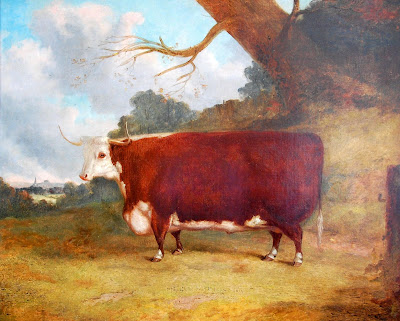
The Bull


This oil painting by an unknown artist hangs in my sister Sarah Davis’s house, in Kingsclere, Hampshire: Caroline, Agnes, Ida and I had lunch with her in the garden there on a warm and sunny Friday: we took The Bull outside too, to be photographed - not easy, because the oil paint is shiny.

The painting was restored by Pippa Jeffries in 2004, at which time its handsome gilt frame was mended also. On the front of the picture are the words 1st prize 15L [fifteen pounds sterling] & silver medal to the breeder, Birmingham 1865. On the back is written P. Davis, Bickmarsh.

Little is known about the Davis family’s origins. Peter was born in 1812 at Dean Park, just outside Burford in the very South of Shropshire - just North of Tenbury Wells, which is in Worcestershire. He was the son of a farmer, Samuel Davis, and of his wife Elizabeth née Reynolds. The 1851 census records the village of his birth, but the Burford Parish registers do not list his baptism.

Peter had two elder brothers: William (born 1805) carried on farming at Dean Park on his father's death, as did his son (another Peter) after him – until he lost his money, having invested it in South American silver mining shares. Our Buckinghamshire cousin Mike Davis is that Peter's grandson.

The second brother, Samuel, baptized at Burford on 2nd January 1910, went up to Cambridge University. Following ordination, he lived most of his life in Devon, as Vicar of Burrington. He was said to be of simple, sweet disposition and fine presence, much revered in the neighbourhood. He married three times having met all his wives on the same day (the second being the sister of the author of Lorna Doone, R.D. Blackmore).

The brothers had two sisters, Carolina, who died young, and Eliza, who married twice: she had four children, but I have no knowledge of any living descendants.

On 8th June 1835, Peter set out on a journey from his home, “Park” - to Edinburgh. The round trip lasted till 22nd June. I have a copy of his diary of this journey, transcribed by his granddaughter Edith Howard Freer in 1898. [Later: now published!]

At the time of his father's death in 1837, Peter was living at Burford Rectory. By 7th June 1841, the date of that year's Census, he had moved to The Lodge, Broncroft Farm, Diddlebury, where he was head of the household, aged 29, a farmer, and living with his sister Eliza (then Mrs Trumper - but widowed), two female servants and two agricultural labourers.

In 1842, Peter, or possibly someone else in his family, won the Tredegar prize for the best two-year-old Hereford heifer. The prize, in the form of a silver cup, was passed down to my father, and is now in Sarah's ownership along with The Bull portrait.

On 30th January 1845, Peter (then 34) was married by licence to a girl from a well-established local family, 14 years his junior. Jane Jeffries' and Peter's wedding took place at Pembridge Church, Herefordshire, Peter being described as a Gentleman, a bachelor living at Milton in Pembridge parish. It is strange that all the witnesses to the marriage seem to be from the bride’s extended family. Milton was a farm of about 600 acres, Peter Davis being the tenant.

On 21st November 1845, Jane gave birth to the first of her ten children, a son John Jeffries Davis. 21 months later, a daughter, Gertrude Louisa was born. Laura Jane Meredith Davis (Meredith was Jane Davis’s mother’s maiden name) was born on 15th March 1850. After this, the family moved from Milton Farm, as in the 1851 census they are shown as living at Bromfield, in South Shropshire, near the Herefordshire border. In Bagshaw’s 1851 Directory of Shropshire, Peter's address is King’s Head Farm, which is on the West of the village.

In 1852, my great-grandfather Arthur Henry was born in Bromfield: in 1855, Agnes (known as Lil) arrived, and then Georgina Reynolds ("Reynolds" after her paternal grandmother), known as Ina, was born in 1857. Eliza Augusta was born in 1858, and Constance Alathea (Alathea being a name found amongst members of the Cheese family, from which the Jeffries were descended) on 25th March 1860.

At Michaelmas 1860, Peter took over as tenant of the Bickmarsh Hall estate, Warwickshire, some 45 miles South-East of Bromfield. Why he went so far out of his country is a mystery: perhaps he couldn't find a big enough farm to suit his ambitions anywhere nearer to home. In the 1861 census, he is said to be a farmer of 1,270 acres at Bickmarsh, employing 29 men and five boys. Also living with the family were a house servant and a shepherd.

Another daughter, Flora May ("Floo") was born on 5th May 1862, and baptized with her elder sister Constance Alathea at Bickmarsh on 13th January 1863. Floo and her husband took off for Australia after their marriage - as did a descendant of Constance Alathea, but not till the 1950s: between them we know of nearly 200 altogether, about ten times those of my great-grandfather. (The only other descendants of Peter we know of are via John Jeffries Davis - nearing 100, including Bruce Coates from New Brunswick, and his family.)

There was an annual cattle show at Bingley Hall, Birmingham, very near to where Symphony Hall now stands. The catalogue for the 1865 exhibition (2nd – 7th December) confirms that Peter Davis of Bickmarsh was the winning breeder in the Fat Cattle class for Hereford Oxen or Steers exceeding three years and three months old. The Bull was then three years and eleven months, and had been fed on hay, grass, barley and bean meal, oil cakes, swedes and mangolds.

A William Aldworth, of Frilford, Abingdon, had exhibited The Bull, so the catalogue said. From the 1861/71 Censuses, it appears Mr Aldworth was born about 1809, and owned and farmed 550 acres at Frilford – with a staff of 47! The church in the background of the picture is the parish church of Abingdon. Round Hill (121 metres), one of the Wittenham Clumps, is in the background.

Alice Marian Davis, the youngest child born to Jane, arrived on 8th March 1866, and was baptized at Bickmarsh on 8th April that year.

Peter Davis died at Bickmarsh on 3rd October 1873, aged 62, and was buried in nearby Dorsington churchyard. The local paper described him as One of the leading agriculturalists in this district. His imposing gravestone (highly polished red granite) is engraved: This tomb was erected by many friends as a memorial of their esteem and affection. Peter left no will: the grant of letters of administration says that his effects were worth "under £8,000". When his wife Jane eventually died on 18th June 1891, she was buried in the same grave, and a further inscription was added.

So there we are.

Friday, 29 August 2008

Cloning about


This sign adorns an art gallery in old Nicosia: we were there in February 2005: I have been looking for a opportunity to use my photograph of it, and now I have one.

I withdrew some cash at a hole in the wall in Gloucester last week: alas, I chose the wrong one. The telephone rang yesterday, a call from my bank: "€1,750 has been withdrawn from your account by someone in Italy: have you been visiting there?" the voice asked.

Apparently the devices that are used in order to clone bank cards are now so midget that you just don't notice them, however hard you look. And I always do look.

Thursday, 28 August 2008

Over the Severn Vale


This has been a Summer's day - at last! We drove to Malvern for a walk on the Hills with our friends Margaret and David Bryer, who live high up on the East-facing slopes. The path from their house leads through old woodland, some ash and sycamore. We emerged into scrubland, and then a panoramic view over Herefordshire towards the Black Mountains. It was hazy, so we could hardly make out Hay Bluff, but the Marcle Ridge stood out clearly enough. Walking South, we skirted Pinacle Hill, pausing to look towards the British Camp and Midsummer Hill before returning for lunch on the Bryers' terrace - from where I took this photograph.

It shows the Three Counties Showground, with Bredon Hill and the Cotswolds behind. We spotted Pershore Abbey and Worcester Cathedral, and Croome church which we visited last month. A great view - but coming away we agreed that we might prefer not to live on so steep a slope: David has to take considerable care when cutting his grass not to cut his feet as well.

Wednesday, 27 August 2008

Thomas


Thomas celebrated his birthday yesterday. In Lisbon.

He moved there a couple of weeks ago, and is busy looking for a flat - with a good view over the river. He seems to have his IT pretty well sorted, as calls to his London business number go directly through to him - at no extra cost to the caller apparently. The next challenge is to learn some Portuguese, but meanwhile he is busy enough with work for his English clients.

Neither Caroline nor I have been to Portugal: we are planning a visit in November - assuming our sale board still remains up. The Thomas Cook European Rail Timetable arrived on the doorstep yesterday, together with a map of all the train lines indicating the scenic routes. A fascinating read, although, as Conan Doyle wrote about its predecessor, "The vocabulary of Bradshaw is nervous and terse, but limited. The selection of words would hardly lend itself to the sending of general messages."

Monday, 25 August 2008

Lunch at The Blue Zucchini


Our good friends Sarah and Helena Priday invited us out yesterday, to The Blue Zucchini in Tetbury. The conversation barely parted from the topic of music, even after Sarah had left early, on Bampton Opera duty. We seemed to be surrounded by excellent raconteurs. Two of the other guests turned out to have been employed by the impressario Victor Hochhauser in a past life: many were the stories that came gushing out about their years working with him, his wife and the rest of their very distinctive cadre. "There was the time," said one, "when Mstislav Rostropovich started tickling Victor, who ran round and round the office laughing helplessly, trying to escape and crying Oh do stop Slava!"

As you may imagine, we were easily the last party to leave the restaurant.

rus in urbe


It's Bank Holiday weekend, but why join queues of cars on the road? I did venture up to Greenbelt last evening: amazing crowds, transforming Cheltenham racecourse for the weekend; but going for the evening only, I felt more a tourist than a pilgrim. (John Bell of the Iona Community impressed me as a speaker; and it was good to talk to those on the CEL stand.)

Yes, here we still are, in Cheltenham. The sale board remains up, but it's more than a fortnight since anyone came to look at the house. On a rare dry August Saturday, Ida (aged 10 months), having discarded a sock, sits under the russet tree to eat her lunch... and gets her beans in a row.

Saturday, 23 August 2008

Rory

Caroline, Agnes (and Ida) and I all went to see Rory Morrell's exhibition yesterday, at the Cheltenham School of Drawing and Painting, which he runs. It was a large show, filling three studios. There was a great variety of charcoal life drawings, all beautifully wrought. There's even one of Agnes, who has sat as a model for the Cheltenham School in the past.

But we also very much liked the oil landscapes of scenes near The Lizard and in Portugal. I fear not enough people knew about this excellent exhibition: there weren't that many red dots. This bit of publicity is too late, as the show closed yesterday evening.

Rory also showed me a folder of photographs he has taken: some of them are worthy of exhibition in their own right. As always, he was overly modest about them.

A quarter of a mile away, in the Gardens Gallery, Pam Stone has a solo show, contrasting but also worth seeing: some quite impressive portraits in a variety of media. That's on till next Tuesday evening, 26th August.

In London, Birmingham or Bristol, either of these shows would be getting quite a lot of attention: as Caroline always says - there's never much of a buzz created by anything here in Cheltenham.

Friday, 22 August 2008

Glorious Gloucester


Clutching my wonderful bus pass and a sandwich, I set off for Gloucester yesterday with a view to exploring the County Records Office. That will have to wait till another day.

I was sidetracked by the Cathedral: just before I left home, Sarah Loveday had arrived, and said I should drop by the Cloisters to look at Diana Green's Creation & Fall etchings, which are on temporary display. So I did (and admired them); which led to an amble round the Ambulatory and into the Lady Chapel. I realised that, in spite of many previous visits, I was looking at much of what I saw for the first time.

An hour or more had passed when a Steward walked by. "Was I joining the Tower Tour, starting in five minutes?" "No," I said, but then thought, "Why not?" The tower of the Cathedral is visible on almost any walk around Cheltenham, but I had never climbed up it.

The guide on duty - it happened to be a friend of ours, Sue Hamilton - does not it seems share my fear of heights. Intrepidly she led us 175 steps up to Great Peter (which strikes the hours), into the adjacent Ringing Chamber, and up again past the ring of twelve bells. Finally, we emerged onto the roof, and there we were, in driving rain, 225 feet above the Cathedral floor.

The view is of course amazing, even on a day like yesterday. When taking the photograph above - there are some more in a web sequence beginning here - I was pointing the camera West over the nave. In mediaeval times, the River Severn would have been visible flowing from right to left in the top of the picture. The West walk of the Cloister is visible at the bottom right, and beyond it the half-timbered building is where Richard II is thought to have held his Parliament of 1378.

To its left is the former Deanery. Caroline's great-great-grandfather Dean Edward Rice, who held office for 36 years, would have lived there with his 12 children: he kept chickens in the Cloister garden, according to Tamara Talbot Rice's autobiography. Sue Hamilton said there were still chickens kept in a roof garden somewhere in the Cathedral Close: I didn't spot them.

At that height, you cannot help thinking about the faith of the monks who organized such a tower to be built 550 years ago. On the bus, I was reading a newspaper article by a professor of philosophy under the headline "The rise of Milliband brings at last the prospect of an atheist prime minister." God save us!

Thursday, 21 August 2008

The Victorian age


Our friend Terry Murphy once told me of a question put to him by Tamara Talbot Rice (the then widow of Caroline's cousin David, the Byzantinist). Tamara never lost the art of rolling her Rs, having been born (before the Revolution) of Russian parents.

"Do you suffer from the tyranny of fruit?" she asked, making "tyranny" sound like a cat's purr. Well, our Victoria plum tree is weighed down with fruit this year, and it's not a time to be away from home. Each evening I run the gauntlet of the local wasp population in order to pick the plums that are ripe. And end up with red fingers from stoning the fruit. Caroline is already asking whether she has enough room in the deep freeze.

The deal as we arrived here was for builders to come and erect a bungalow at the rear of our house: they yanked out an old apple tree in order to provide the driveway. The best investment I've made was planting our two plum trees to take its place.

Bredon and Overbury


Colin and Jessica Russell generously took us out to lunch yesterday at the pub in Bredon. Very good it was too. Although it's only about 10 miles from home, and we must have driven past on the M5 a hundred times, I had never before discovered what went on in the village itself.

It seems Bredon has quite a number of houses of character, as well as the Tithe Barn and St Giles' Church - two stars in Jenkins. I photographed (see above) one of the scenes depicted in a locally-made tapestry which hangs in the nave of the church. It tells a story, along the lines of the Bayeux Tapestry. A monastery was founded in Bredon in AD 716: its Abbot Tatwin – splendid name! – became one of the earliest Archbishops of Canterbury. But in the mid-ninth century, Vikings sailed up the adjacent River Avon, burning the monastery and murdering or deporting the monks. A touchingly related tale: Burma in 2007 had its precedents.

After lunch we drove a couple of miles East. We had made an appointment to visit the garden of Overbury Court, which is in the Yellow Book. Again, we had driven past many times, but I had no idea what lay behind the high Cotswold stone wall that runs beside the road round Bredon Hill.

Until we caught sight of the enormous, partly-ornamental swimming pool in front of the house, it felt rather as if one was back in the 18th Century. Here we were, permitted to stroll in this beautifully landscaped garden, and to admire the prospects towards the Hill and Southwards to the Cotswolds. Nobody else was about – not even one of the three gardeners that it hardly surprised me to hear were needed to look after it all.

It wasn't a surprise either that it should start raining hard before we had seen it all, given what a wet month this has been. We took refuge in the pretty village church, St Faith's – an unusual dedication. It stands just alongside the garden. The narrow nave is flanked with fat, squat Norman columns, each adorned rather incongruously with what look like bedside lights. I liked the 11th Century goblet-shaped font, with strong carving. At the other end of the historical spectrum, there is Victorian stained glass with unusual subjects: Jesus stands barefoot in a garden, weeping at the death of Lazarus: a richly-clad Noah cradles his ark, which appears to be fitted with gun ports. Was he expecting Vikings?

Tuesday, 19 August 2008

OurSpace


This wide-angle photograph was taken looking South-Eastwards from our house yesterday evening. You can just see, on the extreme left, a branch or two of an old russet tree - always quite productive . Then comes a rather straggly Buddleia davidii: I didn't cut it back hard enough last year. To its right is our very vigorous rosemary bush, with a heavily-laden Victoria plum tree behind it - more about that anon. Behind that is one of our outbuildings, and the neighbours' coach house. You can see a line of climbing and rambling roses, Winter honeysuckle and Philadelphus: I planted these along our boundary when we arrived here in 1995. On the far right is the corner of the next door house.

Dominating the centre of the photograph is a Wellingtonia in next door's garden: home to much birdlife, but standing at quite a disconcerting angle I always think. And above it all, a marvellous double rainbow.

Monday, 18 August 2008

The Proms


This time last year, Leo, Mini and I went to the Proms: it was Mini's first experience of the Royal Albert Hall. They both so enjoyed it that they were there again last night. Leo came to tell us about it this evening: they intend to go every year, he said, and I bet they will.

Last Thursday, Caroline and I were lucky enough to be at the Albert Hall too, invited by our old friend Caroline Holbrook, who goes frequently from her home near Newbury. That night the concert was given by the West-Eastern Divan Orchestra conducted by Daniel Barenboim. This orchestra has become an institution in less than a decade, since its founding by Barenboim and his close Palestinian friend, the late Edward Said. It inspires not just musically, but in the way it represents the hope and real possibility of a peaceful future for both Israelis and the Palestinian people. Not a yarmulke or a hijab to be seen! And the orchestra played - besides Haydn and Brahms - music by the Jewish Arnold Schoenberg together with, as an encore, the Meistersinger Prelude by Hitler's favourite composer, Wagner.

Daniel Barenboim conducted the whole programme from memory. In my early '20s, when I was an articled clerk in the City of London, my principal invited me to sit in on a meeting that a certain Enrique Barenboim had arranged with him, to discuss his son's tax position. That son, about my age, came along too: his name was Daniel. I remember nothing at all about the content of the meeting; but I have always followed from afar, and admired, Daniel Barenboim's public achievements.

Sunday, 17 August 2008

Animula vagula blandula


Half a century ago, almost, I was set to learn the poem of which this is the first line. It didn't mean much to me then, nor could I have told you who wrote it. But it's up in large letters at the British Museum, as part of the Hadrian exhibition. It came back to me when I was ploughing through Margaret Yourcenar's historical novel before last month's meeting of our book group; and again on Thursday, when Caroline and I visited the exhibition. It's well worth seeing: on till 26th October.

Hadrian wrote these verses contemplating his life's end, when he clearly sees the soul as departing in a different direction from the body. But where? Becoming Emperor less than a century after Jesus's crucifixion, Hadrian was relaxed about the Christians, but there is no evidence that he entertained Christian beliefs to help him answer that question.

Still less did Hadrian embrace Judaism: indeed, his harshest treatment was reserved for the Jews. On display in the BM Reading Room is a house key. It belonged to a Jew who had fled his home to take refuge (with many others) in a cave: trapped there, he was butchered to death. Hadrian's savagery contrasts with his love of beauty in so many of its manifestations. In the same way, Radovan Karadžić also wrote poetry; and Hitler loved Wagner's music.

My photograph shows Hadrian's lover, the beautiful Greek youth Antinous. He drowned in the River Nile on the day Egyptians were commemorating the death of their god Osiris - from drowning in the Nile. Hadrian had Antinous portrayed here as Osiris, suggesting that he too was reborn as a god from the waters of the Nile.


This statue was found more than 250 years ago during excavations at Hadrian's Villa, near Rome. Only last year, a huge, undamaged head of the Emperor himself was uncovered in Turkey: this magnificent object is the first sculpture you see when you enter the current exhibition. And last week I read in the paper that there were sarcophagi of the same era found, which had been buried up near Hadrian's Wall. How many other discoveries remain to be made?

Saturday, 16 August 2008

tête à tête - The Opera Festival


Riverside Studios, on the Thames at Hammersmith, has been hosting a fortnight of fringe opera, under the enthusiastic artistic direction of Bill Bankes-Jones. The Festival ends this weekend with a visit from Scottish Opera. (They bring five recent works, including one I see directed by Ida's Godfather Frederic Wake-Walker.)

Caroline and I went along on Wednesday evening to sample what was on offer, meeting up with some old friends. It was a heartening experience, particularly after the disappointment I felt with some contemporary music at this year's Cheltenham Festival. Committing oneself to a full evening of Birtwistle, Adès or even Adams requires courage; but everyone it seems can hope to enjoy something during a session with tête à tête at the Riverside.

We saw no less than seven operas, including some work in progress. The excitement began with a snippet about the travails of a knife thrower's assistant, rather splendidly staged in the Riverside's foyer. Just as we were wondering when it was to end, the "orchestra" (which consisted of an electric keyboard) collapsed onto the floor.


Next up, on stage this time, was a little two-hander, one of the singers spending the entire performance in a "zorbing" pod.

This has to be a first, but (like the foyer number) it may also be a last. "Flam", which followed it, composed by Orlando Gough (one of the founders of The Shout), is an altogether more weighty piece. This entirely a cappella music drama was performed with great virtuosity by Rebecca Askew and (see my main photograph) Melanie Pappenheim, together with Michael Henry. With its faint echoes of the Oxen of the Sun, "Flam" will I'm sure be seen elsewhere. It might spoil your fun if I told you the plot.

Size Zero Music Theatre's two offerings were less successful. Though the Manchester-based company shows some potential, better material needs to be found. Before this, though, there was a delightful duet by members of the tête à tête company between an archetypal Prince Charming and his Sleeping Beauty - Snow White - Little Red Riding Hood (all rolled into one): this holds a lot of promise for when more worked up.

Finally, the weird and wonderful Carysfort Stories: this was not so much opera as bitter sweet jazz revue, performed by Georg and Thomas, a couple of Austrian buskers, along with Loré Lixenberg.
The set featured a bar stool, on which two silent women took turns to sit, and a tent, illuminated from behind. All the performers live in or near Carysfort Road, Stoke Newington, from where they brought along this rather low-key drama of local life: Lake Wobegon comes to London. The versatile Loré Lixenberg confined herself to the tent throughout, declining to emerge even for a well-earned curtain call.

This was an appropriately bizarre end to a long evening, throughout which energy levels remained high. It has to be amazing value for £25, inclusive of supper in the buzzy Riverside Studios café, a true festival atmosphere.

Friday, 15 August 2008

The Courtauld Cézannes


Caroline's friend and former colleague at the Courtauld Institute, Bob Ratcliffe worshipped Paul Cézanne, and was one of the acknowledged experts on his work. Caroline, who worked in the slide library, accompanied Bob on trips to record and photograph exhibitions, Bob with a thermos bag for keeping his film at exactly the right temperature, so as not to jeopardise accurate colour reproduction.

The Courtauld Institute's entire collection of Cézanne's work - unique, at least in Britain - is currently on show at Somerset House (till 5th October). For the catalogue, John House, one of Bob's students, has written an eloquent appreciation, dedicating the exhibition to Bob's memory: he died last year. We have been in London for a couple of days and it was fitting that our first stop on arrival should be Somerset House.

Quite apart from the magnificent Cézannes, I always like visiting the Strand, since having worked near there when I was a newly-qualified solicitor; and it is a particular pleasure nowadays to be able to see both outside and inside Somerset House, with its elegant rooms (see the Degas sculpture gallery - below) and amazing staircase (above).

Monday, 11 August 2008

"Prinknash treasures"


This is the title of a loan exhibition at Simon Chorley Art & Antiques, Prinknash Abbey Park. You can only catch it until 14th August though. I recommend a visit.

It was news to me that the monks of Prinknash, always rather a low-key bunch as I perceived them, possessed so many beautiful objects. But a number of the monks have been - indeed are - artists, with friends and patrons who have acted as benefactors over the years. One member of the Community (a noted potter and stone carver) was the son of the cartoonist Heath Robinson: three of his delightful paintings featuring the monks are exhibited.

Moreover, the founder of the community at Prinknash itself was it seems a devotee of the Arts & Crafts Movement. This lovely Madonna and child on marble is by Eric Gill: I loved seeing traces of the censoring hand (shades of Silvio Berlusconi's Tiepolo) which applied the masking tape to Mary's right nipple!

Gill was also responsible for the rather severe drawing of the first Abbot of Prinknash, Wilfred Upson - left, below: Abbot Wilfred seems a little less daunting in William Rothenstein's seated portrait (right, below).

The tape residue and the crack across the Eric Gill tableau say much about the state of the "Treasures". Tender love and care has at some stages perhaps been in short measure; jewel-encrusted chalices could do with a polish, and if the caption wordings were expanded, that would assist those less familiar with the whys and wherefores of ecclesiastical hardware. The current Benedictine Yearbook lists only nine priests at the Abbey now, which must be part of the explanation. And anyway today's monks might have other priorities than to spend all their time maintaining the ornaments of a past era - which ties in with the substance of my controversial post of last Monday.

Nevertheless, there is a great deal to surprise and admire. For a Monday morning, the exhibition room was pleasantly full. Had the show been mounted - as well it could have been - by the V&A, thousands - rather than dozens - would have been delighted through paying a visit. There is still time!

Thanks to Simon Chorley's generosity, all proceeds from the exhibition go to the NSPCC.