Showing posts with label the Ring Cycle. Show all posts

Thursday, 1 August 2013

Guiting again


Mini said last evening, before our customary date attending the Guiting Festival, "Being here always reminds me that the end of Summer is approaching." Well, as if to contradict her, today it's been hotter than ever - and even now, late in the evening, it's still 21 degrees C.

However, yesterday - though it wasn't cold - the sun resolutely refused to sign for our pre-concert picnic, which was a pity, but it in no way diminished the pleasure of the performance by the Carducci Quartet. Here were Emma Denton, Eoin Schmidt-Martin, Matthew Denton and Michelle Fleming after a memorable performance of Mendelssohn's last quartet - ending a recital which deserved (but sadly didn't get) a full house. ("There's just too much music!" as a friend said.)

The three string quartets (Haydn and Ravel before the interval) took less time to play through than one Act of the Ring Cycle, which no doubt explains my surprise that it all seemed to be over so quickly.

Monday, 29 July 2013

Ring Cycling


It would be interesting to work out how many miles I cycled during this last week that I've spent in London. I visited Wandsworth, Maida Vale, Camden and Southwark, and much in between: rather satisfying, to be seven days in London without a freedom pass, but still paying nothing to get around. The chief hazard I identified was not from buses or lorries, but those fellow cyclists who zoomed past at twice my speed.

It's hard to imagine that 2013 will bring me a greater musical experience than the Proms Ring Cycle, which reached its conclusion last night in a packed and hushed Albert Hall. Too often in the theatre applause breaks out the second the curtain falls, without any savouring of the drama: Barenboim though held us spellbound, not just throughout the five and half hours of Götterdämmerung, but for a good few seconds following the final bar of music.

"It ain't over till the fat lady sings" goes the saying; which while true enough on Saturday, can't be said of this Götterdämmerung. Nina Stemme's physique gives no inkling of her vocal power - a superb Brünnhilde; and matched by the best Siegfried I've come across: Andreas Schager - a great actor with a heroic voice. How rare is that!

"Don't you get bored with seeing The Ring so often?" I'm asked. Far from it! Each time there's something you haven't noticed before. One of my favourite themes is that describing Freia's essential contribution to the vitality of her fellow Gods. "Golden apples grow in her garden," sings Fafner. But the same theme occurred last night when Hagen described his blood as "obstinate and cold" (in contrast to the "pure and noble" blood of Siegfried). And Brünnhilde's refusing Waltraute's request to give up Siegfried's love (or rather its token) is accompanied by the music first heard in the opening scene of Das Rheingold to illustrate the renunciation of love in very different circumstances.

Nobody goes to Götterdämmerung for the jokes, but those of us standing tightly-packed in a stuffy Proms arena could be forgiven for a snigger at Siegfried's words to an off-stage Hagen: "Come down! It's airy and cool here."

From left, my photograph shows Margarita Nekrasova (1st Norn), Schager, Anna Lapkovskaja (Flosshilde), Stemme, a sombre-looking Barenboim, the great Waltraud Meier (2nd Norn and Waltraute), Mikhail Petrenko (as at Cardiff in 2006, a Hagen to be feared - he received a pantomime "Boo!" at his curtain call), the ROH Chorus Director Renato Balsadonna, Maria Gortsevskaya (Welgunde), Aga Mikolaja (Woglinde) and Gerd Grochowski (Gunther).

Sunday, 28 July 2013

Tristan und Isolde


If it was a mistake to go to the Proms last night, mid-Ring Cycle, for something different (albeit by the same composer), then it was at least an interesting mistake.

The sound world of Tristan und Isolde is shockingly abstract (compared even to that provided for Siegfried and Brünnhilde in the final scene of Siegfried). The opera moves along steadily in one great sweep: not a lot happens, but the undercurrents are immense. And it requires concentration, which it's harder to give when standing, as I was (mostly) last night: for the Ring, I've had, to date, the luxury of a box seat, so one can be comfortable, even jiggle round a bit.

Semyon Bychkov is no stranger to Tristan, but one feels the difference between his BBC (big blaring chords) Symphony Orchestra and the not-in-the-least Ring-rusty Staatskapelle Berlin. It seemed a performance with far lass sensitivity to the singers - or was it just less good singers? No, I think not. Two in particular shone out: Kwangchul Youn as King Mark and Mihoko Fujimura as Brangäne. Worth being there to hear them alone! Not that you can go wrong hearing any live music @ £1 an hour.

The photograph shows Robert Dean Smith and Violetta Urmana (in the name parts) with Bychkov.

Saturday, 27 July 2013

Siegfried


A large black BMW passed me in Queen's Gate this afternoon, as I biked towards the Albert Hall. "NOT 2B" was its number. So, to while away the time during parts of my least favourite Ring segment, I counted the "Not to be" moments in Siegfried. Mime's plot to get hold of the Ring; Fafner's intent to live forever sitting on his horde; the Wanderer's bid for useful information from Erda, and then his attempt to bar the young hero's way to Brünnhilde; and finally her realisation on awaking that immortality was no longer to be.

"Least favourite" it may be for many - I spied empty seats around for the first time this week - but there are still many magic moments. The break the composer took at the end of Act 2 explains the thrilling gear change you always experience at the outset of the Act 3 Prelude. Last night, the hair at the back of my neck duly stood on end then: one would expect nothing less with this wonderful orchestra on the stage.

Barenboim's relationship with all its members is not always easy to fathom: there was another of those curious frissons last night, again at the end of Act II. Was it bashfulness or defiance, the first horn's failure to come on to acknowledge applause? He deserved the belated recognition Barenboim gave him - not just for his playing of the famous dragon-awakening call, but for carrying on undaunted by Lance Ryan (the boy hero) prancing around at his side, a splendidly surreal (two days running, that word) bit of theatre.

Generally Ryan looked the gawky part, and came into it, vocally, in the final scene, which ended with the audience fully bathed in golden love-fest light. Did he deserve his Brünnhilde? Well, to my ear Nina Stemme wasn't on such fine form as on Tuesday: it will be interesting to hear her on Sunday. the big one.

The other singers were excellent, dramatically and vocally, especially Kränzle as Alberich: his duet with Stensvold's Wanderer at the start of Act 2 was a highlight. And it makes such a difference, being in a hall light enough so you can follow the libretto when you want to - far preferable to straining at surtitles. How great too, not to have production values to complain about! ("There are two Rings taking place here: one by Castorf and one by Wagner." Thus Martin Kettle sums up this year's new Bayreuth production.)

Thursday, 25 July 2013

South Banking


In Ring terms, yesterday and today are holidays, and I'm enjoying a little London leisure. The night-time rain has cooled things down, so making it more comfortable to cycle around. Southwark Cathedral hosts an inter-faith exhibition this week, put on by our good friend Sarah. That made something to aim for: it was an added bonus to find a steward who knew all about the Cathedral's stained glass. Much of it is C.E. Kempe, and indeed there's a memorial to him in the South transept. I admired the colourful Henry Holiday window at the West end also (complete with a panel which seems to depict the Rhinemaidens: you can't get away from it!). The Cathedral, wedged in between railway lines, is now of course dwarfed by the Shard.

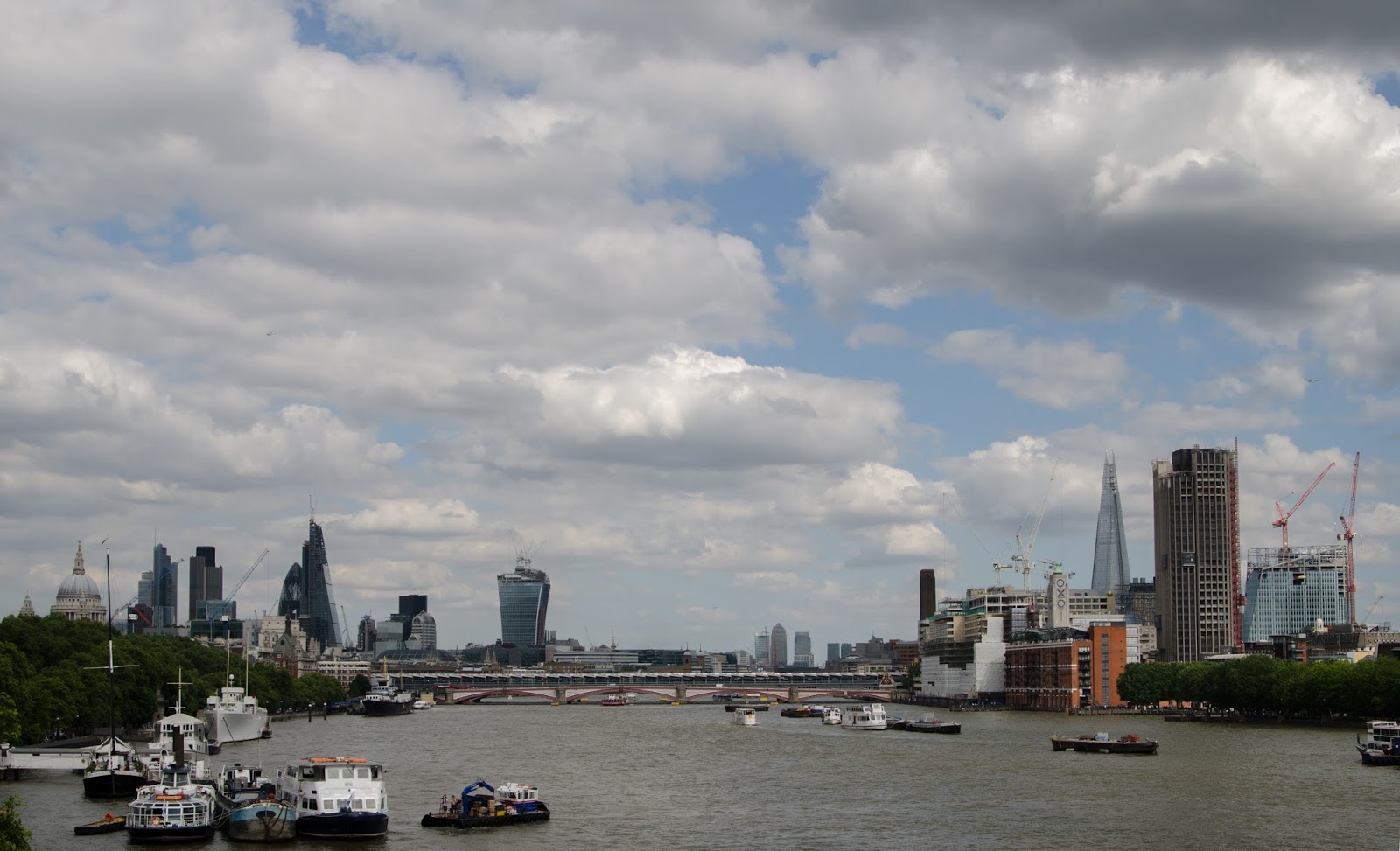
From London Bridge, I pushed/rode my bike three miles upstream along the Thames path: from the dry dock that's home to Drake's Golden Hind (such a tiny vessel to have circumnavigated the globe all those 400+ years ago!) to the brand new St George's Wharf development at Vauxhall. Most of the way was thronged with people enjoying themselves: drinking mainly, but also playing on the shore or on the artificial beach outside the Festival Hall; learning from the brilliant garden exhibition by Hungerford Bridge; watching jugglers, acrobats and limbo dancers; browsing the book stalls by the Film Theatre; queuing for the Eye; photographing each other against the river backdrop, and proselytising - my ear was bent for ten minutes by a young man from South China, who worshipped at All Souls Langham Place and made it his - or rather the Lord's - business to accost people sitting in the pleasant gardens outside Tate Modern on his way home from work every evening (so he told me).

You don't get the feeling that Austerity Britain means much here.

Wednesday, 24 July 2013

ValhAlbert


I toyed with the idea of shutting myself in my study at home, and listening to the first Proms Ring Cycle on Radio 3, but I'm glad I decided otherwise: it's memorable, to put it mildly, being in the Albert Hall with so superb an orchestra, under a conductor who knows the score backwards (and for all his jewishness is self-evidently a Wagner lover), and a magnificent cast.

After Das Rheingold on Monday, the comment from next door was about how they might have acted more. I didn't mind that - though it was a bit uneven (some acting more than others). I particularly liked Loge in an MCC tie evoking the Ashes: "Spür' ich lockende Lust sie aufzuzehren." ("I am strongly tempted to burn them up.")

After last night's Die Walküre there could have been no such complaint, surely, about lack of drama. Notung was - hinted Sieglinde - embedded in Henry Wood's bust; the dead duly lay down and the sleeping were carried off (which was a pity, as Loge's ring of fire - summoned by Bryn Terfel with three first class stamps of his patent leather shoes - ran round the orchestra and a bare stage).

But no carping allowed! This was quite simply the best Die Walküre I've ever heard.

Tuesday, 8 January 2013

High definition performance


It was Kenneth Tynan who coined the phrase "high definition performance". Tonight's Film Society film, last night's Royal Opera live stream and Sunday's Something Understood all come under this useful heading.

The Iranian director Asghar Farhadi won plaudits at the 2011 Berlin Film Festival for A separation: I had meant to catch it when it first came out, but failed. It was well worth waiting, though, for its superb screenplay and mesmerising acting. Only at the end, when music plays, do you realise there has been none throughout.

Music aplenty though from the Royal Opera House throughout yesterday, during the 10-hour live stream of backstage activity, available through theguardian.co.uk/music and thespace.org. We only watched a little until the evening, when we were rivetted by the relay of the whole of Act 3 of Die Walküre.

And Mark Tully's Something Understood is always worth listening to, but this week on "Dignity" he was on specially good form, particularly with his main interviewee, an eloquent Buddhist.

Tynan wouldn't have marked our High Street accordionist with "HDP", but I have recently been enjoying one particular tune he keeps playing. I don't know what it's called - we correspond in smiles, as he's from Hungary and speaks no English.

Saturday, 5 January 2013

War horse


Les Troyens is on this evening, relayed from the New York Met. Caroline and I went along to our local cinema at 5 o'clock, plus picnic, ready for the five-hour big screen session; but by mutual agreement we came away at the first interval. After eating the picnic round our kitchen table, I find I'm much happier listening to Berlioz in the warmth of my study.

In the 'Sixties, I was an avid fan of this composer: Benvenuto Cellini with Nicolai Gedda was one of my earliest experiences of opera at Covent Garden; and three of us drove specially to Edinburgh in May 1969 to hear Janet Baker sing Dido in Scottish Opera's Trojans. This evening, though, in Cineworld I was bored. Was it the production, the singing or the music? Perhaps a combination of all three.

The ghost of Hector's appearance in a puff of pantomime smoke, stock still and dressed in white on top of a cave, with Aeneas kneeling below, brought the Grotto at Lourdes awkwardly to mind. Deborah Voigt as usual seemed unable to stop smirking, unfortunate when you're playing Cassandra.

Yesterday, we came to the end of the Radio 3's relay of the Ring Cycle in 10 instalments (a recording of the Covent Garden production last Autumn). As then, I listened to pretty well every bar; and that probably explained why tonight's rumpty-tum Berlioz left me squirming on my cinema seat.

Thursday, 25 October 2012

The thick of it


I took this photograph in 1999, when we were walking along a strada bianca near Pienza: it hardly does justice to the lichen, an extraordinary colour. I remembered it this morning, as I caught up with the latest goings on in The thick of it. It really does get better and better - and in the whole hour of this bumper episode there isn't a single F word (well, in direct speech anyway). How do they keep a straight face?

I couldn't watch it on Saturday as we were at the Parabola Arts Centre, where they were showing a recording of the Royal Opera's 2011 Tosca: a great cast, and - still more important - Antonio Pappano conducting. Before we went out, there was another Royal Opera House recording on Radio 3: Otello, Pappano again conducting. And earlier in the day, I'd been catching up on the Covent Garden Ring. Conductor? Pappano again.

Caroline's week-long Wagner widowhood ended last night. The highlights of this Ring for me were Act 2 of Die Walküre, with Sarah Connolly outstanding; and Act 2 of Götterdämmerung last night - Tomlinson terrific as Hagen, notwithstanding that wobble: only to be expected in a 66-year-old. (What contemporary relevance in the Prologue too - with all the Norns' talk about ash dieback.)

Are there other operas besides Tosca and Götterdämmerung where all the principals end up dead? (Is there a post on my blog containing more hyperbole?)