Showing posts with label apples. Show all posts

Tuesday, 30 September 2014

September's end


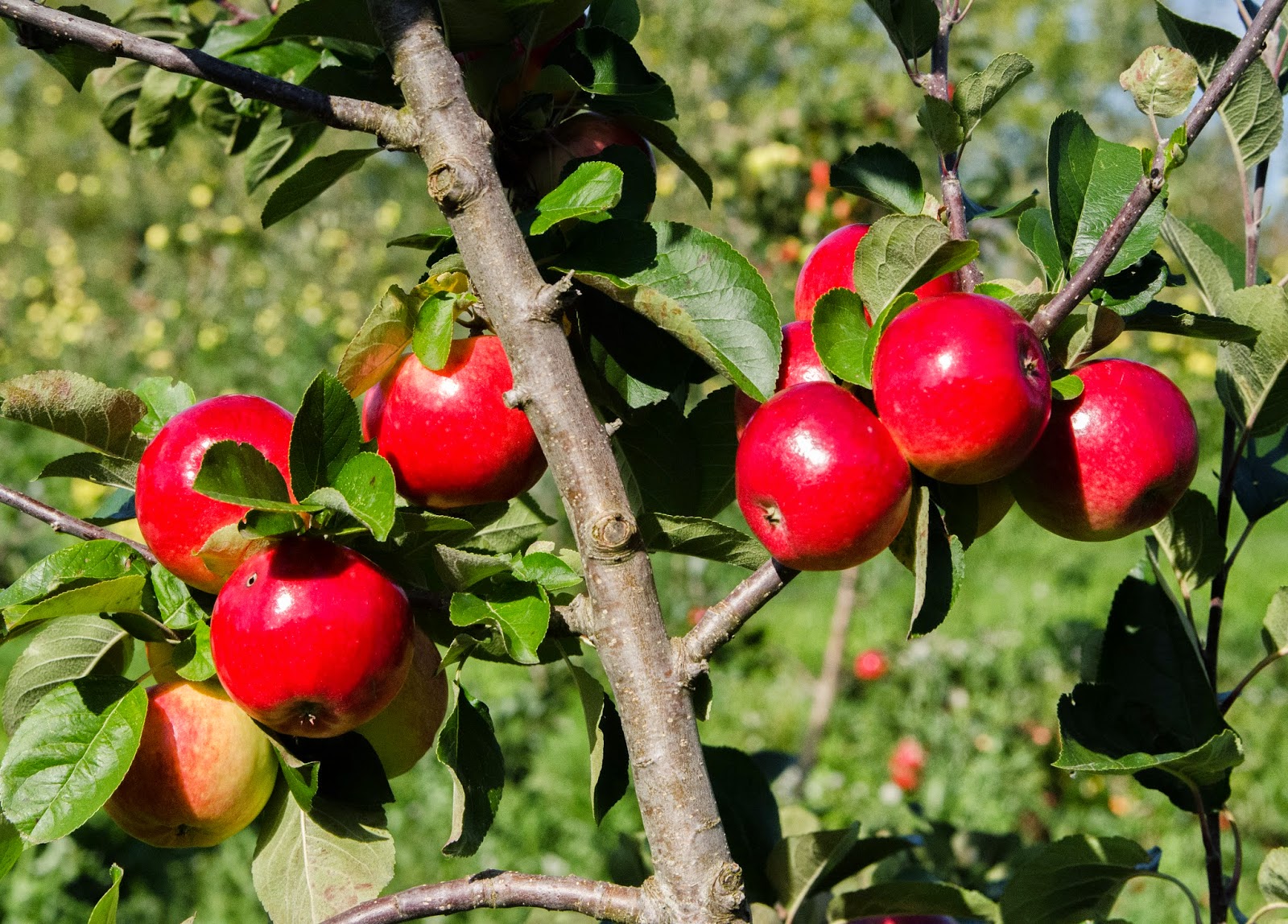
It's been a great month for sunshine, which continues today, and it's still sleeveless shirt weather. Raspberries fruit still in the garden, though the big apple trees have been poor this year. Those photographed in Prue Cooper's beautiful dish on our kitchen table are from one of the heavily-laden little trees.

Monday, 8 September 2014

Severn and Wye


I took this photograph, walking through the orchards of Corse Court Farm, just West of the River Severn, this warm afternoon. (We are enjoying an Indian Summer.) The adjacent St Margaret's Church, Corse must be one of the remotest from its village in Gloucestershire. To have gone round by the road would have meant a long detour, so we walked across to it. It's an idyllic setting, but there is nothing very remarkable about the interior, save for an excellent set of boards explaining about the Chartist Movement. One of five rural utopian communities was briefly established in the neighbourhood in the late 1840s, to my shame not something I knew much if anything about.

Earlier, we had driven just beyond Ross, and I found myself looking down on the River Wye, glistening in the sunshine. Away from the A40, you are soon in narrow lanes with high hedges. Good brakes are needed - and (my advice for the driver of a Chelsea Tractor we encountered) it does help not to be on the phone.

Sunday, 19 January 2014

Foucault's pendulous


By way of explanation of this laboured post title - more laboured even than usual - "floppy" is said to be a synonym for pendulous. And flop the blind cat, Foucault certainly did, onto his master's lap last night after dinner. Though it was the six of us who had eaten so richly in one of Cheltenham's more elegant basements, not necessarily the cat.

This photograph of a distinguished contemporary of Frank Auerbach, Bridget Riley and Peter Blake might or might not be recognised by him as a tip of the hat to Mr. and Mrs. Clark and Percy.

Our host was in sparkling form considering he underwent major surgery last year, but he told me he had felt less anxious about that than the recent hassle he'd had over renewing a tax disc. "Into thy hands I commend my heart."

I've been anxious about pruning the apple trees. A couple of years ago, the experienced Martin Hayes began to take them in hand: today another Martin has been my generous guide. It's really a question of summoning up the confidence to tackle what's a huge task, when trees have been let go like ours have.


Sunday, 3 November 2013

Live from the Oluvvier


50th birthdays undeniably deserve to be celebrated properly, and last night's 150-minute live relay on BBC2 served as a very proper big birthday bash for the Royal National Theatre.

Most of those still alive who have, over the half century, given greatest service upon the RNT stages were there: many of the famous dead (Olivier, Gielgud, Richardson R., Scofield) were brought back to life through film clips. As the evening galloped along, Caroline and I watched enthralled. Undoubtedly some gobbits worked better than others: the two Stoppard extracts fell flat, compared with a sublimely funny and moving scene from Angels in America, for instance. But it was the French lesson from The History Boys, with its creator Alan Bennett as Hector (a role he never played on stage, so far as I know) that stole the show.

Proper, improper? The good old BBC prefaced its broadcast with a foul language warning: more appropriate would be a foul (fowl?) behaviour warning for Miley Cyrus's recent award ceremony cavorting - but what a great David Attenborough twerk tweak! Unwittingly, old Attenborough, prophetically commenting upon our sad times, may have found himself a new, young audience.

Three of our apple trees must be 50 years old or more: they have fruited this year as if it's a jubilee. I'm off out to climb the ladder and pick more, before the winds blow them all down. This one was photographed at Schofields.

Sunday, 20 October 2013

Laden


My mother gave her son-in-law a Cox's Orange Pippin sapling. She died in 1993, so it is now well established - and this year well loaded.

Besides apples, Bill has several extremely productive pear trees in his orchard: he has rigged up an impressive scratter in his garage, worthy of Heath Robinson himself: this year's resultant juice is well on its way to becoming next year's perry. Bill describes his perry-making activities in this fine piece he has written for his parish magazine; and you can email him via this link if you would like to enquire about buying his perry. (It's delicious!)

Wednesday, 25 September 2013

Troy and destroy


John Bell was the speaker on Thought for the Day this morning. He came on immediately after someone salivating over the prospect of life on Mars. John reminded us that "Adam" meant "earthling", and that the earth does not belong to us, but we belong to it - by decree of its maker.

You feel this when kneeling on warm soil to plant garlic and onions, as I have been doing in this lovely spell of mild weather. Softneck Thermidrome garlic this year, and 500g of Troy onion sets - netted against the birds, who enjoy tweaking the sets out of the soil.

I was slow to fix the mesh tightly round our sprouting plantlets earlier, and the result is a plague of caterpillars. It's either I who go into destroy mode, or they who remain in it.

The Autumn raspberries don't look up to much either, but the late Summer canes (seven foot tall in some cases) are still fruiting plentifully. As are the beans and Caroline's tomatoes and figs. She even presented me with her first melon the other evening.

The back lawn is littered with apples, and both lawns are also littered with rose and other prunings: we need more room in the deep freeze for juice and a couple more brown bins.

I photographed these onions this time last year on our visit to the National Botanic Garden of Wales.


Monday, 31 December 2012

Ballerina Flamenco


This is the name of the maiden apple tree Agnes has given me: it's for my birthday last May, but it only arrived a short while ago. That was in the middle of our cold spell, when the ground was frozen. Since then, it's hardly stopped raining, but the last day all the grandchildren are with us is today, so out we all went with the spade to dig a hole in the back lawn. Soil strata, worms, horse manure and blood, fish and bone mixture - all were subject to much comment amongst the three five- and six-year-olds.

Saturday, 8 December 2012

William Tellish


We have had few apples this year, so those few we have collected up carefully. One of the last from the big russet tree fell onto the drive a while ago. I noticed it as I was collecting my bike to go shopping, picked it up and put it safely in the shed, meaning to take it into the house after I'd put the bike away.

But I forgot, and only saw it again when taking the bike out this morning. As it had of course gone completely soft, I tossed it unthinkingly up and over the garden fence, where I've recently been pruning philadelphus. Splat! it went, speared on one of the philadelphus spurs: I couldn't have done this on purpose had I tried a hundred times.

Thursday, 8 March 2012

Orchardist Martin


Following up his offer at a GOGG meeting last year, I approached Martin Hayes to come and prune our old apple trees - they can't have been touched for years, he said. The result of today's work is a vast heap of prunings in the centre of our lawn. The fig, too, looks leaner and fitter having suffered a few drastic blows.

I learnt a lot: the difference between male and female mistletoe, for instance; and that even experienced orchard workers can cut themselves sometimes, and wobble on ladders.

Tuesday, 29 November 2011

Bean counters


Our runner bean plants have never been so prolific! Not only did they crop plentifully over a long period, but there are still lots left for next year's seed and the stewpot. Agnes and Ida were pressed into service to save them today, whilst I dug up the dahlias and gathered yet more apples. (Ida taking a break from her current favourite game, "Pretend...")

Thursday, 17 November 2011

GOGG


There was a seed exchange at the latest Gloucestershire Organic Gardening Group's meeting at Whiteway Colony Hall: I forgot to take the ones I'd set aside, but nevertheless came back with full pockets.

Local orchardist, Martin Hayes was the speaker, though it was not so much a lecture, more a tasting - of a wide variety of apple juices, not to mention cider and perry - with aphorisms.

Martin's enthusiasm, born of 38 years' experience, is palpable. He describes vividly his falling out with an early boss (still alive "because well-pickled by spray"), and meeting two long-term partners in an orchard, "by one of whom I had a lovely daughter". "Don't spray," he urged us, "or you'll never stop. If there's a maggot in there, it proves it's a nice apple. There's always juicing." And "Yes, I do hug trees, but only to measure their age. After all, perry pears flourish for 300 years." Why does Gloucestershire have so many perry orchards - or used to? "Because God went to the top of May Hill, took a bite of a perry pear, and spat it out."

Tuesday, 1 November 2011

1st November: déjeuner sur l'herbe


Well, this one was taken in August, but we were outside again for lunch today, albeit wearing jerseys. Just a few Wallace and Gromit-like clouds (Caroline's description) hovered far above. One might as well make the most of this Indian Summer. After lunch, we picked more of our huge crop of Bramleys, some for storing under the stairs, some for juicing. The tree still looks laden: how many of Earth's - now 7 billion - people would cry for joy at having a few!

Friday, 21 October 2011

National Apple Day


That excellent organisation Common Ground introduced National Apple Day two decades or so ago, in order to celebrate apple orchards, which add much to the distinctiveness of a place. We are lucky enough to have inherited three old (and two rather less old) apple trees of different varieties in our back garden: they give us and others much pleasure, providing us with blossom, shade, support for our climbing Iceberg roses and our hammock swings, not to mention fruit and so juice etc. etc.

Yesterday, I was up a ladder picking some of the Bramleys for storage, and in so doing dispossessing many earwigs.

Thursday, 6 October 2011

Steve Jobs iRP


I have never had an Apple, but Thomas swears by them, and Jobs was by all acocounts a great innovator. Beyond this, however, he was clearly a brave man, struggling to continue work even when seriously ill. This side of him seems to me to have been unjustly neglected, or perhaps I don't read the right newspapers (or - more likely - blogs/tweets).

Will we ever be content to say "Apps - we have enough! Job(s) done"?

Saturday, 11 October 2008

Garden news - 2


Reverting to what I was saying yesterday, if the minutest fraction of the money that is being injected into the banks were somehow directed towards encouraging people to make gardens more genuinely productive - instead of turning them over to tarmac and decking - wouldn't life be vastly healthier? Morrisons' "Let's Grow" scheme has the right idea.

Of course, I wouldn't in any way exclude flowers: they do so much for our mental wellbeing. Apologies in advance for some more horticultural hubris: you expect geraniums to stick around for a long season, but I've never had such luck before with sweet peas. It was nearly four months ago that I reported that ours were flowering - and they are still. You see a lot of extremely realistic artificial flowers around these days, including sweet peas, but despite their short life, there is nothing to compare with having fresh ones in a vase on the table.

It's been a good year too for raspberries, a few of which seem to be there for the picking each morning. And though we've exhausted the fig tree at last, it's hard to keep up with falling apples.

For anyone without the opportunity to grow their own, there is of course a wide variety of vegetable box schemes, some more organic and local than others. Following a recent post, it was good to hear from my Canadian cousin, Bruce Coates that his son and daughter-in-law Kent and Ruth are heavily committed in this field: one of the ways a blog seems to be able to bring together diverse people with similar ideas.

Friday, 19 September 2008

more apples


The then Fr. Patrick Barry, our RI (= religious instruction, sic) teacher, came into class one bright January day just less than 50 years ago and asked us whether we knew what an Ecumenical Council was. Of course, aged 15, none of us had a clue. "Well," he said, "the Pope has just called one." And so began my acquaintance with Vatican II.

There are two schools of thought: did it represent a rupture with the past? Or should it just be seen as an act in the continuing tradition of the Church? I think it's worth copying to a wider (?) public the larger part of a letter to the Editor of this week's Tablet by an Dublin-based Jesuit, Fr. Brendan Staunton.

"May I suggest," he asks, "a small parable as a possible way out of this dualistic impasse? Consider Cézanne, “the father of modern art”, who, having been converted to Impressionism, became dissatisfied with its immediacy and asked himself the question: “How can I create depth without resorting to the traditional means?” By traditional means he meant perspective, a method grounded in projective geometry, the discovery of which had transformed the history of European painting. Now there is depth in a Cézanne, but it is not the same as in a Raphael. Something new has emerged, and Picasso would see the latent Cubism in Cézanne, and push the new out further. Yet Picasso and Matisse are often referred to as “traditional modernists”.

Matisse said he wanted to be a “modern Giotto”, the bridge between the two being light, albeit two different kinds of light. So, could the story of art illuminate the intellectual debates around the interpretation of the Second Vatican Council? Discontinuity or continuity, rupture or reform of tradition. Event or text?

Modern art embodies these notions and this debate and suggests a way out. This could become even more likely to provoke good arguments as we approach the fiftieth anniversary of the announcing of the Council, which Pope John XXIII insisted be called Vatican II, implying that he was not interested in continuing the work begun but halted by the Franco-Prussian war at Vatican I. He wanted Vatican II to be new. Which view is more in tune with this, Alberigo or Pope Benedict XVI? Can both be true?

The novelist John Updike wrote:

“Cézanne, grave man,
pondered the scene,
and saw it with passion
as orange and green,
and weighted his strokes
with days of decision,
and founded on apples,
theologies of vision.”


The apples in today's photograph are from the smallest tree we inherited - an orange-flavoured variety, but we don't know exactly which.

Wednesday, 17 September 2008

Bardsey Island Apples


A little less than five years or so ago, a long tube arrived at our door via carrier, containing a bare-rooted apple tree. It was a sixtieth birthday present for me from our old friends Mark and Eva Fudakowski, whom we met when they lived not far from us at Northleach: their daughter Alex is my Goddaughter, and Mark is a kind Godfather to Thomas.

This was no ordinary apple tree, but one of the very rare Bardsey Island variety. I'm glad to say that - as my photograph shows - it has settled in well in our back garden, where it is in good company: we inherited five apple trees of varying ages and species when we bought the house - there were more, but they fell to the axe when the building plot at the bottom of our garden (a developer had bought it before we came on the scene) needed a drive to it.

This year, all six trees have cropped well: the question is where to store all the good fruit. Thanks to the juicer we bought following advice from John Seymour - ages ago - windfalls are not a problem. Is there's anything - non-alcoholic - better to drink than fresh apple juice? It smells delicious too.

I like the idea that anyone buried on Bardsey Island is guaranteed eternal salvation. Does it work the same, I wonder, if one's ashes are scattered round the roots of a Bardsey Island apple?