Showing posts with label Connolly Sarah. Show all posts

Saturday, 5 October 2013

More Festival-going


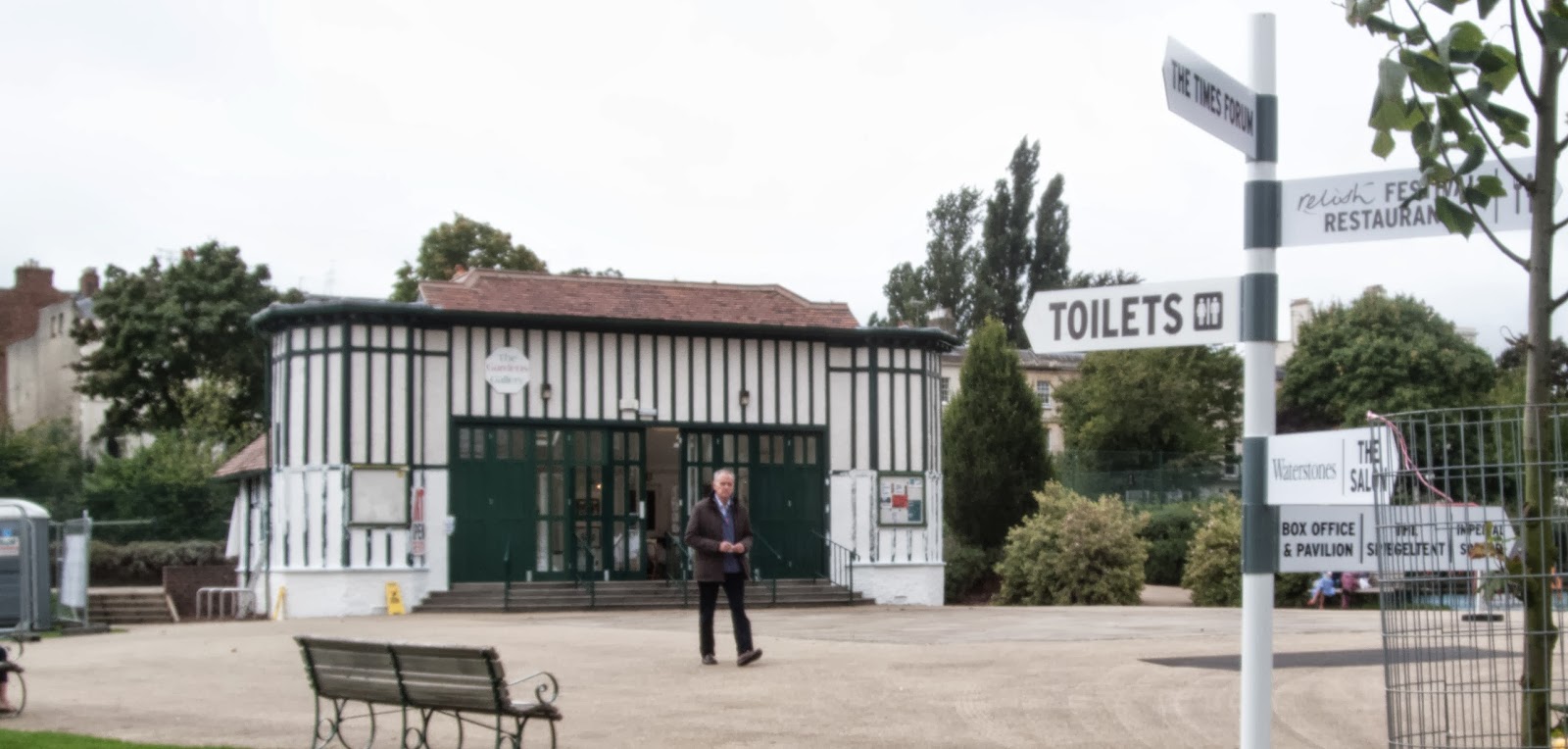
Caroline is rightly indignant with the Cheltenham Festivals continuing to sideline the Gardens' Gallery in Montpellier. Not only do they omit any mention of the Gallery in their brochure, it doesn't even feature on the festival maps, or on the signposts. And the massed bank of festival loos is plonked just next to it, reducing it to worse than Cinderella status. (Postscript: A Festival-goer caught short, spent her penny, and then - noticing the Gallery - went in and spent a further £300.)

Until a month ago, Pascal Lamy headed the World Trade Organization: yesterday afternoon he came to Cheltenham to discuss his forthcoming memoir, "The Geneva Consensus". The Times' Philip Collins kept the discussion nice and general, though without much sympathy for where Lamy was coming from, Collins appearing both less internationalist and more Conservative.

The memoir's title was chosen to juxtapose the author's standpoint with the Washington Consensus, which has come to stand for "Liberalise and God will take care of the rest." Lamy's approach is rather to take care of how trade works - in order for trade to work at all.

He praised Gordon Brown - prescient about the need for global governance - but China's "Don't ask me to do what you haven't done!"sums up the impasse, for instance in reaching a worldwide consensus on carbon reduction. We can't, Lamy maintains, halt globalisation, because technology is its engine - and technology has no reverse gear. It brings people closer to one another, but they still have different cultures. (The Inuits have always killed seals, but Europe expresses its disgust by banning Canadian imports.) Globalisation has formidably shrunk the numbers of the planet's poor, but at the expense of greater inequality.

A stimulating hour! As was my evening session - a genial chat between Mark Lawson and Jonathan Miller. Again, the interviewer gave his subject plenty of rope: with this, he readily reprised the role of enfant terrible, by which he first came to fame. There were a few repetitions, and one or two names escaped him, but otherwise it was hard to think that this was a man in his 80th year.

Until afterwards, that is: beginning my bike ride home, I saw someone in the shadows outside the Writers' Room, puffing at a cigarette. The enfant terrible had morphed into the Picture of Dorian Gray. I turned the bike round, and asked if I could take a photograph. (Nothing ventured...) "I hate being photographed," came the response, but he was willing to chat. "I'm not a Jew, just jewish," I quoted from Beyond the fringe. Was he a believer in the divine? "Certainly not," he said, "and what's more if Jesus came back I would ensure he was brought before the International Criminal Court."

This morning, by contrast, I escaped to Tetbury again, and heard - inter alia - the sublime Sarah Connolly singing Schumann and Duparc. These repeated words of Baudelaire, set by the latter, sum up Tetbury in contrast to grungy, pragmatic, busy, eclectic Cheltenham: "Là, tout n'est qu'ordre et beauté, luxe, calme et volupté."

Used condoms form the detritus after Glastonbury: discarded Times cotton shopping bags after Cheltenham, and statins after Tetbury.


Thursday, 25 October 2012

The thick of it


I took this photograph in 1999, when we were walking along a strada bianca near Pienza: it hardly does justice to the lichen, an extraordinary colour. I remembered it this morning, as I caught up with the latest goings on in The thick of it. It really does get better and better - and in the whole hour of this bumper episode there isn't a single F word (well, in direct speech anyway). How do they keep a straight face?

I couldn't watch it on Saturday as we were at the Parabola Arts Centre, where they were showing a recording of the Royal Opera's 2011 Tosca: a great cast, and - still more important - Antonio Pappano conducting. Before we went out, there was another Royal Opera House recording on Radio 3: Otello, Pappano again conducting. And earlier in the day, I'd been catching up on the Covent Garden Ring. Conductor? Pappano again.

Caroline's week-long Wagner widowhood ended last night. The highlights of this Ring for me were Act 2 of Die Walküre, with Sarah Connolly outstanding; and Act 2 of Götterdämmerung last night - Tomlinson terrific as Hagen, notwithstanding that wobble: only to be expected in a 66-year-old. (What contemporary relevance in the Prologue too - with all the Norns' talk about ash dieback.)

Are there other operas besides Tosca and Götterdämmerung where all the principals end up dead? (Is there a post on my blog containing more hyperbole?)

Sunday, 15 July 2012

Festival envoi


As might have been gathered from earlier posts, we have enjoyed this year's Cheltenham Music Festival. Tonight's "London marathon", the Bournemouth S.O. conducted by Martyn Brabbins, was no exception. Cellist Stephen Isserlis's father died three weeks ago, and the last music Stephen played him was part of the Elgar Concerto: no surprise, therefore - his spellbinding performance of this same concerto, the pivot of this final concert. An extraordinary stillness overcame the Town Hall.

Last night's playing of Grieg's Holberg Suite by the Trondheim Soloists stole that show even with Sarah Connolly performing after the interval - today's Janet Baker, my neighbour suggested. I wonder.

On Wednesday, Thursday and Friday we went to three of the five "Time Capsule: 1914-18" concerts, devised by the fragrant Kathy Gowers. I had misgivings about these at the outset, as so many of the works seemed to come into the deservedly little-known category. But they proved ideal festival fare, the variety providing continuous contrasts, some looking back, some forward - mostly played with great pizzazz: I would single out particularly the Norwegian pianist Christian Ihle Hadland in his Rachmaninov, but also in the piano transcription of Bartók's Romanian Folk Dances. Thrilling!

Not even crying offstage babies and texting audience members in front could take away that floaty feeling you get when something special is in the air.

Monday, 21 July 2008

An die musik


Flouting Pittville Park Regulations (al fresco drinking is proscribed) after the final Pump Room morning concert last Saturday, we threw a Schubert impromptu Kir Boot party.

There could be more such jollity at the Cheltenham Music Festival: I gather there is at festivals such as Buxton and even the dear old Three Choirs. It might help to swell our audiences, which - judging from the dozen events I attended - were poor this year considering the quality of the performance: a very thin house in the Town Hall, for instance, for the sublime Sarah Connolly. And the Town Hall was not exactly jam-packed - as it should have been - for Taraf de Haidouks on Saturday night. (It was good to see our MP Martin Horwood there and his two young children, sitting on the floor tapping their feet.)

The modest turnout can't just be the recession. Where - at the classical music concerts - is the dark- and fair- (as opposed to the white-, the grey- and the no-)haired generation, which throngs the Albert Hall during the Proms season? Is it just Cheltenham, or is it the way we promote the Festival - with rather expensive seats?

Some Festivals ago, the Summerfield Trust gave a grant to enable best Town Hall seats to go to quite a number of children from local schools for a performance (Richard Hickox conducting) ending up with a long Rachmaninov symphony: I recall a gloriously noisy reception in the Drawing-room. It was not an unqualified success - the children had been insufficiently prepared, and it wasn’t the right piece to submit them to. However the principle is right: make them kings/queens for the day, and let the usual audience have a back seat.

Had the marketing for Sarah Connolly been different, with 300 tickets at £5, we could have had a full house, and more income overall at the box office. Our Cheltenham Festivals have become too institutionalized - too much rigid thinking about marketing and sponsorship; and too much visual emphasis on the catering facilities, fine tea-tasting etc. OK, we can't do it without sponsorship, but does the front cover of the Festival programme brochure have to be so dominated by their names? Where does it tell us anything at all about THE MUSIC we are hearing? Isn't music what this Festival is supposed to be about?

Robin Kindersley reflected that, apart from the Connolly evening, every concert he attended contained work by Schubert, and Schubert's music was indeed the central joy of this year's Festival. However, you wouldn't know this from reading Festival Director Meurig Bowen's curious introduction to the brochure - not a mention of Franz Schubert there in his 650-odd words!

In particular - on the three last days - we had performances of the three great Schubert song cycles, with superlative singing by Allan Clayton, Florian Boesch and (an unrecognisable) Mark Padmore, as well as playing by the accompanists Paul Lewis and Roger Vignoles. My neighbour on Saturday for Winterreise had been present at the very first Cheltenham Festival over 60 years ago (and most since), but couldn't recall such fine musicianship. Even for these three events there were some empty seats: Cheltenham's Schubertiad deserved better publicity - and international acclaim.

[I have blogged already on the Festival - here, here and here, in case you are interested.]

Wednesday, 4 June 2008

Lost in translation


Opera in English - save when that's the composer's language - perturbs me. The more so now that surtitles have become commonplace. Caroline and I were at the London Coliseum on Monday. Some magnificent orchestral playing - and singing, from principals in demand to sing their roles the world over. Was it "The Knight of the Rose" we saw? No. According to the programme, and as common sense dictates, it was Der Rosenkavalier. So why make someone as distinguished as a Sarah Connolly or a John Tomlinson learn their roles in English, rather than letting them and the rest of the cast sing in the original German? Is it really so as to make opera more accessible? We were very kindly given tickets, but with prices as they are, I really doubt whether the language factor is what brings a wider range of the public in. (Does the film industry dub foreign films? No, it surtitles them.) Is it so as to draw a line between ENO and Covent Garden? Why not just allow them to compete on musical and dramatic excellence? It can't surely be anything to do with the name "English National Opera"! Do Welsh National sing in Welsh? The late Alan Blyth's essay in the ENO programme book itself squishes any argument for performing Der Rosenkavalier in English: Hofmannsthal sets "standards of... literary excellence never before achieved... The text was written in an imaginary parlance... something inevitably lost in translation."

On the way to the Coliseum, we popped in to the recently reopened St Martin-in-the-Fields. Those short-listed for the commission for a new East window were asked to "animate the light" by a work which harmonised with the clear glass of the other church windows. I hope my photograph illustrates how nothing seems to have been lost by Iranian artist Shirazeh Houshiary in translating this brief.