Showing posts with label Cheltenham Film Society. Show all posts

Wednesday, 17 December 2014

Flying high again


After a good deal of rain, we four walkers took off from the Churn valley this sunless morning in the direction of higher ground. East from North Cerney, you soon reach a plateau, with views towards Blunsden and beyond. Our field path - not too muddy - crossed the White Way before coming to the Calmsden lane. We followed it down into that hamlet, past The Tallet. Pausing to admire the 14th Century wayside cross, we pushed on up along the side of Rendcomb airfield: it's much developed since I was last in these parts. The Monarch's Way was muddy, through Conigree Wood, but overall it was generally agreed to be a good walk on a dry, mild, windless day.

Not so much scenic variety in Nebraska though, judging from the film of that name which we saw last night. It was a road movie, a little slow-moving in parts, but wryly humorous and poignant.

Tuesday, 16 September 2014

Open "Doors"


The launch party for Cheltenham Green Doors took place at the Gardens Gallery last evening. Our local MP made a good speech: the chain gang were amongst the nobs present. Then off we biked for the first Film Society offering, an Indian film, "The Lunchbox". Not many green doors programmes in India I guess.

Wednesday, 19 March 2014

"Not quite what I had in mind"


The 15th annual de Ferrieres lecture took place tonight, at the Bacon Theatre here in Cheltenham. Kevin Brownlow, the film buff's film buff, was - for me - an inspired choice, but alas didn't draw the crowd he richly deserved. Whereas the Film Society attracted its habitual near-capacity audience to a showing of the little-known German film Barbara last night, a mere hundred or so turned out for "Not quite what I had in mind": Brownlow's talk was all about his failed ambition to become the second Orson Welles.

Failure though he might deem himself, he succeeded brilliantly in giving us glimpses of what turned him onto film as a young man, and turned him into an Oscar-winning film historian. One of his breaks was getting alongside the American actor and director Al Parker. Parker, who knew everyone in the Silents and that Brownlow was anxious to meet people from that era, would ring up: "Kevin. King Vidor. Hyde Park Hotel. Tell him I sent you."

From an early age, Brownlow was passionate about film, or rather "Film" - "I am a Film maker, capital F" as he recalled telling someone offering him work in television ("an ulcer-producing activity" - he quoted Jeremy Isaacs). And he clearly lived by the saying of Abel Gance, "It's impossible to make a great film without enthusiasm."

We were treated to a dozen or so film clips - some possibly a little protracted, though not the excerpt from Brownlow's own documentary on the last Glasgow tram: magical. Another clip included an interview with the great Gance: a chief debt of the film world to Brownlow is for his restoration of the silent epic Napoléon vu par Abel Gance after a 20-year struggle. With a further clip, Brownlow let us into the secret of "the hanging miniature" which Fred Niblo used to create the crowd scenes in his 1925 Ben-Hur. And in a clip about the making of Brownlow's own 1975 film Winstanley, we could observe at first hand the rigorous directing of the lecturer himself - perhaps too much of a perfectionist to achieve the commercial success he craved.

In what was a modest, gracious and witty two-hour performance, Brownlow reserved almost his only word of criticism for Charlie Chaplin. Having come across a roomful of outtakes, he concluded that at times Chaplin "didn't know what he was doing, and that's the worst thing you can say on a film set."


Tuesday, 25 February 2014

"Free Men"


We are booked in for War Horse on Thursday, and tonight it was a Film Society offering also set in wartime, but World War II. The story centred upon an Algerian amongst Jews sheltered by a Mosque in occupied Paris.

I don't normally go for this sort of film, but Free Men was different. As the Sight and Sound critic wrote after its 2011 release, "It succeeds as something more contemplative, raising questions about the relationship between race, nation, creed, religion and even sexuality without ever sliding into didacticism."

As with the latest Coen Brothers' film, the last one we saw, some of the images were hauntingly beautiful - for instance, the face of the beggar forever sitting at the entrance to the Mosque. The man in this photograph (seen yesterday in Cheltenham's sunny Promenade) struck a similarly contemplative pose.

Wednesday, 29 January 2014

Savage culture


The sign "Savage culture" hangs above a shop in that extraordinary Cantabrian town Santillana del Mar: it's an oxymoron that came to mind during Inside Llewyn Davis this evening, and in reflecting about last night's film too.

The latest Coen Brothers offering, beautifully set in the early '60s, pivots round a young, gentle-till-provoked hobo, a talented New York guitarist and song-writer. Through many difficult and some violent relationships, not least with ginger cats, we watch his life slowly disintegrating, as his lyrical ballads are ruthlessly dismissed as noncommercial. Ulysses turns out to be the name of the no. 1 cat, but Llewyn Davis' Odyssey has no such happy ending. Why did he fail when Bob Dylan succeeded? we ask. Coming away, Caroline and I agreed: there but for the grace of God goes one of ours (similarly hirsute and entangled with cats).

Inside Llewyn Davis is an extremely funny, very sad film, a description applying equally to Dans la maison, François Ozon's brilliant second-to-last feature from 2012: our Film Society showed it last night. This centres on another male character encumbered by a busted flush of a father, but this time manipulating those around him, as opposed to being manipulated. Claude, aged 16, wreaks havoc within his bourgeois community, sending his literary Maestro mad as fantasy conflicts with reality. Culture, once again a double-edged sword.

I took the photograph in Elmley Castle. Four of us reached there starting from Ashton-under-Hill, happily a dry walk this morning, with fine, long views: the rain has come back since.  It was mostly firm underfoot across Bredon Hill, but horribly muddy on the long descent. (We trudged back the long way, around the road.)

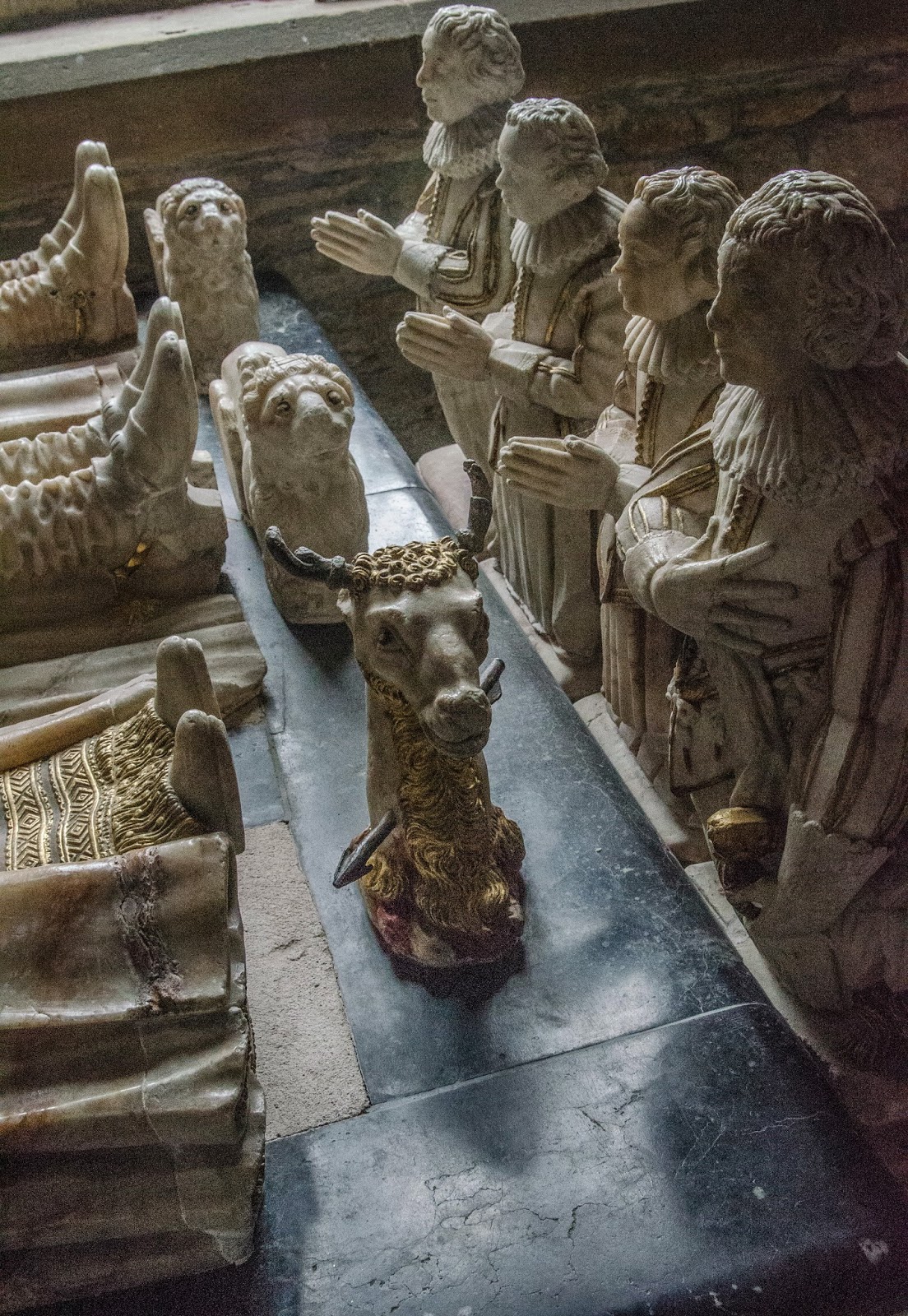
In St Mary's Church, you can't fail to see and wonder at two extraordinary tombs. On one, dating from c1700, the first Earl of Coventry lounges nonchalantly in full wig, one hand reaching out to pick up his coronet. The other - 25 years, but what seems like a whole world earlier - depicts members of the Savage family. Three lie as if asleep, the lady holding her baby daughter; while four other children kneel attentively at their feet. And between them, the head of a stag, with golden locks and one remaining but wondrous ear: its neck is pierced with an arrow. Savage culture once more.

Wednesday, 15 January 2014

Lucas (1)


The papers currently overflow with reports of media idols on trial for sexual offences, so The Hunt was an appropriate choice for the Film Society last night. Members of a small town Danish community hunted down one of their own, Lucas, a likeable kindergarten teacher, following an unhappy pupil's made-up story of his inappropriate behaviour towards her. There's a happy ending, though the scars of the chased/chaste Lucas will remain with him.

This simplifies greatly a complex piece of cinema: director Thomas Vinterberg makes it work well on nearly every level, particularly in terms of suspense - at times quite unbearable. The Lord of the flies came to mind.

I'm still hunting down Gloucestershire churches. Today, Salperton was added to my bag. This gravestone struck me for its uninhibited inscription, commemorating "my beloved husband Bill" (William George Dwight, 1949-2009). It stands to the North-West of the church.

We were walking from the Puesdown Inn, whither the three of us returned very wet. And were then disappointed to find it closed.

Tonight, I've been participating in my first MOOC. "Climate change: challenges and solutions", put on - quite efficiently, it seems to me - by the University of Exeter. Testing for a scientific duffer like me.

Wednesday, 18 December 2013

Grumpy old men - 2


For one reason or another, we hadn't been to the Film Society recently - till last night. "The Guard" (released in 2011) is Irish noir, laced with good visual jokes. There were jokes in the script too, but many of them passed me by: never have I found the words of an English-language film so difficult to grasp. A strong case for subtitles throughout!

Delivering Christmas cards earlier, I dropped one in at Catherine Shinn. Her father, Catherine said, was at home decorating an absurdly large Christmas tree: "we don't do minimalism," she added - unnecessarily, if you have ever been to her magnificent shop: see my photograph.

I bumped into another of my "by hand" card recipients as she walked homewards with the shopping: recently having flown back from a pilgrimage/holiday in the Holy Land, she justified her failure to send conventional cards this year by a desire to save trees. Really!!

Which brings me onto the great airport debate, raging anew this week - mostly about where extra capacity should be built. The leader in today's Guardian stands alone, reminding readers that roads (and runways) breed traffic. "The old Mr Cameron," it goes on, "warned that If we don't act now, and act quickly, we could face disaster from the climate. That danger has not gone away, and neither have Whitehall's own projections for a 50% rise of aviation emissions by 2050, projections that make a mockery of a supposedly binding commitment to cut 80% out of total greenhouse gases by the same date."

Wednesday, 9 October 2013

Chase End


Six of us met at Hollybush today, more than usual. The talk about Royal Mail shares made me wonder whether I had neglected to apply out of distaste for the privatisation or merely indolence.

We had the most lovely walk, notwithstanding, clockwise around Chase End Hill, at the "bottom" of the Malverns. We funked the steep climb up to the top, which - at 600 feet - lets you see all round. Even as it was, we had surprisingly long views - to the Sugar Loaf to the South-West and across to Bredon and the Cotswolds from the woodland ride leading into the Bromsberrow Place Estate: the ride runs between many tree varieties, sweet chestnuts especially plentiful.

Gil Greenall's careful stewardship of his Estate is everywhere evident, not just from the signage: the house itself looks magnificent in its parkland - lakes at just the right distance, and White Park cattle grazing before the curiously Neo-Greek West front. From a distance, the long-established trees behind and to the South of the house make it altogether an imperial setting. (It was five years ago that I came there on a CPRE outing.)

Yesterday evening, we went to our first Film Society evening of the new season, having missed the opening night. "No" recounted the final weeks of the Pinochet era in Chile, and the gathering of popular support for a No vote in the referendum. Pablo Larrain's film jerked along rather disconcertingly: the 30-year-old camera, used to convey a suitably historic feel, secured a nice degree of tension throughout. You kept thinking there would be a sting in the tail, but of course there wasn't, just ambiguity.

Thursday, 6 June 2013

Imagine three days without water


This was what stuck in my mind listening to Paul Younger's Cheltenham talk today. After those 72 hours, we die. It's a frightening thought. Yet Professor Younger stressed his Jeremiad - for it sounded like nothing less - was not moral preaching; just grim warning.

"Water is not an island," he told the large weekday morning audience; and yet so often we ignore the nexus - water and food; water and house building; water and energy. Collaboration is the only way forward:. "See how Iceland is about to become a net exporter of bananas!"

As he was talking, I thought back on that chilling Film Society offering we saw six months ago, about the water wars in Bolivia - and then he mentioned it. Even the rain. "That there has yet been no major international conflict is down to the power of virtual water." Read about it!

Wednesday, 27 February 2013

Cleevewards


From the Plough in Prestbury, we walked today Northwards to Southam, past the vulgarity of the Ellenborough Hotel. Skirting Cleeve Hill, we then made for Bishop's Cleeve, clinging on gamely to its apostrophe notwithstanding the rash of illiterate housing developments spawned there in recent years. Having crossed the A435, we aimed towards Swindon Village: this photograph was taken looking back towards the Racecourse and the escarpment - a surprisingly tranquil scene when you think of Cheltenham's suburban tentacles reaching all around that area. It was a cold morning: the sun only broke through as we arrived home after lunch.

I'm still thinking about last night's Film Society offering, Monsieur Lazhar. Continuing the theme mentioned briefly in last Thursday's post, it portrayed an Algerian asylum seeker: his family having been murdered as they were about to join him in Canada, he bluffed his way into a teaching post left vacant by the suicide of his predecessor. Without any excess of sentiment, we watched his growing engagement with the young teenagers in his charge, his comforting them in their bereavement acting in turn as a comfort for himself. Brilliant.

Tuesday, 12 February 2013

Shrove Tuesday


This is a segue from yesterday's blogpost about papal shriving.

This evening, before going to the Film Society (unusually, a British film Treacle Jr. - gritty and compassionate), Leo tossed me an excellent pancake. I resolved to photograph him tossing the next one, but Splat! It landed on the floor.

We have an addition to our household for a three-week stay, Mesa, a 19-year-old Japanese student. Interesting, trying to explain to her the origins of Shrove Tuesday...

Wednesday, 30 January 2013

Hedgehogs


I spotted this one (left) outside a café in Barcelona: he's just emerged from a review of 2008 portraits, now sorted for my website.

Reports today indicate actual hedgehog numbers are in steep decline: 36 million when I was growing up - fewer than a million now. And what's more, the population has apparently gone down by a third in the past decade alone. (How this data on such notoriously secretive creatures comes to be compiled, heaven alone knows.)

Coincidentally, sales in France of Muriel Barbery's novel, The Elegance of the Hedgehog were also around the million mark following its publication in 2006: Caroline read it with enjoyment, so was keen to accompany me to a local showing of the film version last night. Judging by the amount of nose-blowing around us at the end, I was not alone in being moved by it. Apart from the largely redundant music and a few non sequiturs in the plotting, it was great entertainment.

Tuesday, 8 January 2013

High definition performance


It was Kenneth Tynan who coined the phrase "high definition performance". Tonight's Film Society film, last night's Royal Opera live stream and Sunday's Something Understood all come under this useful heading.

The Iranian director Asghar Farhadi won plaudits at the 2011 Berlin Film Festival for A separation: I had meant to catch it when it first came out, but failed. It was well worth waiting, though, for its superb screenplay and mesmerising acting. Only at the end, when music plays, do you realise there has been none throughout.

Music aplenty though from the Royal Opera House throughout yesterday, during the 10-hour live stream of backstage activity, available through theguardian.co.uk/music and thespace.org. We only watched a little until the evening, when we were rivetted by the relay of the whole of Act 3 of Die Walküre.

And Mark Tully's Something Understood is always worth listening to, but this week on "Dignity" he was on specially good form, particularly with his main interviewee, an eloquent Buddhist.

Tynan wouldn't have marked our High Street accordionist with "HDP", but I have recently been enjoying one particular tune he keeps playing. I don't know what it's called - we correspond in smiles, as he's from Hungary and speaks no English.

Tuesday, 18 December 2012

"Loose Cannons"


I'm generally well-disposed to Italian films, and tonight's Film Society offering started rather promisingly. The beautiful Nicole Grimaudo, playing the young female lead, evoked Jeanne Moreau in Jules et Jim in her opening scene. What's not to like? I was thinking.

But once smitten by her gay business partner, Nicole's character ceased to develop, and the same went for most of the others on screen. The gay romps were unsubtle too. However, I liked the pair of anarchic maids: their appearances were enlivened by one or two amusingly Absurdist lines in Ivan Cotroneo and director Ferzan Ozpetek's script.

As usual before Christmas, the Film Society laid on a lavish spread of wine and cheese afterwards: no wonder the membership list is full.

Tuesday, 27 November 2012

"Animal Kingdom"


When Leo and I were in Melbourne in January 1998, he went to watch tennis, whilst I explored the botanic gardens (my photograph), and also the surprisingly excellent National Gallery of Victoria. The visit to the latter came back to me this evening, watching "Animal Kingdom", our Film Society's latest offering: the Gallery was the setting for a couple of the scenes in this violent film.

I went along by myself as the Society's leaflet showed the film as an 18, and that rules it out for Caroline: in fact, it's only a 15, there's no sex and the violence is dealt with pretty discreetly. There's worse in BBC4's "The Killing III" (I'm hooked!).

"Animal Kingdom" has some excellent performances, in particular from Jacki Weaver. Moreover, it remains tense mostly throughout. (In other words, I only looked at my watch once.) You fear it's all going to end badly for our young "hero", who has a charming exchange about cricket with the main villain at one stage. In fact the ending is the best bit. And what a nice change to have all that Australian sunshine when you've grown accustomed to Nordic Noir!

Tuesday, 13 November 2012

"Even the rain"


It's our youngest grandson's fifth birthday today, and Laurie's effort at photographing the photographer (in April this year) came to mind this evening as I watched the Film Society's latest offering: it's a film about filming an historical epic in Bolivia; and one of the few female characters videos the filming.

Pirandello would have admired this layering effect, and more so the echoes between the historical exploitation (being filmed), the location's "current" (1999-2000) water wars and the exploitation of the film extras.

Not a bunch of laughs, but a very brave film, and a tribute to the difference a film can make.

Tuesday, 30 October 2012

"Mao's last dancer"


I took this photograph from the train when we were in China in 2002. The journeys we then made came vividly back to mind this evening, as we watched our Film Society's latest offering, "Mao's last dancer". That true-to-life film's scenes of its hero's childhood in rural China contrasted dramatically with the footage shot in Houston and Washington, where the eponymous dancer, Li Cunxin ended up as a ballet star. An extraordinary story! And told with great sensitivity to both sides of the political struggle which ensued when Li's visa ran out.

Never enough handkerchiefs for this one's audience, I'd say.

Friday, 2 March 2012

Black "Comedy"


Happy memories of Clifford Williams’ RSC production of The Comedy of Errors were brought back last evening! They were awakened by the National Theatre relay of its current revival of this early Shakespeare.

First put on in September 1962, I saw it at Stratford the following year, with Alec McCowen and the late-lamented Ian Richardson, Clifford Rose and Barry MacGregor in the male leads - other parts played by Donald Sinden, Diana Rigg, Janet Suzman…

I'm inclined to confess that yesterday the best bit was my Ben & Jerry ice cream in the interval. The production by the Royal Court's Dominic Cooke is dark, dark, dark - more uniformly so even than Act 1 of Propeller's recent Winter's Tale. I really don't think that the earlier play can stand that much directorial business: it left a distinctly unpleasant taste in the mouth - not one offset by some excellent acting and - praise be! - verse speaking: in the latter department, Pamela Nomvete as an unlikely-looking Abbess was outstanding, though her part is only a minor one.

It was the second occasion this week that I've left a so-called comedy dissatisfied: on Tuesday our Film Society showed a French film (from 2008), Louise-Michel: it was the first time I've ever found myself walking out before the end: it made me feel quite sick.

Wednesday, 18 January 2012

"The Concert"


On its release in 2009, the New York Times hated it, as did some of our own papers; but we are still raving about last night's chaotic Cheltenham Film Society offering - a take on Russian Jewish musicians somehow getting it together to play Tchaikovsky in Paris's Théâtre du Châtelet. As a romantic tear-jerker-cum-action-packed political farce, it risked falling between every stool; but as a piece of magic-realist escapism, it was a great evening out, for this general music-lover anyway. Buena Vista Social Club on speed.

The fragrant Melanie Laurent steals the show, run close by Gheorghe Anghel of the brilliant Taraf de Haïdouks, stars of a couple of our Cheltenham festivals in past years. I felt sorry for those who left when the film started running without subtitles: they missed a treat.

Tuesday, 6 December 2011

Service


I took the bus to Witney today, almost the first time I've been to (as opposed to through) that town. I seem to recall a visit with my mother, who had worked for a little while in the famous Early's factory in the 'Thirties as part of her social studies diploma experience: we came away with a bright red blanket. Now, it's almost a decade since blankets were made in Witney, which has seen much redevelopment alongside its original heart - full of the usual charity shops.

I was there to see a friend who was hospital-bound: the only place for a chat was apparently the landing by the lift and stair-head, not exactly an oasis of peace. Whilst bureaucracy ensured that the patient had plenty of scope for cultivating... patience, it was still evident that a culture of very personal service prevailed within the hospital. It contrasted interestingly with the situation portrayed in Sebastián Silva's The Maid, which we saw this evening (at the Film Society). Its protagonist is of a type more commonly found in Silva's 21st Century Chile than in 21st Century England, where next to nobody is called to the vocation of a maid. What the film expertly sketches is the degree of genuine attachment members of a family can feel for their long-suffering servant, brilliantly acted by Catalina Saavedra. "I love them and they love me. I'm part of the family," her character confesses.