Showing posts with label sculpture. Show all posts

Wednesday, 10 September 2014

The value of art


Instead of a walk in the countryside this Wednesday, four of us met in Gloucester, to visit the Cathedral exhibition, Crucible 2. Some of us spent more time on it than others, but there's never a shortage of things to do in Gloucester, especially on a sunny day.

100 exhibits are a lot to take in. I didn't look at them all, but one or two stood out: Kenneth Armitage's giant hand on the lawn North of the chancel; the Vulcan maquette by Eduardo Paolozzi in the crypt; William Pye's water sculpture in the South transept, to name just a few. None of these has any religious significance, so what, you may wonder, were they doing in a Cathedral exhibition?

Actually, I'm quite comfortable with the idea that our great religious buildings should be used for the widest possible range of activities. What's more vexing is the way our perception of art differs according to the monetary value placed upon it. Crucible 2 is not a selling show, but we are all aware of the astronomical prices for which contemporary works of art are sold. Indeed, security is obviously a major concern for the organizers of this exhibition, though the hordes of people going round - no wonder, when entry was free - were very far from being frisked.

My photograph juxtaposes one of the well-secured exhibits in Crucible 2 (Kate Parsons' "East West - matter of interpretation") with - in the foreground - a cheerful framed colour photograph of May Hill, left by the local Free Art Friday group for anyone to take home with them. Does this subversive placement make it a Disobedient Object, as currently on show in the V&A?

Thursday, 7 August 2014

Tangled legs


The day started early and badly. I fell down stairs. As I was carrying half a mug of tea, it seems to have splashed every surface of the hall. Luckily, it happened only two steps from the bottom, so it was just my pride that was wounded.

Caroline (leaving early for Oxford) dropped me by Leckhampton church before seven so I could walk the dog for her. The light was good, but taking photographs I always find flare a problem when there's low sun. Perhaps it's the lingering influence of our visit to the Yorkshire Sculpture Park last week that these two logs caught my eye, lying by the path on my way back home.

Wednesday, 30 July 2014

Moore still


Continuing our quest for Yorkshire treasure, we have just returned from Wakefield and the Hepworth Gallery. Brilliant! As a building it knocks the new Cheltenham extension into a cocked hat. And what other British artist of the 20th Century has such a shrine in their home country, around which so much other excellence is assembled?

Earlier we visited Salts Mill, which must have one of the most extensive arts-related bookshops in the country, not to mention all those Hockneys. And the magnificent Yorkshire Sculpture Park, with its eclectic mix, the majestic Moores (today is his 116th birthday) standing out from the crowd. A heady experience.

Wednesday, 23 July 2014

La Fontaine du Christ


We stopped here en route for Pleyber-Christ this morning. It was not something you would do if you were in a car: too much kerfuffle. But easy as anything when biking. The fountain, long a ruin, has now been rescued, and is presided over by a smiling, bearded stone Christ. It could be mediaeval, but isn't. We saw a similar sculpture yesterday in Guimiliau church, a Flight into Egypt which we were surprised to see dated 1992.

A garden flourishes beside the fountain, with a blue hydrangea: its petals have gathered on the cobwebs beneath Jesus' outstretched arms. The massive slate-topped bench to the right indicates this might be a minor place of pilgrimage, or at least the destination for a Sunday walk.

Five pine trees stand guard over a calvaire at the junction just adjacent, one of half a dozen we passed on our short ride today. (There are 30 in "our" parish alone). But this one differed: in place of a backing group (often a Virgin and child), there were two ensembles, one either side - a Pieta and a man and a boy. One of the series of excellent drawings on display in Pleyber-Christ church indicates the boy is leading the blind St Herve. [How do you do accents on a Hudl?]

Monday, 9 June 2014

Portraiture


Our local art gallery is hosting the National Portrait Gallery's photography show entries at present. I went along this morning, and marveled at many of the entries, which make my portraits look feeble in the extreme.

The exhibits are on two floors: when you reach the top one, you find a list of the prizewinners; but why can't the portraits awarded prizes be identified, so you can see which they are when you look round?

Somehow, we managed to miss the Open West show this year, but the above photograph shows part of one of the entries, still left in situ outside the rear of 51 Clarence Street: an untitled viscose yarn installation by Londoner Stella Whalley.

Wednesday, 29 January 2014

Savage culture


The sign "Savage culture" hangs above a shop in that extraordinary Cantabrian town Santillana del Mar: it's an oxymoron that came to mind during Inside Llewyn Davis this evening, and in reflecting about last night's film too.

The latest Coen Brothers offering, beautifully set in the early '60s, pivots round a young, gentle-till-provoked hobo, a talented New York guitarist and song-writer. Through many difficult and some violent relationships, not least with ginger cats, we watch his life slowly disintegrating, as his lyrical ballads are ruthlessly dismissed as noncommercial. Ulysses turns out to be the name of the no. 1 cat, but Llewyn Davis' Odyssey has no such happy ending. Why did he fail when Bob Dylan succeeded? we ask. Coming away, Caroline and I agreed: there but for the grace of God goes one of ours (similarly hirsute and entangled with cats).

Inside Llewyn Davis is an extremely funny, very sad film, a description applying equally to Dans la maison, François Ozon's brilliant second-to-last feature from 2012: our Film Society showed it last night. This centres on another male character encumbered by a busted flush of a father, but this time manipulating those around him, as opposed to being manipulated. Claude, aged 16, wreaks havoc within his bourgeois community, sending his literary Maestro mad as fantasy conflicts with reality. Culture, once again a double-edged sword.

I took the photograph in Elmley Castle. Four of us reached there starting from Ashton-under-Hill, happily a dry walk this morning, with fine, long views: the rain has come back since.  It was mostly firm underfoot across Bredon Hill, but horribly muddy on the long descent. (We trudged back the long way, around the road.)

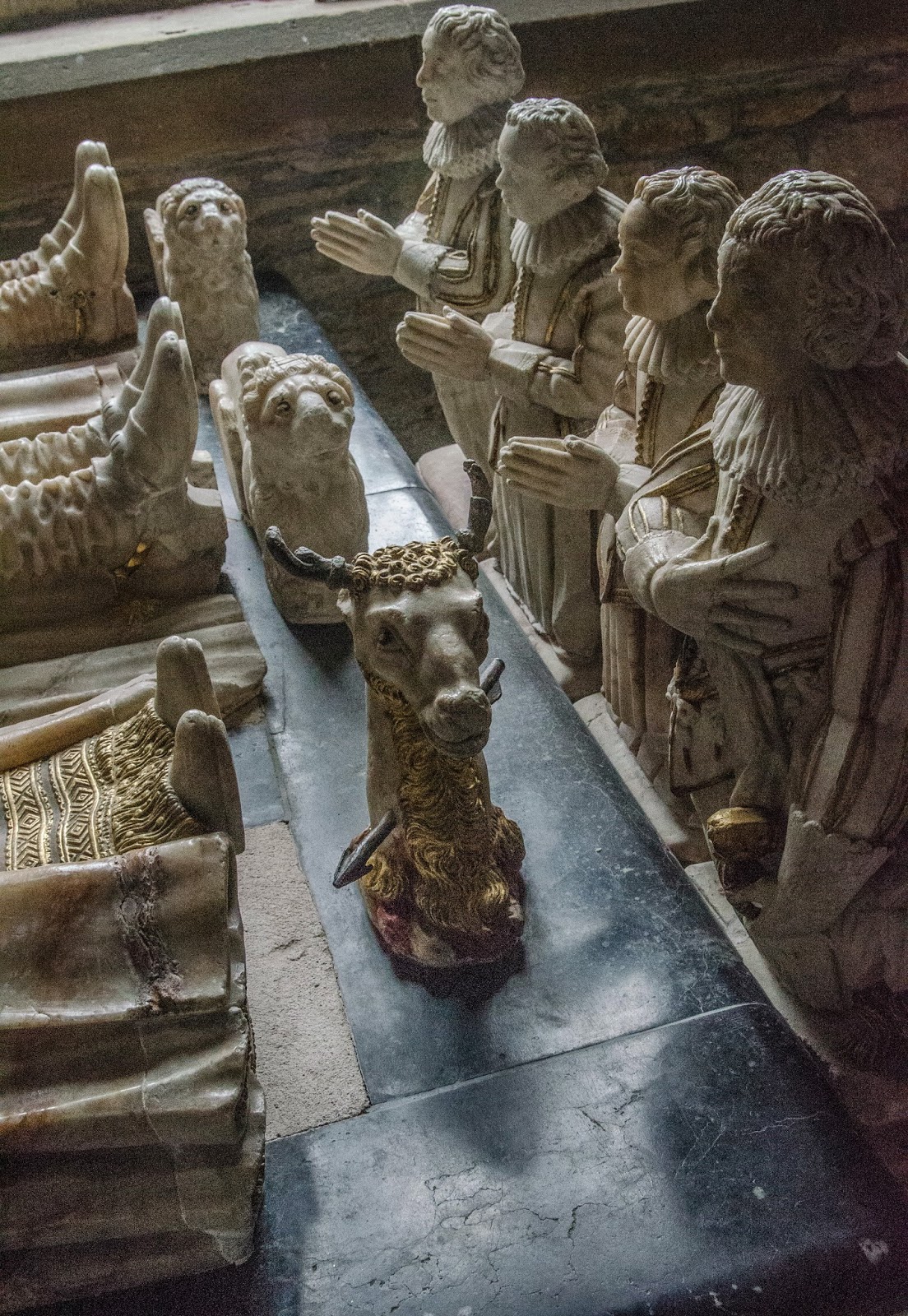
In St Mary's Church, you can't fail to see and wonder at two extraordinary tombs. On one, dating from c1700, the first Earl of Coventry lounges nonchalantly in full wig, one hand reaching out to pick up his coronet. The other - 25 years, but what seems like a whole world earlier - depicts members of the Savage family. Three lie as if asleep, the lady holding her baby daughter; while four other children kneel attentively at their feet. And between them, the head of a stag, with golden locks and one remaining but wondrous ear: its neck is pierced with an arrow. Savage culture once more.

Thursday, 8 August 2013

Friendship Circle


The Western section of Cheltenham's Sandford Park used to have a clump of mature trees as one of its loveliest features. They were felled two decades or more ago, replaced by an inanimate "Friendship Circle". This consists of three blobs in cast iron by the South African artist Neville Gabie, intended to commemorate Cheltenham's various twinning links.

Like the Sophie Ryder I posted about last week, this piece of public art came in for a barrage of criticism at first: I joined the chorus of disapproval. But seeing it today I realised it had come to earn its keep - certainly more so than the sculpture in the Eastern section of the park, The Weathered Man, about which I wrote last December.

Maybe my change of mind was influenced by the grandsons discovering that one of the trio was hollow. "We are baby crabs in our mother's shell," said Laurie.

Friday, 2 August 2013

Lapping it up


As Ogden Nash wrote, "The entrance requirements for grampahood are comparatively mild. You only have to live until your child has a child." Well worth the wait, I say!

It was 16 years ago that Sophie Ryder's Minotaur and the Hare was purchased for permanent display in a prominent position in Cheltenham's Promenade. There were the predictable howls of protest, but now I guess they would be easily drowned out by a chorus of approval - if it was to be mooted that the sculpture be removed. The chorus would be led by grandparents deprived of a most beautiful climbing frame.

Friday, 26 July 2013

Black and blue


The Confraternity of St James celebrated their patronal feast with lunchtime tapas yesterday, but those of us present in North Paddington were in somber mode: the deaths and injuries of so many train passengers en route for Santiago cast a black shadow over proceedings.

It comes less than a fortnight after the fatal crash near Paris. I reflected on having travelled along both stretches of line in recent times: the French and Spanish maintain that provision of excellent rail links fit for the 21st Century should not merely earn them a bubble reputation - a claim now punctured (at least in Spain's case) by what looks like the negligence of one man.

One woman has made a difference to Trafalgar Square, with the unveiling yesterday of Katharina Fritsch's Hahn/Cock. I biked past after dark, the polyester resin sculpture, nearly 5 metres high, roosting surreally on its plinth. Great!

Saturday, 15 June 2013

Fresh Air 2013


Caroline's trusteeship of the 11th biennial Quenington Sculpture Show secured me a free lunch there today. We arrived in time to have a good look round most of the exhibits before the rain came down. Lucy always seems to find something striking to be placed on display in the river: I rather liked this cheerful object, "Metal paper boat" by Lewis Davidson. Yours for a mere £550.

Thursday, 25 April 2013

Lescar


I had visited the ancient capital of the Béarn by myself in April 2009. Caroline and I stopped off there for some lunch today, on our way out of Pau, where Caroline had picked me up from the station. The 12th Century cathedral houses contemporary mosaics and capitals (including a Flight into Egypt), one of the loveliest of carved Annunciations (in the sacristy) as well as later royal tombs and a modern Saint-Jacques with a surprised look. This imp is one of several curious modillions supporting the apse roof: you need to sleuth your way around the outside to find it!

Saturday, 16 March 2013

Sheffield Millennium Gallery


"Barking up the right tree" is the title of this eye-catching creature, one of many striking exhibits I saw in Sheffield yesterday. First, I was directed to the Graves Gallery (it closes early): something of everything there in the way of 16th-21st Century pictures and sculpture, a really well-presented collection. Then, I discovered the much newer (as its name implies) Millennium Gallery, which leads off the rather spectacular Winter Garden.

Johnny White's sculpture is made up of pieces donated by the people of Sheffield: it becomes quite animated, depending which button you press, and serves to reflect the huge and varied collection of cutlery, metalwork and silverware permanently on display in one of the rooms.

Another (larger) at present houses "Forces of Nature", a temporary show on the theme of landscape: it stems from Ruskin's association with Sheffield, but apart from a host of wonderful Ruskin drawings, the exhibition includes sculpture, and paintings by Turner, Watts, the Pre-Raphaelites and many contemporary artists. There's a spell-binding video showing the progress of a large roundish block of wood from its initial deposit in a flooded stream out into the open sea over a couple of decades.

Thursday, 28 February 2013

"A three-year Odyssey"


This is how sculptor, Rory Young described his journey leading from the important commission for statues of seven martyrs for the niches on the nave altar screen at St Albans. Rory was talking to supporters of the Gloucestershire Historic Churches Trust this evening - a crammed Chedworth Village Hall. He called his lecture, "Mediaeval form and colour inspiring new work at St Albans Cathedral".

Goodness knows how many images we were treated to! Some slides incorporated two or more, so it must have been in the hundreds. They illustrated a voyage round mainland Europe (Amiens, Verona, Padua, Rome), but particularly England: other cathedrals of course (Westminster, Durham, Exeter, Coventry, York, Wells...); abbeys such as Westminster, Tewkesbury and Downside; great parish churches (St John the Baptist, Cirencester, St Mary, Warwick, Holy Trinity, Coventry), and lesser ones (South Newington, Notgrove, Leigh Delamere). Then there were the trips to the V&A and the Mercers' Hall. All served to illustrate a quest for hints of original colour, and the best sculptural representation of flowing garments and off-guard expression.

Perhaps Helen Whitbread over-egged it when she paid tribute to "a present Michelangelo in our midst," but we were certainly wowed.

Alas, we couldn't stay for supper in the pub, as bidden: it was 19-year-old Misa Yamahoi's last evening with us. One of a group of students from Japan, she arrived to stay with us on the 10th, the day before the Pope resigned. It seems strange that all the hoo-hah surrounding this event in our media should so completely pass by someone in our midst but from quite another world.

Friday, 28 December 2012

Miserden


Edmund drove me up to Miserden this morning. We were meeting a friend for a walk, and looked forward to it being a testing one: we were all in need of overcoming the ill effects of Christmas.

It turned out, however, to be a brief road stroll, as said friend had forgotten his boots. (He had, to compensate, brought with him the keys of his wife's car, necessitating some tricky telephone negotiations whilst we walked.)

The triangular route ended by St Andrew's Church. This (right) is an intriguing Anglo-Saxon doorhead in the North wall. It sits above a modern (well, 14th Century) opening, known according to the guidebook as "the Devil's Doorway": the devil would apparently come in by the South door and leave by the North.

The church also contains some excellent early 17th Century monuments, including one of Sir William and Lady Sandys in Derbyshire alabaster: their clothes look particularly lifelike. None of us could imagine anyone having the skill to create such a memorial today, at whatever price.

Tuesday, 4 December 2012

Bronze cosmetic


This statue has been "lying" in Sandford Park, here in Cheltenham, for six years, but I hadn't looked at it before today. "The Weathered Man", by local sculptor, James Gould was commissioned by the Environment Agency as the cherry on its £21 million flood relief "cake". The project involved reshaping the surface of the park, through which runs the River Chelt, in order to accommodate a supposed once-in-100 years flood risk. (The odds may have shortened a bit since it was first planned.)

I have nothing against public art as such, but please can it be better done (than this)? From any angle, "The Weathered Man" looks a poor specimen. I'd rather the long log you can see under the trees in the left of my photograph was the basis for any commemoration thought necessary, than this lumpy creation - far from capable of redeeming the ugliness of its location, especially with litter blown up against the railings.

Monday, 19 March 2012

Leonard Stanley


Why do we all flock again and again to see the same well-known sights, when there are so many minor miracles waiting for us to experience? I must have driven along the A419 passing less than a mile North of Leonard Stanley a hundred times, but never once, in nearly 40 years as a Gloucestershire resident, have I entered the village before today. And the best way is clearly on foot - not difficult, with Stonehouse station such a short distance away. St Swithun's, the church, "contains much very good work," Pevsner (under)states. Above an aumbry in the Chancel is this most curious 12th Century representation of Adam and Eve as animals: Eve-bitch holds the apple in one paw and the serpent's body in the other. Tomcat-Adam looks on questioningly: shall I/shalln't I? It's crude work, but brilliantly anarchic. Two more conventional, and even finer, Norman sculptures adorn the ends of the central shafts further down the Chancel.

Wednesday, 13 July 2011

St John's, Elkstone


We took advantage of a sunny evening and Mini staying the night to drive up to Elkstone before supper: she hadn't visited the village before, with its fine church surrounded by tall trees: the main attractions are the 12th Century nave and chancel, but my eye was drawn to the figures carved high up on the 15th Century tower. One (on the North-West corner) is playing the citole, while this odd fellow on the N-E blows his shawm. (Pevsner supplied the details.)

Saturday, 18 June 2011

Fresh Air 2011


Lucy and David Abel Smith's Quenington garden seems fuller than ever this year, with weird and wonderful sculptures - 170 listed in the catalogue. "Fresh Air" has been going every other year for two decades now, a remarkable achievement on the part of Lucy and the other organisers. We were invited to the Private View today - it's on till 10th July. Coming round the corner of The Old Rectory, you see the Mill Race with Giles Rayner's copper Island, and on the far bank three of Rebecca Newnham's haunting Fledge figures, giant seed pods drifting in the breeze.

Tuesday, 14 October 2008

Holst


Cheltenham acquired a new piece of public art earlier this year: a statue of Gustav Holst now stands in the centre of the fountain in Imperial Gardens. (Holst was born in Cheltenham in 1874.)

Holst's fame resting as it does on his composition of The Planets, they are listed on the fountain's surround. What will future generations make of the sponsors' names which accompany each planet on its plaque I wonder? The name of the sculptor, Anthony Stones also appears prominently on the base of the statue itself, the lettering being somewhat larger than that of Holst's own name!

But what really irks me about the statue is that, first, it is too small for its situation, and secondly it portrays the composer as a conductor. (He is incidentally shown wearing a cummerbund as part of his evening dress: wouldn't he have worn a white waistcoat?) Someone like the contemporary composer Pierre Boulez could well in due course be immortalised with a baton in his hand: surely not though the shy Gustav Holst, whose topple backwards from a podium contributed to his death at the comparatively early age of 59.

Having carped sufficiently, I have to say that the rebuilt fountain seems to have become a popular meeting place, and the ornamental grasses planted round it look great!