Thursday, 27 February 2014
"War Horse"
After so many had said how wonderful the play was, it's perhaps hardly surprising I felt a bit disappointed by War Horse. It was relayed from its London stage this evening to our Cineworld, where 750 of us filled four of the "screens" to watch it in reverent silence: in contrast, the live audience stood at the end and hooted their approval.
It's worth going to admire the amazing puppetry, and not least to see the goose. The story itself begins well enough, but seems to lose focus as soon as World War I breaks out. Perhaps it would be more enthralling in the actual theatre auditorium, but I wasn't much involved during the French/German scenes.
The dialogue and the songs lacked the punch and bitterness of Oh What a Lovely War: you may say there's no comparison, but for me the memory of that evening at Theatre Royal, Stratford East nearly 50 years ago, is ineradicable. Apart from the puppets, I doubt I'll recall much of War Horse in five weeks time.
By when the property opposite (War House?) will still be shrouded in its onesie. The grass verge in front of it has already disappeared beneath the wheels of attendant lorries.
Labels:
Cineworld,
Oh what a lovely war,
puppets,
War Horse,
World War I
Wednesday, 26 February 2014
Cranham
If there's an award for the least-twee Cotswold village, Cranham must be in the running. We four walkers parked up from the pub today, and did a circuit which virtually beat the parish's bounds.
The church, restored by Sidney Gambier Parry, looks ordinary from outside, but within contains treasures: a pair of mysteriously dark paintings depicting miracles in the nave, an early 16th Century German reredos, some fine stained glass from the Powell workshop either side of the Chancel.
The mud was manageable on a warm, mainly sunny morning - perfect for resumption of exercise: it was the first Wednesday walk for four weeks. From the Common, our path led past Haregrove, complete with its hare weathervane: this photograph was taken from the drive. I wonder who lives there? Not Lily Allen: we passed her house at Overton a little later on our walk, stepping aside for the Sainsbury's van careering down her drive. It was followed shortly by the Royal Mail. Surely a sensible privatisation would have seen Sainsbury's bidding to deliver letters alongside its frozen peas?
Labels:
Allen Lily,
Cranham,
Gambier Parry,
Powell,
stained glass,
walking,
ww
Tuesday, 25 February 2014
"Free Men"
We are booked in for War Horse on Thursday, and tonight it was a Film Society offering also set in wartime, but World War II. The story centred upon an Algerian amongst Jews sheltered by a Mosque in occupied Paris.
I don't normally go for this sort of film, but Free Men was different. As the Sight and Sound critic wrote after its 2011 release, "It succeeds as something more contemplative, raising questions about the relationship between race, nation, creed, religion and even sexuality without ever sliding into didacticism."
As with the latest Coen Brothers' film, the last one we saw, some of the images were hauntingly beautiful - for instance, the face of the beggar forever sitting at the entrance to the Mosque. The man in this photograph (seen yesterday in Cheltenham's sunny Promenade) struck a similarly contemplative pose.
Labels:
Cheltenham Film Society,
Coen,
Sight and Sound,
War Horse
Sunday, 23 February 2014
Surprise!
Caroline hosted a party to celebrate her sister-in-law's birthday yesterday. Cars were parked elsewhere, so it was a genuine surprise when she was ushered into our drawing-room.
Friday, 21 February 2014
Takács +
Graham Mitchell was the guest bassist with the Takács Quartet this evening, for a performance of the Dvořák String Quintet. I much enjoyed it! Not a work I remember ever hearing before, it took away the slight feeling I had after Rusalka, that Dvořák could be a bit of a bore.
Mind you, it was helped along greatly for me by having a seat close enough to be able to watch the eye contact between the players: a performance like this doesn't happen by accident, you realise.
Before the interval they had played Janáček's first quartet, which Edward Dusinberre introduced for us: as introductions go, it was a model, and it was lovely to hear the great man's speaking voice, as opposed to the voice of his violin. But what he said took away from, rather than added to the enjoyment of this wonderful piece, I found.
What made me happiest all evening was the sublime Andante of Mozart's E flat quartet, K 428, a perfect illustration of that unique Takács sound. Aren't we lucky to have had them in our midst so regularly these past three decades!
Labels:
Dvořák,
Janáček,
Mozart,
Pittville Pump Room,
Takacs Quartet
Thursday, 20 February 2014
Light, the shadow of God
Naunton church has two sundials on its tower: this one appeals to me as it resembles a face, with its two eyes and smiley mouth. I photographed it this sunny afternoon, on my way back from Shipston-on-Stour. The journey became something of a crawl: in the process I bagged five more Gloucestershire churches for my photo project.
Having just been to the Catholic funeral mass of a cousin's widow, my visits to these Anglican churches made me realise what a lot of time we still waste, fighting the old battles, instead of joining together as Christians to combat secularism in all its forms. My cousin had 13 grandchildren and 10 great-grandchildren, many of whom were there, but of them only a minority seemed at home in a church. What can those Latin words possibly mean to the secular world of today?
Labels:
ecumenism,
Gateley family,
Naunton,
secularisation,
Shipston-on-Stour,
sundial
Wednesday, 19 February 2014
Long drop
Looking down from one of our second floor windows, I spotted these broken slates yesterday. Looking around the garden, there are more of the same. Though our roof isn't by any means an old one, the weekend gales have clearly played havoc with it. Oh dear, more scaffolding!
Tuesday, 18 February 2014
Colourful Clifton
This was supposed to be the day of our Romania reunion walk in the Cotswolds. In the wake of last week's storms and flooding, and with rain forecast for this week, we postponed it - needlessly as it turns out: today has been sunny, still and only occasionally showery.
From Bristol Temple Meads, I cycled along discrete paths all the way to Edmund's boat, a lovely scenic route. Then, with the boys, we explored the harbour, altogether a safe place. It helps that Bristol has a green Mayor of course.
The inspector on my Cross Country train back to Cheltenham blotted a happy day out by rushing through the train, banging his machine into my shoulder with malice aforethought: I am not in the habit of sending irate emails to Customer Relations, but this afternoon I broke with habit.
Monday, 17 February 2014
Birthday pie
When you're rising 94, you earn the description of "about our oldest friend". With Stephen coming to lunch today, the day before his birthday, Caroline baked him this special apple pie for pudding. He ate with gusto.
Sunday, 16 February 2014
Spring is in the air
We walked up from the Kilkeney viewpoint and along the ridge towards Withington, as I had done in the rain the other Thursday. Severe weather warnings remain for many parts of the country, but with us the outlook has changed completely. So it was a revelation that today, looking over the upper Coln Valley, you could see Baker's Wood and Brockhampton Quarry clearly in the left distance, and Foxcote near to hand. Even the rash of conifers fail to mar this grand landscape. Skylarks and buzzards accompanied us on a still, warm morning. And for once it wasn't muddy.
Labels:
Brockhampton,
Foxcote,
River Coln,
walking,
Withington
Saturday, 15 February 2014
Display of affection
The Tate's version of Rodin's The Kiss has returned to Cheltenham for a six-month visit: it had been here for a longer period in the '30s, when I trust it was better displayed. With a sculpture as iconic as this, you really need to be able to walk round it, so why is it stuck into a relatively narrow passageway, up against a wall?
Friday, 14 February 2014
Mini hearts carrots
Leo's Godmother is staying with us, and the six of us sat down to supper this evening with a special Valentine's vegetable.
Thursday, 13 February 2014
Tree watch
Caroline is on the warpath to protect the beech tree in the garden of the empty house on the other side of our road: a notice has come round, that the new owner wants to reduce its magnificence.
Wednesday, 12 February 2014
No punts in view
In the Parks this morning, the Cherwell had almost overflown onto the Oxford University cricket ground. And the Windrush Valley, below us as we drove home, was flooded worse than I have ever seen it. When will our politician begin to make (and take action upon) the connection between these extraordinary conditions - repeated all round the world - and the climate change we humans are effecting?
Tuesday, 11 February 2014
On Your... Eminence!
"Marx" is not a name to associate immediately with a Prince of the Catholic Church, yet Cardinal Reinhard Marx it is seen here with Catherine Pepinster, editor of The Tablet: he was talking in Oxford this evening.
The Archbishop of Munich, one of Pope Francis' "C8", and a heavy hitter in every sense, was giving the 2014 Newman Lecture, his theme “A Certain Idea of Europe”: I was glad to have been there. Not just for the substance, but for the reassurance of seeing that there's at least one very human presence besides Pope Francis in the top echelons of the Church - someone with an internationalist outlook, able to communicate 99% effectively in a foreign language (if not more than one), sporting not a vestige of scarlet but what looked like designer stubble, and referencing - his only mention of an American - Philip Roth, for goodness' sake.
Europe, the Cardinal said, was in pole position to dominate the year's headlines, not just being in the news, but making the news. The commemoration of the centenary of the beginning of World War 1 was as important as the elections to the European Parliament this May. "All the soldiers who fought in the terrible civil war of Europe were baptised and had learned the 10 Commandments. This history is not over, but very present... Europe is still in the making."
Peace and security are two sides of the same coin, he stressed, paying tribute to the EEC/EU for providing us with a secure peace for longer than his own lifetime.
I buy the Cardinal's idea that only the Church can bring the Gospel to society, and what indeed is the future of mankind without the Gospel? As he stressed, he isn't a politician, but I'm glad there are such as he intent to "inspire the European project with the voice of the Gospel" (another Marx-ism), and to urge all of us in the rich West to learn a culture of restraint.
Sunday, 9 February 2014
Rusalka
Dvořák's music always casts a spell over me, and whenever I've heard bits of Rusalka on the wireless, I've wanted to see it staged. But last night's live relay from the Met. - we went to the Roses Theatre in Tewkesbury to catch it - turned out to be disappointing.
For one thing, the transmission was badly affected by the awful weather. The link remained more or less unbroken, despite the wind and rain, but was subject to pretty continuous bursts of hiccoughs, a bit like a silent film. For another, the Roses seemed less comfortable as a venue than I'd remembered: I squirmed a lot in my seat and shivered in the cold atmosphere. (At least they manage the house lighting better than at Cineworld, and parking is easy.)
The real problem was the opera, which seemed to drag interminably. People dislike Wagner for being long-winded: Rusalka seemed far worse. Despite some excellent singing and a beautiful stage picture throughout, we could have done with it being cut by half - and especially without the scene featuring assorted animals, some looking as if they were marshalling planes from runway to terminal. All in all I shall not be rushing back.
Wagner kept returning to mind: there are obvious similarities between the opening scenes of Rusalka and of Das Rheingold, each moral tales in their own way. Dvořák's strong Christian faith contrasts however with Wagner's idiosyncratic religious views: you can't imagine Brünnhilde signing off on Siegfried as Rusalka does with her prince: "May God have mercy on his soul."
Earlier, we had driven to Great Rissington to meet friends from Oxfordshire. I thought we would be safe walking high on the side of the valley of the River Dickler, but the rain has ceased to sink in even up there.
Friday, 7 February 2014
Eponymous
I suggested a Cotswold walk to my Romanian walking companions of last May, who took up the idea. The date was fixed for later this month, but in view of the great rains I thought I had better investigate the state of the footpaths leading from Kingham Station, our rendezvous.
A pretty path normally runs North along the West side of the River Evenlode: after 400 metres it disappears, currently: the river bank is now no longer visible. So what remains is a walk along the road through Kingham village, till you reach a path across to the edge of the Daylesford Estate.
A series of more or less colourful owners have held Daylesford over the years. Warren Hastings, impeached for "high crimes and misdemeanours" in India; Harman Grisewood (not the actor); the 2nd Lord Rothermere; Baron Thyssen, and now the Bamford family. Princess Margaret's son has a cottage on the estate.
Walking through, it all reeks of expenditure - most visible through the sculpture and horsiculture - but, no arguing, it's well kept. My photograph shows one of the products that secured the Bamfords' position in the world doing its work, no doubt with a view to making things - ultimately - even more beautiful. I had to traipse through the mud meanwhile.
Thursday, 6 February 2014
Appalling calling
Soon after leaving Whittington in the Coln Valley on this morning's walk across to the Churn, I passed this gateway into Sandywell Park. Sadly, little remains of that estate's grand past, as depicted by Kip 300 years ago: the house itself was converted into flats some time ago.
It was dry then, but this was the only photo-op. I had: the rain came down, continuing relentlessly till I reached my destination, the Colesbourne Inn. And as I set foot inside the front door, mine host appeared to say, "Sorry, no food: we've had a power cut."
On the ridge below St Paul's Epistle, Mark Vestey's boundary wall is under repair. Briefly, I joined the friendly man from Chedworth labouring away under his tarpaulin, placing stone on stone: though not nearly as elaborate a construction as at Sandywell, it seemed to bear out the truth of Pam Ayres' lines:
I am a dry-stone waller,
All day I dry-stone-wall,
Of all appalling callings,
Dry-stone-walling’s worst of all.
Labels:
Ayres,
Chedworth,
Churn Valley,
Colesbourne Inn,
Kip,
River Coln,
Sandywell,
stone walling,
Vestey,
walking,
Whittington
Wednesday, 5 February 2014
Wet minster
The refurbished Cheltenham Art Gallery and Museum has now opened its Paper Store, which I visited yesterday. And very beautiful it looks too. What hasn't yet opened is the door to the wide balcony giving out onto the former St Mary's Church, recently rechristened Cheltenham Minster.
The town's sole mediaeval building - a fine one - has long been hemmed in, but from the Gallery extension it can be seen in all its glory. At present, however, only through a sealed window.
I enjoyed "Embrace", the current loan exhibition curated by Sophia Wilson. Next week its somewhat eclectic assemblage of works of the last century or so depicting loving relationships will be joined by Rodin's The Kiss - to commemorate the artist's visit to Cheltenham in 1914.
There's a "health warning" as you go into the show, aimed at parents of children under 16. I think in this day and age it's more likely to be relevant to alert the young who are thinking of taking their reactionary (grand)parents along - though it was only the Gilbert and George full frontal that I found really nasty.
Tuesday, 4 February 2014
"When Chris shall come..."
Another funeral at St Gregory's, the second within a week. Today's affair was rather less meaningful, I felt. The feeling started during the entrance hymn, "How Great Thou Art" when (as prompted by the service sheet - replenished with typos throughout) I found myself about to sing "When Chris shall come..." The deceased, who often had a twinkle in his eye, would perhaps have joined in the giggles.
"How great thou art" comes to mind also when I walk in or near Coldwell Bottom. Not for the first time has it featured to illustrate a freeranger post. Despite too much conifer planting and the distant pylons beyond the Churn valley, this beautiful view often remains the one I'm drawn to when - as this morning - obliged to take over the dog run.
Labels:
Churn Valley,
Coldwell Bottom,
Floss the dog,
freeranger,
funeral,
St Gregory's
Monday, 3 February 2014
Lashing out
It was 40+ years ago that I bought my first cooker, a Tricity President. It still sits there, in the corner of our kitchen. But today, we bought a replacement.
What a bafflement! You may as well take a pin to the list. But we cut the Gordian knot, and - having resisted firmly all the add-ons which no doubt make Currys a profitable outfit - we await delivery in a fortnight's time.
Sunday, 2 February 2014
Presentation
Today is the feast of the presentation of Jesus at the Temple of Jerusalem. It used to be called Candlemas. At dinner last night, we were talking about the pilgrimage route to Santiago de Compostela: our host has completed it twice. He was quizzed by another guest. "What does a Jew do when he reaches Santiago?" The response, of course, was "Present himself at the tomb of the Apostle James, himself a Jew in boyhood."
It was an evening full of insights: the use of Seville oranges in a soufflé for one; but particularly into the mind of "South Africa's foremost documentary photographer" (the description is Lesley Lawson's), photographed here with his elder son. He presents his work conceptually, ostensibly eschewing lyricism.
But does he really? I asked (knowing his work via the monograph in Phaidon's 55 series). Perhaps with the lapse of time, David Goldblatt admits, we can now view some of those stark images of South Africa in the Apartheid era as indeed lyrical.
Labels:
food,
Goldblatt,
judaism,
Lawson Lesley,
photography,
Santiago de Compostela
Friday, 31 January 2014
In memory of Meigh
At my office in Rodney Road, we were lucky to have the services of Martin Wright for a while, after we took over the firm opposite, Ticehurst Wyatt & Co. for which he worked. His wife Mary was one of the Meigh clan: she died a while ago, her brother Philip six years ago and her brother Walter last year. Now Harry Joseph Meigh, the survivor of his generation, has also died aged 90. His splendid requiem took place today.
Harry and Clothilde themselves presided over a large family, occupying a good proportion of the front of St Gregory's Church. Unlike at many Catholic funeral masses, however, there was nothing reticent or bewildered about the next generations' participation in the rituals. Indeed quite the reverse, Dominic leading the way both with his singing, and a very fine tribute: it was something I could not have begun to manage for either of my parents.
His father, Dominic told us, was said to have been blessed - as a child - with the face of an angel and the temper of a devil. A Christian Brother who taught at his school once admonished him: "Harry Meigh! Don't harry me." But he excelled in practical tasks, and in a career making aluminium bronze castings. More importantly, he and Clothilde worked out their understanding that the laity were as much called to holiness as the religious by bringing Equipes Notre-Dame (Teams of Our Lady) to these shores: of the 11,000 teams across the world, over 120 are in Britain. (The organisation's colourful fish symbol, with intertwined wedding rings, adorned the service sheet.)
In his homily, a monk from Prinknash described one of Harry's final acts - blessing each of his six children and asking them to forgive him. Having arranged a meeting, we were told, Harry was forever fixing a post mortem: we certainly gave him a good one.
I was sorry not to be able to track down a photograph I was sure I had taken of Harry in his prime. This one will have to do instead: it's of the representative of the local Normandy Veterans Association who attended the funeral. Harry having landed on Gold Beach on D-Day, his medals were placed on his coffin.
PS The family have now sent me this happy picture of Harry:
Labels:
Equipes Notre-Dame,
funeral,
Meigh,
Prinknash Abbey,
requiem,
St Gregory's
Thursday, 30 January 2014
Freeman of Cheltenham
Bob Freeman's funeral takes place today. Family and friends will meet afterwards at the Gardens Gallery, Montpellier, which Bob did much to help establish and support. Only last October, when few would have known how unwell he was, he exhibited this portrait of Stephen Isserlis there.
Besides his own artistic work, Bob produced a regular monthly round up of exhibitions and events: a large number of those on his mailing list will have shared my sadness at hearing - before Christmas - that he had become too ill to continue this encouraging and enlivening endeavour.
RIP.
Wednesday, 29 January 2014
Savage culture
The sign "Savage culture" hangs above a shop in that extraordinary Cantabrian town Santillana del Mar: it's an oxymoron that came to mind during Inside Llewyn Davis this evening, and in reflecting about last night's film too.
The latest Coen Brothers offering, beautifully set in the early '60s, pivots round a young, gentle-till-provoked hobo, a talented New York guitarist and song-writer. Through many difficult and some violent relationships, not least with ginger cats, we watch his life slowly disintegrating, as his lyrical ballads are ruthlessly dismissed as noncommercial. Ulysses turns out to be the name of the no. 1 cat, but Llewyn Davis' Odyssey has no such happy ending. Why did he fail when Bob Dylan succeeded? we ask. Coming away, Caroline and I agreed: there but for the grace of God goes one of ours (similarly hirsute and entangled with cats).
Inside Llewyn Davis is an extremely funny, very sad film, a description applying equally to Dans la maison, François Ozon's brilliant second-to-last feature from 2012: our Film Society showed it last night. This centres on another male character encumbered by a busted flush of a father, but this time manipulating those around him, as opposed to being manipulated. Claude, aged 16, wreaks havoc within his bourgeois community, sending his literary Maestro mad as fantasy conflicts with reality. Culture, once again a double-edged sword.
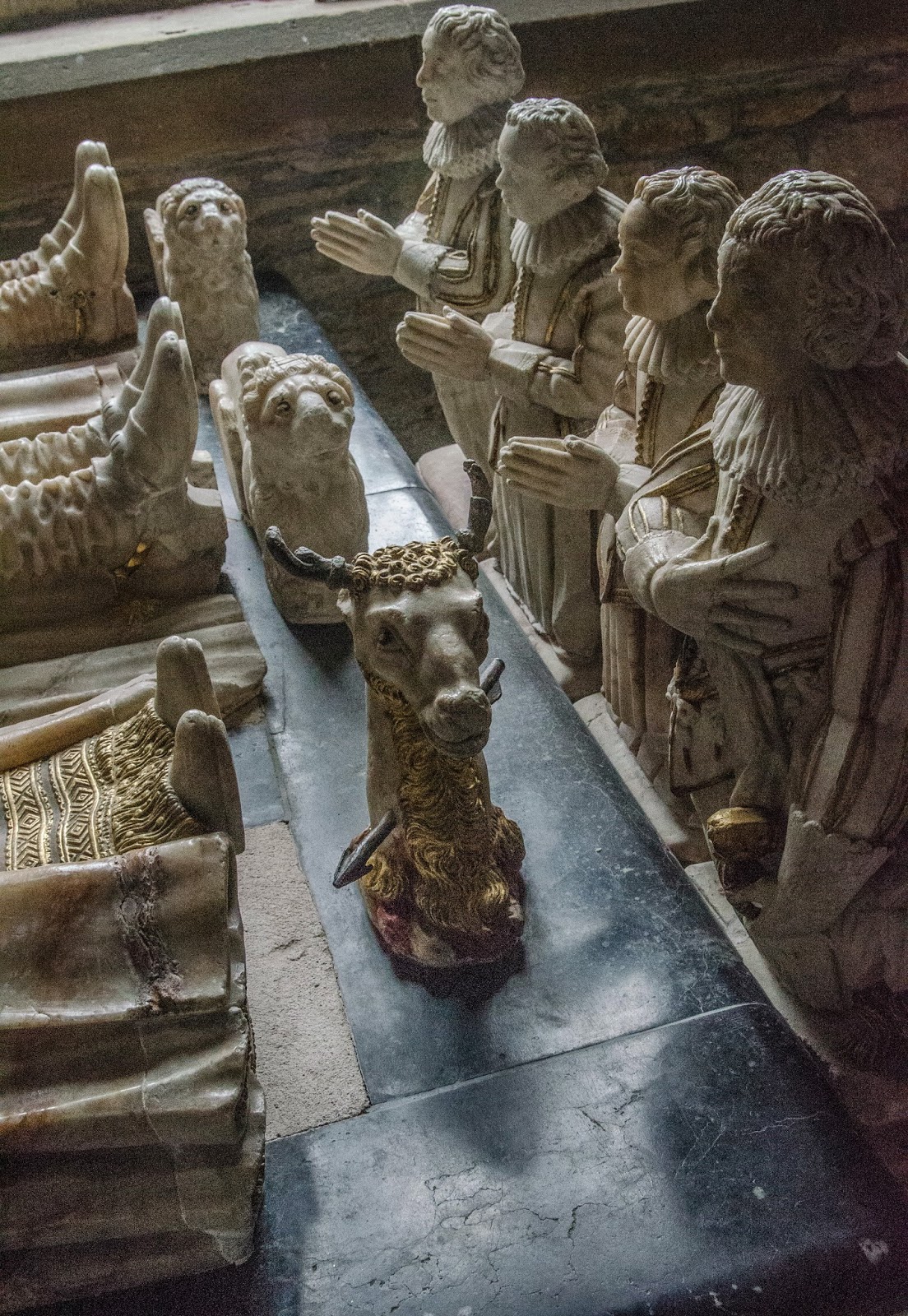
I took the photograph in Elmley Castle. Four of us reached there starting from Ashton-under-Hill, happily a dry walk this morning, with fine, long views: the rain has come back since. It was mostly firm underfoot across Bredon Hill, but horribly muddy on the long descent. (We trudged back the long way, around the road.)
In St Mary's Church, you can't fail to see and wonder at two extraordinary tombs. On one, dating from c1700, the first Earl of Coventry lounges nonchalantly in full wig, one hand reaching out to pick up his coronet. The other - 25 years, but what seems like a whole world earlier - depicts members of the Savage family. Three lie as if asleep, the lady holding her baby daughter; while four other children kneel attentively at their feet. And between them, the head of a stag, with golden locks and one remaining but wondrous ear: its neck is pierced with an arrow. Savage culture once more.
Labels:
Ashton-under-Hill,
Bredon,
Cheltenham Film Society,
Cineworld,
Coen,
Dylan Bob,
Elmley Castle,
film,
Ozon,
Santillana del Mar,
sculpture,
walking,
ww
Subscribe to:
Posts (Atom)