Thursday, 30 June 2011

Floreat Boesch


I photographed the great Austrian baritone, Florian Boesch in relaxed mood at lunchtime, after his taxing recital in the Pittville Pump Room. Taxing, yet he seemed just as relaxed on stage as off, in spite of the demands of his programme of Loewe, Schubert and Mahler songs.

As three years ago, when he stunned us with his Schwanengesang, members of the audience were on the edge of their seats for much of the time: in particular, the eight Loewe songs were brilliantly characterised. (I knew none of them.)

Cheltenham's own (it seems) Roger Vignoles was the excellent accompanist. But why were there so many empty seats? What is it about even the best lieder recitals that turns our concert-goers away?

Wednesday, 29 June 2011

Leaving Levers

Our local comprehensive, Bournside School will be closed tomorrow, along with many others, but the strike action is not - as it might be - because the school is abandoning its visual arts specialism. As a result of that bit of educational vandalism, Jake Lever, Head of Community Arts at Bournside, is having to find another job: thankfully, he has done so, and will soon, along with his family, be on the move to Birmingham.

Over the eight years he has been in Cheltenham, Jake has built up thriving community links: there has been a myriad of amazing projects involving professional artists and enthusiastic participants. The Visual Arts Specialism has enormously enriched the experiences of Bournside students.

So, tonight's private view at the Parabola Arts Centre was also a time to say farewell to one of Cheltenham's most prominent artists, Jake's wife Gillian. Gillian's abstract paintings, inspired by music, form the stunning centrepiece to this year's main Cheltenham Music Festival exhibition. With weavers Sue Hiley Harris and Anna Glasbrook showing alongside, it's a vibrant display in excellent surroundings - probably Cheltenham's premier exhibition space of that size.

Tuesday, 28 June 2011

Freedom (again)


Over supper, we've been "listening again" to the first of this year's Reith Lectures, given this morning by Aung San Suu Kyi. Such a brave lady! I was struck by her statement that, notwithstanding her Theravada Buddhism, her commitment to non-violence was not for moral so much as practical political reasons. One of several Christian references however was to Jesus' plea, "My Father, if it is possible, let this cup pass away from me."

Earlier, in the mass of SS Peter and Paul, the first two readings also spoke of what Daw Suu called "unfreedom" - that of the respective eponymous heroes of the day (or rather of tomorrow, since it was a vigil mass). We don't know how lucky we are; and yet how often do we pass over the opportunities so many Burmese daily make, to assert our claim to freedoms under threat?

Thursday, 23 June 2011

"A second barrel"


Over recent weeks, I have had back from the online publishers Blurb a couple of books comprising the posts to this blog - the first with those from May to December 2008, and the second (the cover is pictured above) January-June 2009. Indulgent? Certainly; but rather pleasing to think there is something more than just what's there on blogger.com.

Wednesday, 22 June 2011

Population matters


In the evening yesterday, Caroline and I biked down to a meeting in our Town Hall put on by the NGO Population Matters: its Chairman, Roger Martin was on the platform with Jonathon Porritt, whom he introduced as "Britain's leading campaigner on behalf of future generations". Jonathon (speaking of himself as a sustainability activist) boasted that he'd been described by Ann Widdicombe as "completely bonkers" for suggesting that the time would come when having more than two children might be regarded as irresponsible.

He quoted the 2009 report by Murtaugh and Schlax of Oregon State University, looking at the relative benefit of decisions which have an impact on one's carbon footprint. Based on then current figures, doing an aggregate of "good" things like driving a fuel-efficient car, introducing energy-saving measures at home etc. might save one individual a maximum of 500 tonnes of CO2 in a lifetime. Deciding not to have another child, however, would save nearly 9,500 tonnes - six times the average US citizen's lifetime CO2 use.

It was our wedding anniversary: this is one of the few images we had of us on that sunny day 36 years ago - there were no group photographs. Since then we have acquired four children and three grandchildren...

Monday, 20 June 2011

"Freedom"


In a family of cat lovers, it's hard to express anti-feline feeling; so I much enjoyed being able to read aloud a passage from Jonathan Franzen's "Freedom" to the family during our holiday (on which Thomas even brought along his cat). The riff comes towards the end of this marvellous book, where our hero, Walter is seen as "a nutcase and a menace" for wanting to protect the songbirds around the lake - where his family have been coming over generations - from the domestic pets brought in by the households in the new development, Canterbridge Estates. "The older cat owners on the street did politely accept the [coloured neoprene cat] bibs and promise to try them, so that Walter would leave them alone and they could throw the bibs away."

Franzen's gift is to be able to see the funny side of any serious argument. And so the book cavorts along through its nearly 600 pages treating all manner of particularly green issues in a highly entertaining way. I enjoyed it even more than his earlier masterpiece, "The Corrections".

Sunday, 19 June 2011

Roses


At lunch in Coln Rogers on Thursday, we had news about our old house (situated about half way between there and here in Cheltenham): we were there from 1983 to 1994, during which time I planted more than 50 different varieties of roses in the garden. The news was that they have now all been uprooted, as the people who bought the house from us (Londoners) seldom use the house, and have ordered the garden to be turned over to minimum maintenance.

A variety I never tried was one of my mother's favourites Iceberg; but my sister Charlotte gave Caroline a pair of the climbing version of Iceberg a few birthdays ago: we planted these up against our old apple trees, and - as you can just see from my photograph - they are doing really well.

Saturday, 18 June 2011

Fresh Air 2011


Lucy and David Abel Smith's Quenington garden seems fuller than ever this year, with weird and wonderful sculptures - 170 listed in the catalogue. "Fresh Air" has been going every other year for two decades now, a remarkable achievement on the part of Lucy and the other organisers. We were invited to the Private View today - it's on till 10th July. Coming round the corner of The Old Rectory, you see the Mill Race with Giles Rayner's copper Island, and on the far bank three of Rebecca Newnham's haunting Fledge figures, giant seed pods drifting in the breeze.

Friday, 17 June 2011

"The Diary of a Shropshire farmer" - again


It's arrived! There can be nothing much more satisfying than to receive a copy of one's own book in the post. Or seeing one's name as author on Amazon.

As trailed previously, my great-great-grandfather, a farmer, wrote a diary, two volumes of which have only fairly recently come to light. They cover his mini-Grand Tour of the North of England and Scotland as a young man of 23, and his day-to-day life in Shropshire during the two years following. Together, they give a snapshot of what British life was like in the 1830s. I have included an introduction, sketching the changes that he witnessed, and that our landscape faces today. This is the bare outline, anyway: it conceals an awful lot of hard work, and not just by me. Let's hope for some reviews!

Thursday, 16 June 2011

Hits and misses - 2


Still to do is the sorting of photographs taken during our fortnight away - and the deletion of many of them. Some of the "hits" include this early morning scene from just outside our lofty Castillian B&B, where we spent the night we arrived in Spain. Wind turbines were everywhere to be seen in both Spain and Portugal. How do they get them up to some of those high places!

And we admired the engineering of all the many tunnels and viaducts on what is an astonishing motorway network: especially below the Picos de Europa, the views of both coastline and mountains are breathtaking, but no photographs alas! I was sorry also to miss the chance of trying to snap the pod of dolphins that accompanied us as our ferry made its way through the rather uncomfortable swell of the Bay of Biscay on Monday evening: my mind was on other things.

Wednesday, 15 June 2011

Hits and misses


Plenty of time is needed in the Asturian city of Avilés if you are looking for the new Niemeyer Centre there. The shining white architectural shapes of Oscar Niemeyer's design stand out a mile off against the harbour backdrop, but as you approach closer by car, the cultural centre itself seems more and more inaccessible. The signage seems non-existant! Eventually, we gave up, so the nearest I came to a photograph was when we saw Caroline's young cousin wearing the T-shirt.

Other cities' attractions, however, proved a hit on our trip: gliding out of Portsmouth with Brittany Ferries, we admired Nelson's Victory. Burgos Cathedral was distractingly beautiful for our Ascension mass-going. Picking up Agnes from Porto airport terminal (it opened five years ago) meant we could admire its brilliant design at close quarters - an extraordinary contrast with nearby Braga's mediaeval heart.

Tuesday, 14 June 2011

Fecundity


We arrived home safely today after 18 days away with the garden looking very overgrown. It's not the ideal time of year to be away. Meanwhile, in Cantabria yesterday morning, before catching the ferry, we revisited Santillana del Mar, that astonishingly perfect (and surprisingly unspoilt) mediaeval town with its stone-paved streets and luxuriant window boxes. Everything is way ahead in Spain (and Portugal), with the main problem access to water, as I hinted last week. The smallholders of our village open and close the channels diverted from the mill stream by an elaborate dance movement, so giving life to their maize crop. We just turn on the hose.

Wednesday, 8 June 2011

Old and new in Portugal 2011


We are getting to the end of a fortnight at a rented mill house, Casa do Lagar, a few miles North of Ponte de Lima, in the Portuguese Minho: I have been on holiday from blogging as well as generally. The first week was hot, but the weather has changed rather, and as some of the family has now left, I have returned to the computer, despite snail-like connectivity.

We are only half a mile from the A-3 motorway, with a working quarry a similar distance away the other side, but the main sound reaching us is that of running water, with the occasional ox cart trundling past on the lane. Apart from our garden with its swimming pool, all the land around is intensively cultivated – sweet corn, grapes, cabbages etc. The vines mark the boundaries of small fields hardly bigger than allotments: their owners are out both early and late with hoes, diverting streams of water for irrigation.

In the huge Ponte de Lima market, these same smallholders can be seen seated with their produce about them, or perhaps a basketful of rabbits. They stare at us, as we do likewise by training our cameras upon them.

Thursday, 26 May 2011

"A sustainable world: reasons to be hopeful"


Jonathon Porritt spoke to a full house at our local Friends' Meeting House last evening on this, at first sight surprising, theme. (I had organised the event on behalf of Christian Ecology Link, of which Jonathon has for long been a Patron.) It was appropriate for "hope" to be the watchword at a Christian gathering, though "optimism" was how Jonathon more often referred to it - something rather different.

He spoke powerfully, and with his customary fluency - who answers questions more generously? - about the uniqueness of human knowledge; about the benefits that he perceives will come from technology, and about the new mandate existing in civil society worldwide, to create wealth with lower impact. And he suggested that, so far from being wired for agression, we might indeed be wired for empathy, his "hopeful" conclusion being that "the sheer urgency of the crisis will bring us together!"

But we need to call upon our spiritual resources, and - crucially - at present, social justice is not there in the churches' practice, even if it is in the teaching.

Monday, 23 May 2011

Birthdays


It's that time of year again.Today, Caroline gave me an early birthday present of a new wheelbarrow, to replace our old rust bucket. Definitely not worth wrapping up and taking with us to open in Portugal next week! On Wednesday last, it was Leo's birthday, which he celebrated in Osaka. On his return, he came yesterday to report, and whilst here baked this cake for his workmates today. Orange and chocolate.

Sunday, 22 May 2011

OAE at NSF


Last October, I photographed Zoe Shevlin, bassoonist, playing at Tetbury with the Academy of Ancient Music. Last night, she popped up in an enlarged Orchestra of the Age of Enlightenment for the final concert in this year's Newbury Spring Festival. We were invited by Sarah as a joint birthday present.

On paper, the programme looked unchallenging, symphonies by Mozart and Schubert and Beethoven's 4th Piano Concerto with Artur Pizarro; but in the way Paul Daniel and the OAE tackled it, fresh sounds seemed to spring out all the time. In particular, the slow movement of the concerto came across as more sublime than ever.

It is always a pleasure to be allowed to join in such a friendly festival as Newbury's, church pews notwithstanding. The cavernous St Nicholas' in Newbury was of course packed. Sun streamed in through Hardman glass ("not good" in Pevsner's judgment), and there was still light in the sky as we drove homewards later along the M4.

Saturday, 21 May 2011

"livesimply"


Clifton Cathedral was the scene of the launch, last evening, of a livesimply award scheme. The idea is aimed at engaging parishes so that they take God's creation seriously.

Christian people are challenged to live simply, to live sustainably with creation, and live in solidarity with people in poverty. CAFOD launched the livesimply campaign five years ago; but now it's been repackaged for community use. A couple of parishes are leading the way, and were represented in the Cathedral yesterday: the schoolchildren of one of them performed a movement piece to St Francis's Canticle of Brother Sun: very nicely too.

All we need in Cheltenham is a handful of people to take it forward...

Thursday, 19 May 2011

Commercial consumer waste


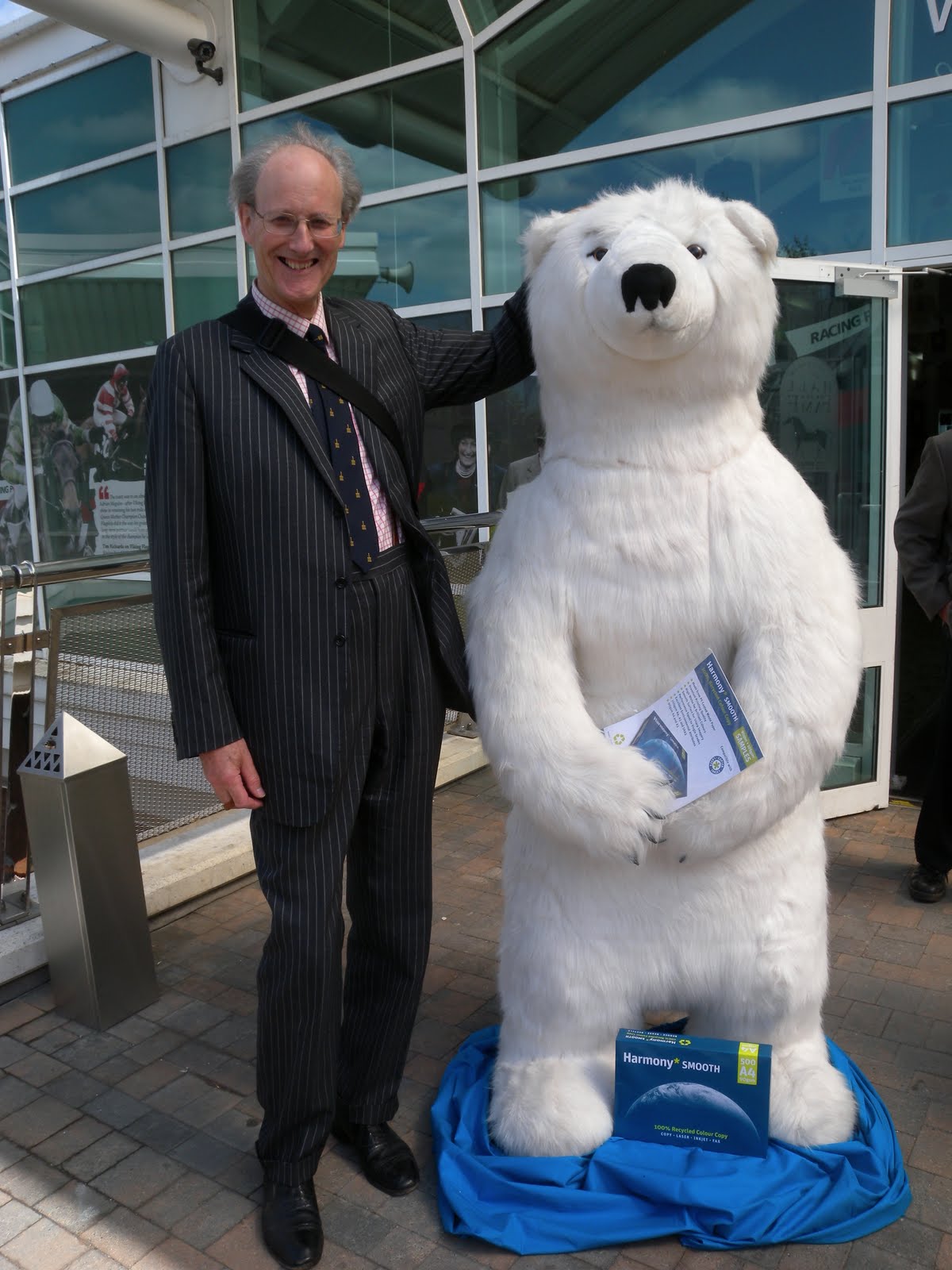
Not often these days do you see me in a suit, and only very rarely escorted by a polar bear. I was at Cheltenham Racecourse, not for the horses, but as a guest of the Commercial Group, whose 5th annual CSR Day took place today. This was a follow up from the chance meeting I had with someone from Commercial at the Cheltenham Connect pub quiz earlier in the year.

It's quite a big deal, CSR these days. On the whole, it seems right for Commercial to shout from the rooftops about their success in meeting carbon reduction targets etc. Their Green Angels scheme sounds good fun, and really does breathe life into the organisation, as claimed. And it's good that being green doesn't have to cost more.

I was drawn to go by the prospect of hearing Franny Armstrong in the flesh: she had made an impression on me with The Age of Stupid and 10:10; but today she looked weary. And by the end I too was weary of the relentless proferring of consumer items - albeit recycled - by those manning the many stalls, which pay to finance the Day. As Franny says, the problem is that we see about 200 advertisements every day: how can we counter their effect?

Wednesday, 18 May 2011

"The Diary of a Shropshire Farmer"


I mentioned last week the impending publication by Amberley of my great-great-grandfather's diary: well, now here's what it will look like. I'm told the book will be in my hands in four weeks' time.

A kind friend let me use her Claude Hayes Haymaking on the cover. Ideally, there would be a portrait of the diarist on the front, but there is none: so little is known about him apart from the two diaries - discovered by chance - which make up this volume! As I say in my introduction, it's a lot down to the fact that my father never knew his grandfather; my grandfather never knew his, nor his father his.

Sunday, 15 May 2011

High definition performance


Not only do we have a Spanish señorita staying at the moment, but a Swiss mister too. Paulo, employed by Nespresso and notwithstanding his name from the French-speaking part of his country, is here for a fortnight’s intensive work with Caroline on his English. The Japanese in particular are fabled present-givers, but nobody has ever arrived laden with so many gifts as Paolo, generous man. And game too: we were booked in to the Met. live relay of Die Walküre yesterday: “May I join you?” he asked – not having any previous opera-going experience, still less any experience of grappling with Wagner’s Ring.

Happily, Robert Lepage’s new production (costing upwards of $16m) could not be clearer for the viewer: it is in fact outstanding in all respects, with a stunning set: a simple concept, but fiendishly complicated technically – the start was delayed half an hour as computers were sorted out, so we learnt. It’s always a worry that such a delay might mean one of the stars is struggling to be fit.

That was no problem yesterday: all six principals were in geat voice. Though Deborah Voigt’s Brünnhilde is never going to be to my taste, all the others are perfectly suited to their parts, with Bryn Terfel the most human of Wotans, and his stage wife (the superb Stephanie Blythe) the most statuesque. During Die Walküre, there is always a heart-rending moment, depending on the performance: last night, it was Eva-Maria Westbroek’s O hehrstes Wunder! which made the hair at the back of my neck stand up. The conductor was Jemes Levine, clearly in considerable discomfort: I had no desire for 3D, but do wish we had had surround sound: the Roses Theatre, Tewkesbury doesn’t run to that.

"Why does it need to be so long?" asks Caroline. Something of an answer to this is given by Alex Ross in his recent New Yorker article: "Ultimately, the bond Wagner forms with his listeners is one of pure, wordless emotion, and his gift for capturing the nuances of human feeling constantly complicates our response." This takes time.

Earlier in the day, we had enjoyed a different sort of theatrical experience, champagne breakfast with kind friends who were staying at the new Ellenborough Park Hotel in nearby Southam. No expense has been spared there either.

I spotted that today is the third anniversary of this blog. Can I really have been retired so long?

Friday, 13 May 2011

A touch of Galician Spring


On the day of the Royal Wedding, our very own younger version of Pippa arrived to stay – from Spain. A graduate of Vigo University, Lorena is looking for an internship here, where she can put to good use her excellent English and her skills in advertising and public relations. Meanwhile, she is completing a year at the University of Gloucestershire, and lodging with us till the end of next month.
She’s already had a good go at me for not making more of my photographs. I’m about to put her at work finding us casas rurales to stay in, on our way back to the ferry after our fortnight with Thomas in Portugal.

Thursday, 12 May 2011

Peter Davis' diary


I mentioned last year that I was on the way to seeing my ancestor, Peter Davis' diary into print: well, I now have a date from my publishers, Amberley: I caught the bus to their new Stroud offices - pictured - on Tuesday.

And the date? Rather fortuitously, it's my birthday, 30th May! So, look out for more in due course about "The Diary of a Shropshire farmer: a young yeoman's life and travels 1835-37".

Wednesday, 11 May 2011

News from Miri


Jemima Louise Rose Lawrence is the newest name for our family tree, born 7,000 miles away in Sarawak just over a week ago, to Kate and Oliver. With her cousin Sofia Filippi, arriving six months earlier for Hannah and Fabio, she evens things up as between my father's male and female offspring - seven apiece now.

Two granddaughters will surely keep my sister busy for a few years, particularly coming as they do from the more multinational department of our immediate family: she's naturally planning a visit to Miri fairly soon.

Tuesday, 10 May 2011

Rattled by 3D


A friend rang to tell me he had wasted most of Saturday morning trying to book for the Dudamel concert at the Proms this year: by the time he got through, it was sold out. Simon Rattle was once regarded by the critics as Dudamel is now, but barely a couple of handfuls were all that turned up to Cineworld, Cheltenham last evening for his appearance in the world's first 3D HD symphony concert film. My photograph shows what it's like being at a 3D performance without special glasses; though I'm bound to say wearing them gave me as much of a headache as taking them off. (The sound was brilliant.)

The snapshot shows a conductor, now 56, who used to be a familiar figure in Cheltenham Town Hall when half his present age and in charge of the CBSO. Then the hair was black, there was a lot more of it - and, dare I say, the shoulders were less hunched.

The concert - Mahler and Rachmaninov - is filmed in Singapore's amazing Esplanade concert hall: the way the first part is presented puts the audience in the passenger seat on a test drive with Sebastian Vettel - an audience, that is, which normally prefers the comfort of a sedately-driven saloon car. Things improve with the Rachmaninov, where we are treated to something of a Singaporean travelogue. Very beautiful too.

Would I go again? Yes, I think so, depending on the make-up of the programme: last night, the Cineworld website gave us not a clue as to what was in store! But I'm not sure the 3D adds much.

Sunday, 8 May 2011

Cerney House


Caroline had been there before, but Friday was my first visit to Cerney House Gardens. I was delighted to have seen them, the more so as there were few others there when we went, so that it seemed as if we were monarchs of all we surveyed.

Jumping perhaps to conclusions, it seems that the Anguses came to North Cerney nearly half a century ago, developing their enormous garden gradually, so that it now percolates both up and down the wide valley above the village. There has been much tree planting, including this group of four quinces, amidst many varieties of tulip surrounded by box hedges - this (for me) was the main focal point.

If truth be told, I found the whole place a little run down, as if it was proving too much even for the large team still in service there. It is one thing to foster a natural look, and another to lose that sense of vibrant coherence you get with a really convincing garden, such as Rockcliffe.