Wednesday, 30 July 2008
Pinswell
Tuesday, 29 July 2008
Godfather Michael, R.I.P.
When I first went into partnership as a solicitor, it was with Michael Rawlinson and Harry Wiggin in 1974. Michael, his wife Anne and their two (then young) children Nicholas and Susan became firm friends. Michael was Leo's very fond Godfather: he never forgot a birthday.While Harry and I moved on, Michael stayed at Wiggin and Co (it was always "and" then) until his retirement, 11 years ago. Latterly he was the firm's PSL, one of the first of that breed in this country, and one of the best: Michael ran a very tight ship in the legal information flotilla, and played an important part in securing for his firm its high reputation in a specialist field. (He would no doubt have been quick to draw attention to the mixed metaphor - not in any pedantic way, but illustrative of his deliciously dry and self-deprecating sense of humour.)
The cruelty was that no sooner had Michael retired than he contracted Parkinson's Disease, which with added complications immediately laid him low. Little of that travelling he had longed to do with Anne was possible, and none of the walking. Rather, his life became more and more an alert mind imprisoned within a bent body. Even a short while ago, when visiting him at our nearby Sue Ryder Home, he had books on mathematics and the Northern saints at his side. On a rare occasion he lost the thread during his conversation with me. "Please talk among yourselves," he said.
Anne looked after Michael at home lovingly, with only very occasional breaks when she went to see the children (now happily settled in Spain and America). She would ring me if this meant I could visit Michael in nearby respite care. She did this most recently last week. I noticed a change in him on Friday, but on Sunday he seemed more on the ball. Yesterday morning, when I called, he was sleeping in his chair, Radio 4 playing as usual. I sat with him for 15 minutes, watching his face change mood, a smile twice flickering across it as he dreamed. Poor man, I thought: he looks so well - surely this living death could continue a long while. Please let it not be so!
In the evening, Anne rang to say that Michael had died - suddenly and peacefully whilst being given his lunch. Thanks be to God, but equally - as Leo said - "How sad, as he was such a nice bloke."
Monday, 28 July 2008
Chris the hedges
That's the bare facts; but beyond them there are the chats over the coffee (the whole of life is here); Chris's deadpan humour; his pride in the progress of his twin sons - Mark, the tennis player, has come with him the last couple of years; and (this year) Ruby, the mad puppy. Chris is one of the nicest, most capable people I know, but also one of the most modest - oh, and chaotic.
Sunday, 27 July 2008
Matthewman's - not this year
In Matthewman's sweet pea catalogue, you will find a bewilderingly long list of getting on for fifty varieties. Since seeing their stall at the Chelsea Flower Show, I have bought Matthewman's seeds and planted them in late Autumn as instructed; but last year's purchase - for some reason - remains in its wrapper. So in April, realising I had missed the boat, I bought some plants from our local florist/greengrocer, Robert Young: they have done brilliantly! The most delicate colours, and the longest, straightest stalks - some more than 18" - you could wish for.Sweet peas are such a gift. You provide a simple structures (as for runner beans) and wind some string round it, then hey presto! They do the rest themselves. On the row, so long as you keep cutting - which you can do for ages - they look ethereal: in the hand in a bunch, they make a great bouquet: in a vase on the kitchen table, they are best of all, giving out their delicious scent. Their short life makes them all the more special. Whom the Gods love die young.
Saturday, 26 July 2008
Washbrook
Having set off in time to meet our friends John and Sue Colquhoun for a walk beforehand, we aimed Westwards from Painswick into unfamiliar territory. Our path followed the Cotswold Way for a mile or so, then branched right down into a likely-looking, wooded valley, leading to what turned out to be the Washbrook. Soon we came across an unexceptional mill building, just like so many one comes across beside a stream - but look at this William and Mary doorway!
Walter Hawkins, a Bristol brewer, built Washbrook as a grist-mill, it seems. Successive owners milled cloth and then corn here for more than two hundred years. Hawkins' coat of arms, flanked by more swags, surmount another doorway on the same frontage, with an oval window above.
What extraordinarily rich carving to find in the middle of nowhere! (What an encouragement to go places on foot!)
Thursday, 24 July 2008
Is the Pope green?
Leo Hickman raised this question last weekend, in the Guardian. It followed Pope Benedict's words in Australia: gazing out of the window on his flight there, he had, he said, been filled with introspection about the plight of the environment.
Benedict is getting something of a reputation as a green Pope. Solar panels have appeared on Vatican buildings, and the Apostolic Penitentiary numbers ecological offences amongst new forms of social sin.
Moreover, Vatican City boasts it is the only sovereign state to have zero carbon dioxide emissions - thanks to the Vatican Climate Forest in Hungary. But, as a theologian from Louvain University points out, where is the justice in this "indulgence-type" method of offsetting one's carbon footprint?
As expected, Hickman's crunch point is to home in on the population consequences of the Church's opposition to contraception - much the same as I reported Jonathon Porritt had concluded in a blog I posted last month.
The Vatican hosts, amongst very many other organisations, a Pontifical Council for Migrants and Itinerants, headed up by a Cardinal. Travel lightly, it urges: use public transport, carry less luggage and do everything you can to make your holiday environmentally friendly. But what about Vatican Airlines, launched last year to ferry pilgroms back and forth to the world's shrines? Given that a pilgrimage is a metaphor for life's journey, shouldn't we be thinking more in terms of making virtual pilgrimage these days?
Those who may have been gazing down from the two planes in my photograph could also have been "filled with introspection," but it is only we who gaze upwards that see the damaging vapour trails.
Slow Sunday
So, wellcome to Resurgence's Slow Sunday idea! The first is this coming Sunday 27th: we are urged to make bread - and even provided with a recipé. As Satish Kumar says, only 4% of bread is baked in local bakeries: "Lorries full of factory bread," he writes, "rush up and down the country on our motorways, polluting the air so that they can provide the nation with cheap bread. But we have paid a very high price for this cheap bread in CO2 emissions and climate change. This mass-produced bread is stale and sterile."
(I spotted these delicious-looking rolls - they were baked locally - in the window of Barber & Manuel's, Leominster: we visited it earlier in the month.)
Tuesday, 22 July 2008
OYBike
Paris, Barcelona and now... Cheltenham! As I anticipated last month, the University's new cycle hire scheme has been extended throughout Cheltenham as a whole. It's England's first town centre scheme.
Any of 30 bikes can be commandeered at any of nine docking stations - like this one in Montpellier.
And it's free for the first half hour, so you can for instance jump on at the Station and leave your yellow cycle in the Town Centre. If you want one for the day, it's £8 - quite a bit less than the cost of two gallons of petrol. There has been no great rush for them yet - the procedure needs simplifying - but it is early days, and the recession has hardly begun to take hold.
As Cheltenham's terrain is basically pretty flat - compared to somewhere like Sheffield or Bristol - and we are all having to extend our mortgages each time we fill up our fuel tanks, it should succeed.
Monday, 21 July 2008
An die musik
There could be more such jollity at the Cheltenham Music Festival: I gather there is at festivals such as Buxton and even the dear old Three Choirs. It might help to swell our audiences, which - judging from the dozen events I attended - were poor this year considering the quality of the performance: a very thin house in the Town Hall, for instance, for the sublime Sarah Connolly. And the Town Hall was not exactly jam-packed - as it should have been - for Taraf de Haidouks on Saturday night. (It was good to see our MP Martin Horwood there and his two young children, sitting on the floor tapping their feet.)
The modest turnout can't just be the recession. Where - at the classical music concerts - is the dark- and fair- (as opposed to the white-, the grey- and the no-)haired generation, which throngs the Albert Hall during the Proms season? Is it just Cheltenham, or is it the way we promote the Festival - with rather expensive seats?
Some Festivals ago, the Summerfield Trust gave a grant to enable best Town Hall seats to go to quite a number of children from local schools for a performance (Richard Hickox conducting) ending up with a long Rachmaninov symphony: I recall a gloriously noisy reception in the Drawing-room. It was not an unqualified success - the children had been insufficiently prepared, and it wasn’t the right piece to submit them to. However the principle is right: make them kings/queens for the day, and let the usual audience have a back seat.
Had the marketing for Sarah Connolly been different, with 300 tickets at £5, we could have had a full house, and more income overall at the box office. Our Cheltenham Festivals have become too institutionalized - too much rigid thinking about marketing and sponsorship; and too much visual emphasis on the catering facilities, fine tea-tasting etc. OK, we can't do it without sponsorship, but does the front cover of the Festival programme brochure have to be so dominated by their names? Where does it tell us anything at all about THE MUSIC we are hearing? Isn't music what this Festival is supposed to be about?
In particular - on the three last days - we had performances of the three great Schubert song cycles, with superlative singing by Allan Clayton, Florian Boesch and (an unrecognisable) Mark Padmore, as well as playing by the accompanists Paul Lewis and Roger Vignoles. My neighbour on Saturday for Winterreise had been present at the very first Cheltenham Festival over 60 years ago (and most since), but couldn't recall such fine musicianship. Even for these three events there were some empty seats: Cheltenham's Schubertiad deserved better publicity - and international acclaim.
[I have blogged already on the Festival - here, here and here, in case you are interested.]
Maggie's Cotswold Farm
As Colin Russell was one of the organizers, there was traditional jazz, live during the afternoon, and an ice cream stall. The sun mainly shone, but there was the inevitable rush for umbrellas at one moment. Cotswold Farm is set in an almost unspoilt stretch of countryside, North of Cirencester, with views towards the Wiltshire Downs, its flower gardens tumbling down into a secret valley. There is a huge and productive kitchen garden too: we bought lettuces.
(More photographs here)
Sunday, 20 July 2008
20th meeting of the book group
I had been there on weekends when my parents came to visit me at All Hallows; so my last acquaintance with Wells was 52 years ago. I hardly remembered it at all. Simon led us around the Cathedral and precincts: a magical tour, ending in an old prebendary's house, called - why? - The Rib, with the most mysteriously beautiful mediaeval interior.
The book for discussion? Marguerite Yourcenar's Memoirs of Hadrian. The score? Two of us liked it, two didn't. I didn't (much). 300-odd pages with no dialogue: an impressive attempt at historical reconstruction, but a bit charmless I thought. More interesting as an insight into the author, than the subject.
Friday, 18 July 2008
Fit to print
Hooray! Caroline's latest achievement has been wading through a sea of bureaucracy to help establish The Gardens Gallery, which greatly enhances the experience of a trip to Montpellier, as many are finding.
Other family news: Edmund is in Cork, sailing. Leo and Mini have been busy furnishing his flat. Thomas is off in a few weeks' time to Lisbon, to live there for a while (if you have any Portuguese contacts, do email him). Agnes has two or three weeks' house-sitting lined up shortly, and is open to further similar offers. Ida has four teeth, which make themselves felt, and are easily visible as she hardly ever stops smiling. Rosie has lost her Winter coat (and is twice the dog for it). And we still await a buyer for our house, but meanwhile enjoy, if not the sun. then the Summer garden smells: lavender, pelargonium, dianthus, jasmine, roses, tobacco plants, sweet peas and night-scented stock. Still no datura flowers though.
Thursday, 17 July 2008
Marc-André Hamelin
With such musical excellence, it's peevish to complain. But if you know me, you will not be surprised that I do, on two aesthetic counts. First, I loathe the Stygian gloom into which the Pittville Pump Room is plunged by the curtains being drawn. This problem seemed to have been cracked last year. There are volunteer helpers around: if there is a potential risk that people will walk past the windows during the performance, then why not post someone outside to redirect them? The interior of Cheltenham's most beautiful building looks so much better in daylight.
Secondly, the size of the catering marquee grows like Topsy. The picture I posted with my blog last week was taken at last year's Festival. At least then one could see some of the front of the Pump Room from Pittville Park, but this year it is impossible to walk into the Park during a concert interval without going through a tented city - which (with its ill-matched hoardings) completely dominates the view when walking up from the town centre. What a shame! I thought this was supposed to be a Festival of Music, not another Festival of Food & Drink.
Wednesday, 16 July 2008
Widdershins zoo
Jeremy, Caroline and I had a dampish walk along the Cotswold escarpment below Long Compton, a pretty village, which I remember driving through each weekend on my way back and forward to London, when staying with my parents at Arrow. Somehow, it has survived those years of heavy traffic. Long-term residents no doubt still breathe a sigh of relief. The trouble is, there surely can't be by-passes for every such village, can there?
More photographs here if you have the energy.
Tuesday, 15 July 2008
"Is modern music murder?"
I've only just caught up with Joe Queenan's provocative article with this title. Listening to Peter Maxwell-Davies's new piano quartet on Sunday morning at the Pittville Pump Room, my thoughts went along similar lines: I hadn't read any programme notes, so heard it with an innocent ear. For one reviewer it "commanded total attention over its 24-minute span." I was talking to her in the interval, and - coward that I am - declined to air my view then: for this listener the 24 minutes could not come to an end soon enough. But at the outset of this Primrose Piano Quartet concert, I did much enjoy their performance of the Dohnányi String Serenade.
It was rather the same story on late Thursday night at the Town Hall Tickell & Bhamra session: spnm put it on to explore the possibilities of combining Indian and British folk traditions. The motley quintet (Northumbrian pipes, sitar, tabla, melodeon and fiddle) came with eight works - four written out by spnm composers, four composed by the players themselves: the performances of the latter - sometimes verging on a jam session - won hands down. I was describing the programme to someone at a later concert: evoking Goering he murmured, "When I hear the words spnm, I head for the exit."
Nobody was doing this on Friday morning, when the Estonian Philharmonic Chamber Choir (in their second Cheltenham Festival appearance) were performing unaccompanied music from their folksong treasury. An astonishing sound! And free wine afterwards.
Friday, 11 July 2008
Marches past
Means of transport (this was supposed to be a low-carbon holiday!): OK, so we did drive 466 miles; but taking our bikes on the back of the car: we had three days' cycling round the villages - no punctures and not too many hills; and we had a number of longish walks - along Hergest Ridge above Kington and in the woods at Croft.
Sunshine? The swimming trunks I took for all those refreshing dips in cool river pools came back unworn. It seemed to rain most days, but never for too long that we were in danger of losing our sense of humour. The worst moment was listening to the actor playing Richard III say "All the clouds that lour'd about our house" were "in the deep bosom of the ocean buried" whilst sitting on a plastic chair in a pool of water.
Food: we liked all the pubs we visited for lunches (and some suppers) out - and the little Hat Shop Restaurant in Presteigne. There was much emphasis placed everywhere on local produce. It's not quite the same as being in France of course, but the food was just as tasty - and probably cheaper.
Best bits: the landscapes; the villages; churches, and their embellishments; little things that catch the eye; the architecture; the gardens; the trees; the windows and doorways; the friendly natives; the history - including lots of Davis family history, inevitably (boring for poor Caroline) - and being an hour's drive from the nearest dual carriageway.
Wednesday, 9 July 2008
Mad north-north-west
I shall try to put together a bit about our fortnight away later (by popular request!). Meanwhile, one memorable event last week was Shakespeare's Richard III in the ruins of Ludlow Castle. With strong performances from the three tragic queens (bringing to mind Macbeth's witches in this production), I was struck by the way the play both contrasts and overlays the mad with the bad.But for me the holiday's most searing experience was to visit (earlier that same day) a former work colleague. Not much my senior in age, he has for the past year been confined to a home for elderly people with dementia. Once the childlike excitement in his voice subsided, he might have been the man across whose elegant office desk we used to sit and chat. When I told him we were staying near a big house locally, “We used to go to dances there,” he recalled. I brought along some rather ritzy wafer chocolates, Ludlow's best. “Like After Eights,” he said, as he struggled to open the bag. Eventually, I did it for him; and he then proceeded to scoff the lot within the space of five minutes. Death by chocolate would be a merciful release, I thought.
Thirty-nine years ago, I was present in the Queen Elizabeth Hall for the première of Peter Maxwell-Davies's Eight songs for a mad king. It was a novel sort of occasion: members of the Pierrot Players sat in cages on the stage, with a frenetic Roy Hart as the deranged King George - as mad, but not as bad as his predecessor Richard also III - leaping around them, and eventually seizing and stamping upon a player's violin. At the end, the composer Max, looking for all the world like a schoolboy, jumped up onto the stage to storms of applause.
Was it all a con, I wondered, this blend of foxtrots, gavottes, didgeridoo, birdsong imitations and the rest? Now the work has the status of a classic. Even a wine is named after it! And its creator is Sir Max and revered as Master of the Queen's Music.
This afternoon, in the Pittville Pump Room, Max discussed his piece with conductor Charles Hazlewood as part of our Music Festival, before its performance by Psappha - one which (in the light of last week's experiences) made excellent sense, in its commemoration of extreme madness with extreme music.
Tuesday, 24 June 2008
Gloucs. and Herefs.
It will be interesting to compare and contrast the Cotswold countryside with that of Herefordshire, where we shall be spending the next two weeks – at a variety of locations: we had thought of going to France, but decided to stay nearer to home – for a variety of reasons! First, just to cover the remote possibility of someone wanting to buy our house, and to move in quickly, it will be good to be able to get home easily. Secondly, we need to walk the talk about reducing our carbon footprint; and thirdly, I have still to see the colour of my pension provider's money. More in a fortnight.
Saturday, 21 June 2008
33 and counting
Now, here we are with our three grandchildren for the weekend: what could be better! But I do wonder what sort of a world it will be for them 33 years hence.
Friday, 20 June 2008
Out to tea
I was surprised to learn that Marigold's mother and her three children had only come to the Cotswolds in 1943, when Marigold was still a teenager. Upon arrival at Upper Dowdeswell Manor, they were paid a visit and asked "Where are your horses?" "We don't have any." "Oh," said the neighbour, "what on earth will you do with yourselves!"
Marigold at length told her hospital boss, amid many tears, that she was leaving. "What next?", he asked. "I am buying a cow," she said, and so began a happy time building up a herd of pedigree Jerseys.
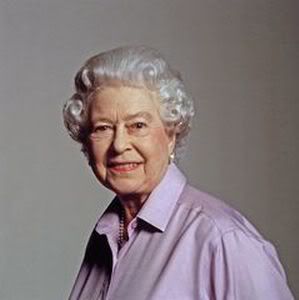
Everything of which Marigold spoke seemed bathed in affection; nothing in affectation. Despite not having had the best of health, she looked as serene as ever, more and more resembling the Queen, to whose sister she was such a good friend.
Thursday, 19 June 2008
Recessional
In this dire housing market, Humberts will have been pleased to have sold five out of the seven properties included in their auction last evening, at the Queen's Hotel here in Cheltenham. Four weeks ago, I outlined the plans we had for when I retire and sell our house. Since then, one couple only has been round. Frustration is setting in! Particularly as we have worked hard on the garden, which is looking at its best. But yesterday the telephone rang: someone else wants to come round tomorrow. Great excitement!
Meanwhile, also yesterday, we had Barry the carpenter at work boxing in pipes in the basement; a new carpet laid on the kitchen staircase, and I went to buy two new loos from B&Q. Recalling the days when there was an ironmonger's shop on every High Street, it is quite a shock to go to B&Q: it must take up a site rather bigger than the average football pitch. Going in, I turned left, but eventually found myself at precisely the wrong end of the store. After telling me his life story, a cultured assistant pointed me to Aisle 23 in the far distance, saying Two loos? Long trek. Here's some Albi brickwork.
Wednesday, 18 June 2008
Garden news
Today it looks as if we may at last have a bit of the rain we need. The runner bean plants are flowering too early and are covered in black fly. Home Guard potatoes have only just come into flower: Tim Rose Price (400 foot higher up) says he is eating his. My lettuice plants have been eaten by the slugs, and seed has twice failed to germinate: the rocket gone to seed. We have had some radishes, none exactly a prize-winner. Rhubarb is good; gooseberries and raspberries are now on tap. Caroline is fighting with the pigeons over the currants.The Philadelphus, the pineapple tree, sweet peas and Sweet Williams are all flowering; and the lavender and a rather wonderful dark blue iris. The white clematis looks better than usual in our far apple tree. A tobacco plant has seeded itself by the door of the bikeshed. The oriental poppies are nearly over. Of the roses, New Dawn, the big rambler on the stable and Buff Beauty are all past their best, but Félicité et Perpétue is just coming into full bloom, and Compassion is as good as ever. On 17th June last year, my Datura had ten blooms - see photograph: this year there is so far nothing showing.
Graham Sutherland has a vivid drawing of Datura blooms in the Arts Council Touring Exhibition, "Geometry of Fear", currently showing at the Cheltenham Art Gallery, which I saw yesterday: it features work created in the aftermath of World War II - from the exhibits, a time of hope, as much as fear, it seemed to me. The show is very worth a look - if you happen to be in Cheltenham, Rhyl, Plymouth, Ayr or Leamington Spa between now and next March!
Th Gallery also has an excellent Hogarth print exhibition - on till the end of next month.
Tuesday, 17 June 2008
Football matters
It makes it much easier to watch, with England out of the equation. And on such an unseasonably chilly night, we didn't mind sitting with supper on our knees, rather than being outside at the round table in the garden, which is where one would expect to find us on 16th June.
This alternative football photograph was taken when I was walking near St Agnes in Cornwall last July.
Sunday, 15 June 2008
Designer oak
The Pinetum was the starting point for one of our family bike rides, to St Weonards. I seem to remember the first puncture occurred about ten minutes after we had set out down the woodland track - and the last (of several) some hours later.
Which reminds me that this is Bike Week: the Cheltenham Cycle Campaign were handing out leaflets in the High Street and showing off the smart yellow bikes you can hire if you belong to the University of Gloucestershire - and which may soon be available to all Cheltenham residents, as they are in Paris and elsewhere.
Saturday, 14 June 2008
Onegin and much champagne
Sadly, this was one I took last year! On Thursday at Glyndebourne, it was a cold and rather damp evening for Eugene Onegin. But not on stage: what a production! And an unforgettable Letter Scene. Thanks to our most generous hosts, we cannot believe our good fortune in catching it.
Nonetheless. I reported last week 's Science Festival reflection that we have not yet had our Pearl Harbour moment when it comes to climate change: in the Guardian, also on Thursday, Mark Lynas writes: "If current [climate] policy continues to fail... then 50% to 80% of all species on earth could be driven to extinction... and much of the planet's surface left uninhabitable to humans."
So, what becomes of Glyndebourne? Are they fiddling whilst Rome burns? The usual magnificent programme book proclaims carbon-neutrality. In his Foreword, Executive Chairman Gus Christie mentions "our on-going aspirations to reduce our CO2 emissions". If an application to put a wind turbine on nearby Mill Plain is granted, it will reduce operational carbon emissions by around 70%, he writes - but 74% of Glyndebourne's carbon footprint is down to audience travel.
So, will we fix it by all piling into the train? What about the food miles, and all that champagne? "Dost thou think, because thou art virtuous, there shall be no more cakes and ale?" Sir Toby Belch's rhetorical jibe becomes a real question when (as Lynas says) "no politically plausible scenario we could envisage will now keep the world below the danger threshold of two degrees."